
How to Identify the Denarius of Geta
A collector's guide to attributing a silver denarius of the Severan prince Geta by its legend, portrait, reverse type, and fabric.
Read the full Denarius of Geta encyclopedia entry →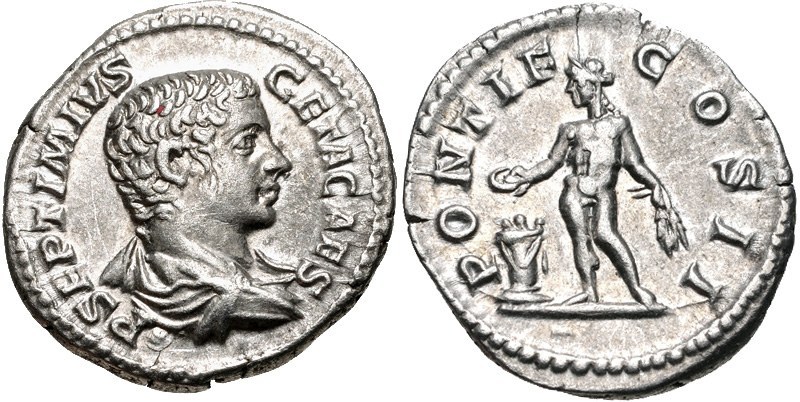
Start with the obverse legend, because it is the single most decisive clue. Ancient dies place a Latin inscription around the portrait; on a Geta coin it will contain the name GETA, often with P SEPT or P SEPTIMIVS and a rank abbreviation (CAES for Caesar, AVG or PIVS AVG once he was Augustus). If the legend instead reads ANTONINVS, you are holding a Caracalla; if SEVERVS, it is the father. Reading the letters, even partially, prevents the most common misattribution within this dynasty.
Study the portrait next. This piece shows a youthful, right-facing bust, consistent with Geta's earlier issues where he appears as a beardless boy or young man; his latest Augustus-era coins show an older, bearded head. The style is high-relief Severan work, and on this specimen the bust is draped and/or cuirassed. Note that Geta and the young Caracalla can look alike in the portrait alone, which is exactly why the legend takes priority.
Check the physical fabric to confirm it is a denarius rather than a larger or later coin. Expect silver, roughly 18-20 mm in diameter and about 2.5-3.5 g, on a thin, hand-struck flan with slightly irregular edges and, often, minor striking flatness. A silver-colored piece that is much larger and heavier is likely an antoninianus or a sestertius/provincial bronze, not this denarius.
Read the reverse type and its legend to pin down the exact issue. The standing figure here is a deity or personification identified by attributes (wand, scepter, cornucopia, patera, spear) and named in the short reverse legend. Matching that legend and figure to a reference (RIC for Severan silver) narrows the coin to a specific type and helps date it, consistent with the AD 208 attribution.
Finally, weigh authenticity. Geta denarii are widely faked, from cast copies to modern struck forgeries and tooled genuine coins. Cast fakes often show a soft, grainy surface, a seam on the edge, and bubbles; suspicious pieces that are too perfectly centered, too heavy, or magnetic should be rejected. Favor coins with honest wear, undisturbed silver surfaces, and, where possible, a provenance or a dealer who guarantees authenticity.
Frequently asked questions
What legend confirms a coin is Geta's?
Any obverse legend containing GETA (commonly with P SEPT or P SEPTIMIVS and a rank such as CAES or AVG) confirms the attribution. The name is the decisive element.
What size and weight should a genuine Geta denarius be?
Roughly 18-20 mm in diameter and about 2.5-3.5 g in silver, struck on a thin hand-made flan. Substantially larger or heavier silver-colored coins are a different denomination.
How do I avoid buying a fake?
Watch for casting bubbles, edge seams, unnatural sharpness, or a magnetic response. Buy from dealers who guarantee authenticity and prefer coins with documented provenance and undisturbed surfaces.
Does the reverse figure help date the coin?
Yes. Matching the standing figure and its reverse legend to a reference like RIC identifies the specific type and its approximate date, supporting an attribution such as AD 208.