
How to Identify the Denarius of C. Cato
A collector's guide to recognizing the 123 BC C. Cato denarius by its Roma head, Victory-in-chariot reverse, moneyer signature, and silver fabric.
Read the full Denarius of C. Cato encyclopedia entry →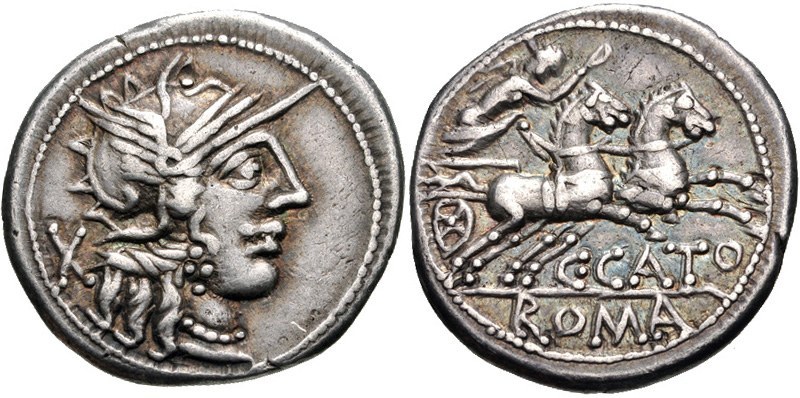
Begin with the reverse, which is the decisive feature. Look for Victory driving a biga, a two-horse chariot, galloping to the right; she holds the reins in one hand and a whip in the other. Below the horses, in the exergue or lower field, find the moneyer's signature C·CATO. That name is what separates this issue from the many other Republican denarii that also show Victory in a chariot. If you cannot read a signature, compare the letter forms carefully before attributing the coin.
Turn to the obverse to confirm the period. It should show a helmeted head of Roma facing right, with the helmet plumed or winged in the second-century BC style, the legend ROMA, and a mark of value near the chin or behind the head. Roma's helmeted profile is standard for denarii of this date and, combined with the C·CATO reverse, pins the coin to the 123 BC issue catalogued as Crawford 274/1.
Check the physical characteristics. This is a small hand-struck silver coin, generally about 17 to 20 mm in diameter and weighing roughly 3.7 to 4 grams. Expect an irregular flan, some off-center striking, and natural toning; ancient dies were cut by hand, so no two examples are identical and minor style variation is normal rather than a warning sign. A coin that is perfectly round, unnaturally uniform, or the wrong weight deserves scrutiny.
Watch for look-alikes and modern reproductions. Victory-in-biga denarii were struck by numerous moneyers, so always read the name rather than relying on the chariot scene alone. Be cautious of cast copies, tourist replicas, and coins with tooled or smoothed surfaces; casting bubbles, seams on the edge, a soapy texture, or a suspiciously light or heavy weight are red flags. For any meaningful purchase, buy from a reputable dealer and, if in doubt, seek an opinion from a specialist in ancient coins.
Frequently asked questions
What is the single best clue for this type?
The moneyer's name C·CATO beneath Victory in her two-horse chariot on the reverse. Many denarii share the Victory-in-biga design, so the signature is what confirms the C. Cato issue.
How do I know it is silver and the right size?
A genuine C. Cato denarius is struck in silver, measures about 17 to 20 mm across, and weighs roughly 3.7 to 4 grams. A coin far outside that range, or one that is not silver, is likely a different denomination or a reproduction.
Should I clean an ancient coin like this?
No. Cleaning or polishing an ancient silver coin can strip its natural toning and surfaces and sharply reduce its value. Leave conservation to a professional and preserve the original patina.
How can I spot a fake?
Compare weight, diameter, and style against known examples of Crawford 274/1. Casting seams on the edge, small surface bubbles, a soft or soapy texture, or an off weight suggest a cast copy. When unsure, consult a specialist in ancient coins before buying.