
How to Identify the Denarius of C. Antius Restio
A collector's guide to recognizing the 47 BC silver denarius of moneyer C. Antius Restio by its portrait, reverse, legends, and ancient strike.
Read the full Denarius of C. Antius Restio encyclopedia entry →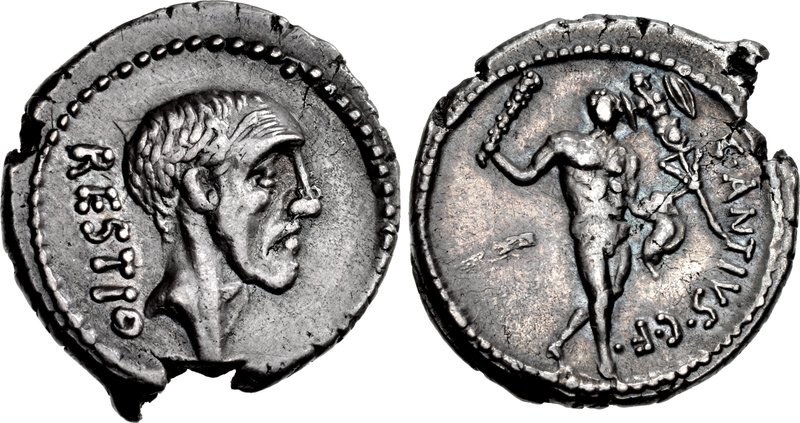
Begin with the format and metal. This is a hand-struck silver denarius of the late Roman Republic, small in diameter and typically in the weight range of a first-century BC denarius, broadly around 3.5 to 4 grams. The flan is often slightly irregular, and the surfaces should show the toning and honest wear of ancient silver rather than the flawless finish of a machine-struck modern coin.
Read the obverse legend. A genuine example of this type carries a bare right-facing male portrait accompanied by RESTIO, the cognomen of the ancestor being honored. This named portrait is the single most useful diagnostic; if the legend or the head does not match, you are likely looking at a different moneyer's issue from the same broad period.
Check the reverse for the striding figure with martial attributes, generally described as a club and a trophy of captured arms, together with the moneyer's name rendered as C ANTIVS C F. The pairing of the RESTIO portrait with this reverse, and the abbreviation C F (Gai filius, son of Gaius), confirms the attribution to C. Antius C.f. Restio and points to the Crawford 455 catalog reference.
Be cautious of look-alikes and fakes. Many late-Republican denarii share a similar module and portrait-plus-reverse layout, so match the specific legends rather than the general appearance. Watch for cast reproductions with a seam or grainy surface, tooled or re-engraved details, and ancient or modern plated forgeries with a copper core showing through breaks in the silver. When in doubt, weigh the coin, examine it under magnification, and rely on reputable dealers or third-party authentication before assigning value.
Frequently asked questions
What single feature best confirms this coin?
The obverse portrait paired with the legend RESTIO, combined with the reverse name C ANTIVS C F, is the clearest confirmation. Together they identify the moneyer C. Antius C.f. Restio and the Crawford 455 type.
How can I tell a genuine ancient strike from a cast copy?
Genuine coins were struck between hand-engraved dies and show slightly irregular flans, crisp high points, and no mold seam. Cast fakes often have a soft, grainy surface, rounded details, and a faint seam around the edge.
What should the coin weigh and measure?
It is a small silver denarius, typically in the broad range of about 3.5 to 4 grams and roughly the diameter of a small modern coin. A piece far outside that weight is likely a different denomination, a fake, or badly corroded.
Could this be a plated forgery?
Ancient and modern plated copies exist. Check breaks, edges, and worn high points for a copper-colored core beneath the silver, and confirm the weight, since a plated coin is often lighter than a solid-silver denarius.