
How to Identify the Demetrios Poliorketes Nike Tetradrachm
A Macedonian silver tetradrachm of King Demetrios I Poliorketes, celebrating his naval victory at Salamis with a striking image of Nike standing on a ship's prow.
Read the full Demetrios Poliorketes Nike Tetradrachm encyclopedia entry →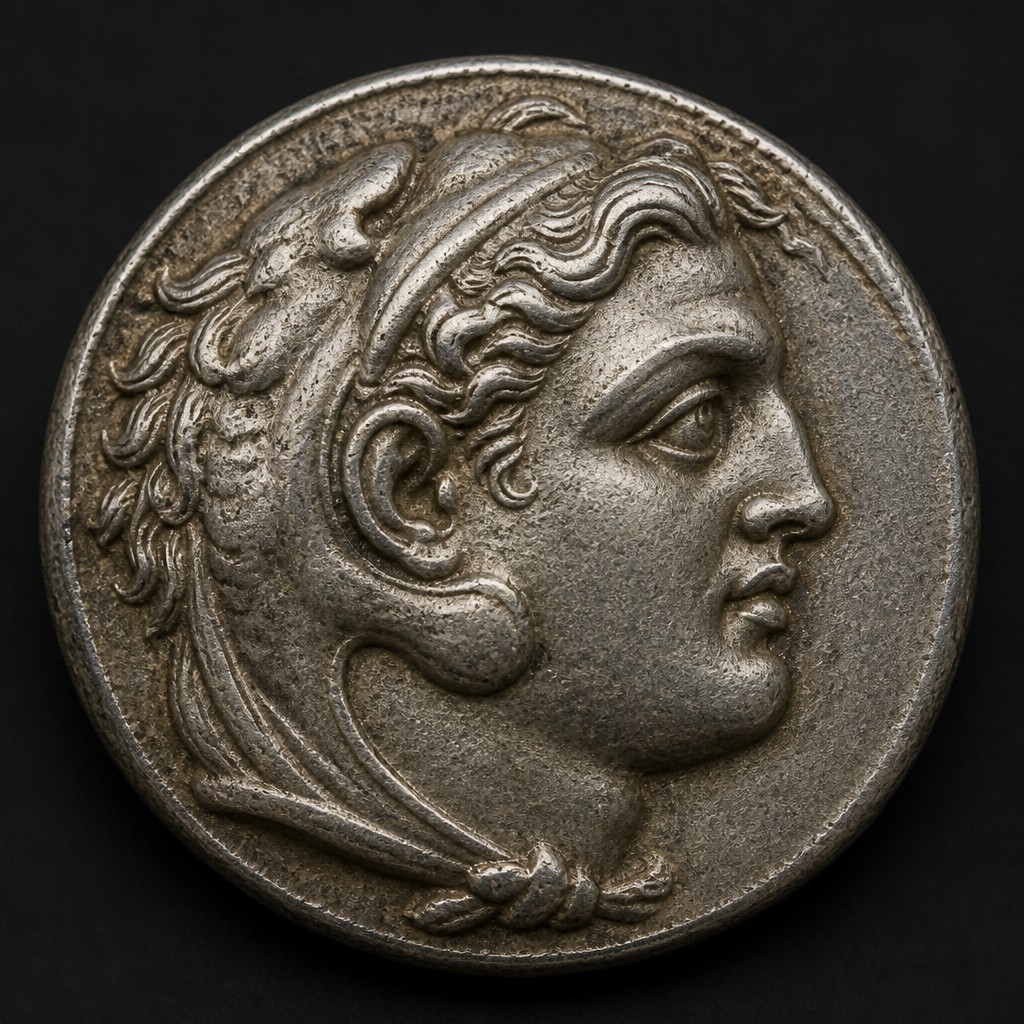
What the Coin Is
Demetrios I Poliorketes ("the Besieger") was a Macedonian king and one of the most colorful successors of Alexander the Great, known for his ambitious military campaigns by land and sea. His silver tetradrachms, struck in the years following his great naval victory over Ptolemy's fleet at Salamis on Cyprus in 306 BC, commemorate that triumph with one of the most admired designs in Hellenistic coinage.
Obverse Design
The obverse shows Nike, goddess of victory, standing on the prow of a warship, her wings spread wide and one foot often set slightly forward as if bracing against the motion of the sea. On many examples she raises a trumpet to her lips as if signaling the victory, though some die varieties omit the trumpet and show her simply holding a stylis (a small mast-like standard) instead. The ship's prow beneath her feet is rendered with visible timbers and a ram, grounding the mythological figure in a specific naval context.
Reverse Design
The reverse depicts Poseidon, god of the sea, striding or standing with his body turned as if about to hurl a trident overhead, a chlamys draped over one shoulder and one foot resting on a rock or outcrop. The royal legend BASILEOS DEMETRIOU (of King Demetrios) runs around the figure, along with one or more control monograms specific to individual mints and officials.
Size, Weight, and Metal
This is a silver tetradrachm struck on the Attic weight standard, generally weighing close to 17.2 grams, consistent with most Hellenistic royal tetradrachms of the period. The flan is typically broad and reasonably thin, allowing good detail in both the Nike and Poseidon compositions.
Mint Marks and Where to Find Them
Because Demetrios controlled territory and mints across the Aegean at different points in his reign, look for small monograms or symbols in the reverse field near Poseidon's legs or in the exergue, which identify the specific mint city responsible for a given issue. These marks, along with subtle stylistic differences in the rendering of Poseidon, allow specialists to attribute coins to particular mints within his kingdom.
Telling It Apart from Similar Coins
The Nike-on-a-ship's-prow obverse is unique to this issue of Demetrios and is not used by any other Hellenistic ruler, making it one of the most immediately recognizable royal tetradrachms of the period. The Poseidon reverse is broadly similar in style to other Hellenistic depictions of striding gods, so the obverse combined with the royal legend is the most reliable way to confirm the attribution.
Judging Condition at a Glance
On the obverse, check the definition of Nike's wings and the timbers of the ship's prow, which are engraved with fine detail that wears away relatively quickly. On the reverse, Poseidon's raised arm and the folds of his chlamys are the first areas to flatten with circulation, so sharp detail in both these areas indicates a well-preserved example.
Authenticity Red Flags
Given the fame and desirability of this type, modern reproductions exist, sometimes with a Nike figure that looks stiff or poorly proportioned compared to genuine dies, or a ship's prow rendered as a vague, undetailed blob rather than distinct timbers and a ram. As with other ancient silver, an unusually light weight, a suspiciously uniform toning, or a visible casting seam around the edge are all signs that a coin should be examined more closely before being accepted as genuine.
Frequently asked questions
What historical event does this coin commemorate?
It commemorates Demetrios I Poliorketes's naval victory over Ptolemy's fleet at the Battle of Salamis on Cyprus in 306 BC, one of the major military triumphs of his reign.
Why does Nike stand on a ship's prow?
The ship's prow directly references the naval nature of the victory being celebrated, distinguishing this Nike composition from other Hellenistic depictions of the goddess.
What weight standard was used for this tetradrachm?
It was struck on the Attic weight standard, with genuine examples weighing approximately 17.2 grams.
How can I identify which mint struck a specific example?
Look for small control monograms or symbols in the reverse field near Poseidon or in the exergue, which identify the specific mint city within Demetrios's kingdom.