
How to Identify the Danish Speciedaler
A large silver crown coin used in Denmark before the krone, identifiable by its royal portrait obverse and crowned Danish arms reverse.
Read the full Danish Speciedaler encyclopedia entry →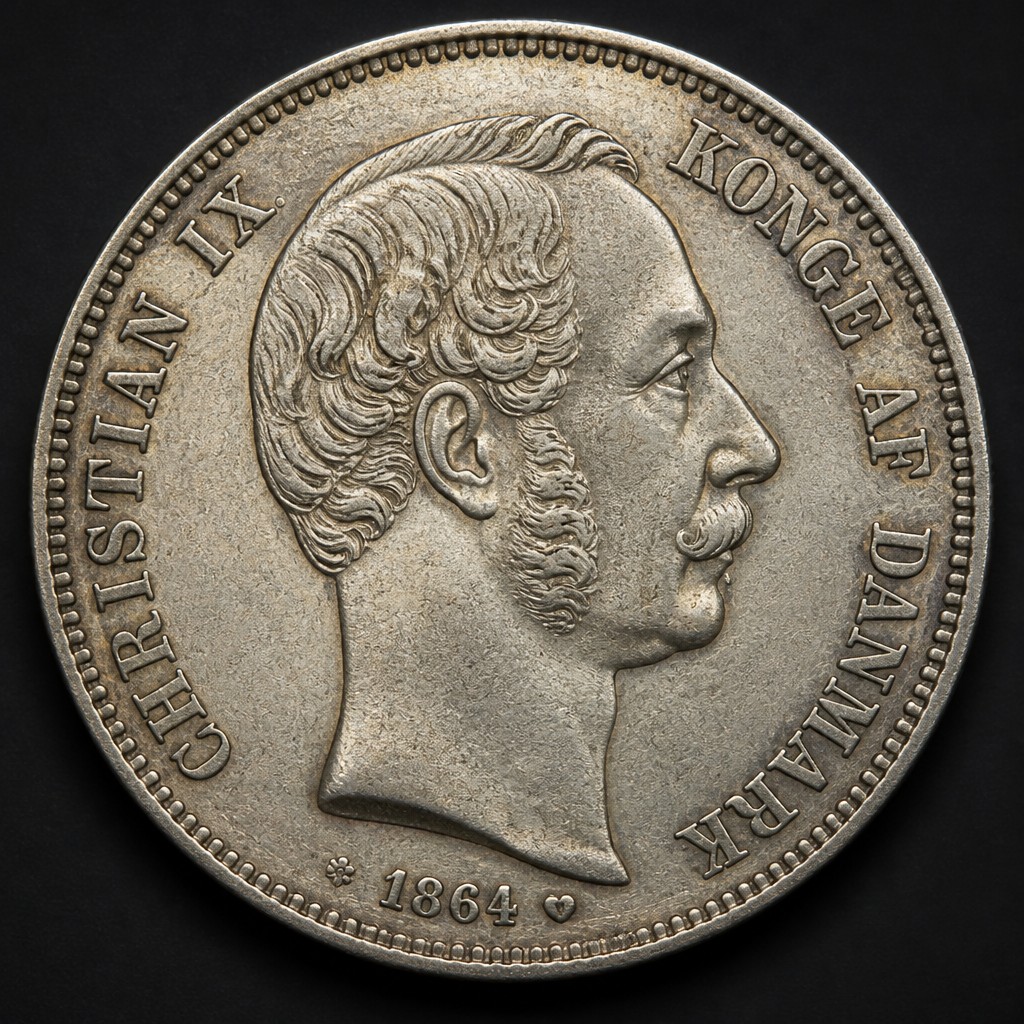
What Is the Danish Speciedaler?
The Speciedaler was Denmark's principal large silver coin during the 18th and 19th centuries, used until the country adopted the krone in the 1870s as part of the Scandinavian Monetary Union. It circulated as the standard "crown"-sized denomination for major transactions and is a favorite among collectors of pre-krone Danish and Scandinavian coinage.
Obverse Design
The obverse typically bears a portrait of the reigning Danish monarch — rulers such as Frederik VI, Christian VIII, or Frederik VII appear on different issues — shown in profile with a Latin-style royal title circling the rim, for example forms referencing "DEI GRATIA REX DANIAE" (by the grace of God, King of Denmark). Some earlier issues instead show a crowned royal monogram rather than a portrait.
Reverse Design
The reverse generally displays the crowned Danish coat of arms, featuring the three crowned lions and heart shapes associated with the Danish royal house, surrounded by an ornamental wreath or mantling. The denomination "SPECIEDALER" or "1 SPECIE" is inscribed along with the date, and a mint official's initials often appear in small letters near the base of the design.
Size, Weight & Metal
As a crown-sized coin, the Speciedaler is struck in silver of roughly .875 fineness, weighs close to 28 to 29 grams, and measures around 38 to 40 millimeters across — a substantial, heavy coin that feels notably larger than later krone coinage.
Mint Marks
Danish coinage of this period was produced primarily at the Royal Mint in Copenhagen. Look for the mint master's initials in tiny letters, usually positioned near the rim or beneath the coat of arms, which can help date and attribute a specific issue.
Telling It Apart from Similar Coins
Because Denmark, Norway, and Sweden all used related speciedaler and riksdaler systems in the same general era, confusion is common. Norwegian speciedaler coins from the union period share a similar large silver format but display the Norwegian lion-with-axe emblem rather than the Danish triple-lion arms. Swedish riksdaler coins are also similar in size but carry the Swedish three-crowns motif. Always check the coat of arms and the language of the legend (Danish/Latin versus Swedish or Norwegian forms) to confirm the correct country.
Judging Condition at a Glance
On higher-grade examples, the fine curls of the royal portrait and the individual crown points on the coat of arms remain distinct and separated. On well-circulated coins, the king's cheek and the highest points of the crowns flatten first, and the rim lettering can become shallow or partly worn away.
Authenticity Red Flags
Given the age and collectible value of these large silver coins, watch for artificially aged or "toned" surfaces meant to mask polishing, mismatched fonts in the legend compared to known genuine examples, and edges that lack the expected reeded or lettered pattern for the period. A coin that feels unusually light for its diameter is also worth weighing carefully against reference figures.
Frequently asked questions
What is a Speciedaler?
It was Denmark's main large silver coin denomination used before the krone was introduced in the 1870s.
Whose portrait appears on Danish Speciedaler coins?
Depending on the issue, portraits of Danish kings such as Frederik VI, Christian VIII, or Frederik VII appear, though some issues use a crowned monogram instead.
How do I tell a Danish Speciedaler from a Norwegian or Swedish one?
Check the coat of arms: Denmark shows crowned lions and hearts, Norway shows a lion with an axe, and Sweden shows three crowns.
How heavy is a typical Speciedaler?
It generally weighs around 28 to 29 grams and measures roughly 38 to 40 millimeters in diameter.
What should I check for authenticity?
Look for consistent lettering style, correct edge treatment, and a weight that matches expected figures — unusually light or oddly toned coins deserve extra scrutiny.