
How to Identify the Coronet Large Cent
A visual guide to the Coronet, or Matron Head, Large Cent (1816-1839), covering its coronet-and-bun portrait, wreath reverse, size and weight, and how to distinguish it from earlier and later large cent designs.
Read the full Coronet Large Cent encyclopedia entry →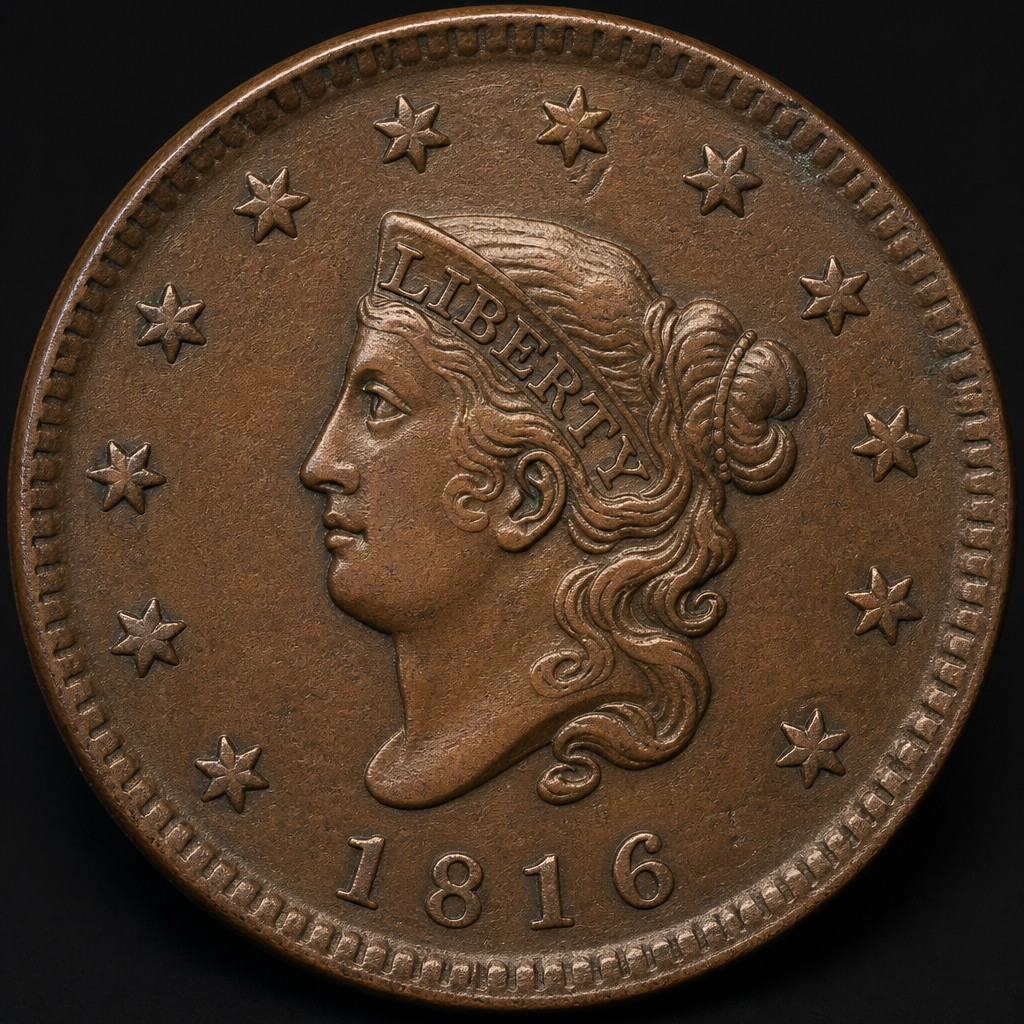
What It Is
The Coronet Large Cent, also called the Matron Head cent, was struck from 1816 to 1839. It followed the Classic Head design and represents a matronly, more conservative portrait of Liberty than earlier styles, reflecting a shift toward a heavier, plainer engraving style at the Mint.
Obverse Design
Liberty faces left wearing a coronet, or tiara-like band, inscribed with the word LIBERTY. Her hair is gathered into a bun at the back. Thirteen stars surround the portrait, and the date appears below. Later dates in the series (starting around 1835-1839) show a slightly modified, sometimes called "Young Head," style with tighter curls and a more youthful appearance, which collectors treat as a bridge toward the following Braided Hair type.
Reverse Design
The reverse carries a wreath, typically shown as laurel or olive branches, enclosing the words ONE CENT. "UNITED STATES OF AMERICA" runs around the border, and the fraction 1/100 sits beneath ONE CENT on most dates.
Size, Weight, Metal, and Edge
Like all large cents of this era, the Coronet cent is struck in pure copper, weighs about 10.89 grams (168 grains), and measures roughly 28-29mm in diameter, noticeably larger than a modern cent. The edge is plain.
Mint Marks
No mint mark appears anywhere on the coin. Every large cent from this period was struck exclusively at the Philadelphia Mint.
Telling It Apart From Similar Coins
Compared to the preceding Classic Head cent (1808-1814), the Coronet's portrait sits more centrally with the coronet clearly labeled LIBERTY and the stars evenly spaced. Compared to the following Braided Hair cent (1839-1857), the Coronet's hair falls in a simpler bun rather than the tightly braided coil seen on later issues, and the facial style is a bit more angular. Overlap years like 1839 can show both hair styles and are best distinguished by comparing the treatment of the hair at the back of the head.
Judging Condition
On a well-preserved example, look for sharp definition in the hair curls, a clear LIBERTY on the coronet band, and full, rounded stars. Wear typically shows first on the highest points: the hair above the ear and the tips of the stars. Heavily circulated examples often have a smooth, flattened portrait with the coronet inscription partly worn away.
Authenticity Notes
Because large cents are struck in soft copper, they are prone to environmental damage, corrosion, and old cleaning that can be mistaken for wear or damage. Watch for cast copies, which often show a grainy or pitted surface texture, seams around the edge, and slightly soft, mushy details compared to the crisp relief of a genuine struck coin.
Frequently asked questions
What years were Coronet Large Cents made?
They were struck from 1816 to 1839, with a transitional "Young Head" style appearing in the final few years.
Is there a mint mark on a Coronet Large Cent?
No, all examples were struck at the Philadelphia Mint and show no mint mark.
How do I tell a Coronet cent from a Braided Hair cent?
The Coronet cent has a simple bun hairstyle, while the Braided Hair cent shows a tightly woven braid around the head.
What metal is the Coronet Large Cent made from?
It is struck in pure copper, weighing about 10.89 grams and measuring roughly 28-29mm across.