
How to Identify the Corinthian Stater
A collector's guide to recognizing Corinth's silver Pegasi by the flying Pegasos, the helmeted Athena, size, control marks, and common look-alikes.
Read the full Corinthian Stater encyclopedia entry →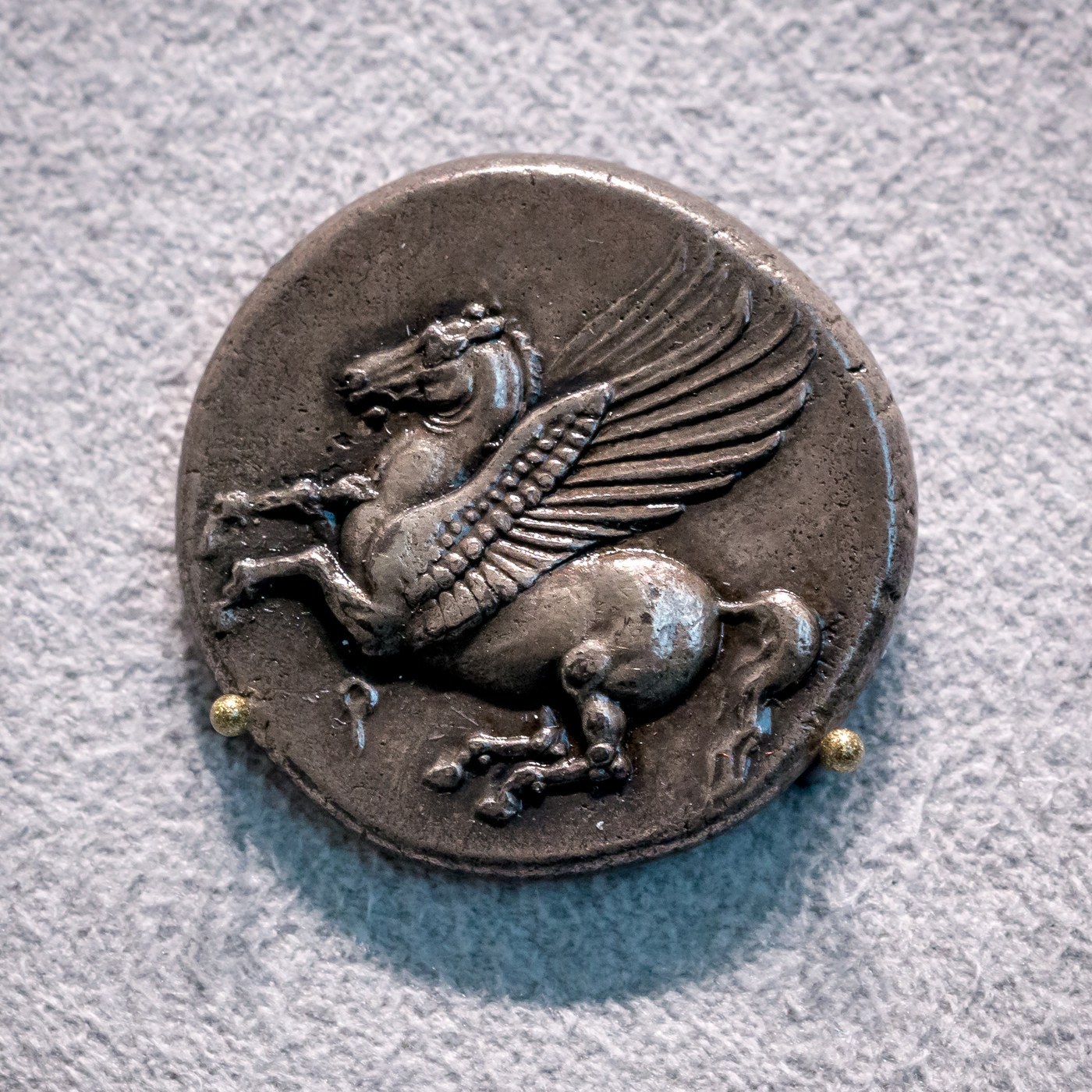
Start with the two defining images. A genuine Corinthian stater pairs a winged horse, Pegasos, on one side with the head of Athena in a Corinthian helmet on the other. On the fourth-century type shown here, Pegasos flies to the left. The single most useful diagnostic for Corinth itself is the koppa, an archaic letter shaped like a Q, placed beneath the horse; this is the initial of Corinth (Korinthos) and marks the mother city rather than one of its colonies.
Check size and metal next. The coin should be silver, roughly 20-22 mm in diameter and about 8 to 8.6 grams. Ancient staters were struck by hand, so expect an irregular, slightly oval flan, off-center designs, and a surface that is not perfectly round or uniform. A perfectly circular, machine-even coin with a smooth raised rim is a warning sign of a modern reproduction.
Read the Athena side for control marks. On these later issues Athena wears the helmet pushed back on her head and is often accompanied by a small symbol or one or two letters in the field, which distinguish individual issues and magistrates. These field symbols, together with the koppa, are what separate a true Corinth stater from the many similar 'Pegasi' struck by colonies such as Ambracia, Leucas, Anactorium, and Syracuse, which used their own initials or badges in place of the koppa.
Be cautious about authentication. Corinthian staters are widely faked, including cast copies and modern die-struck forgeries. Cast fakes often show a soft, grainy surface, a seam around the edge, and mushy detail on the high points. Because style, weight, and control symbols must all agree with published die studies, unfamiliar buyers should favor coins with old provenance or a reputable dealer's guarantee, and treat any coin that looks too crisp, too round, or unusually light or heavy with suspicion.
Frequently asked questions
How do I know a Pegasos coin is from Corinth and not a colony?
Look under the horse. Corinth's own staters carry the koppa, an archaic Q-shaped letter, as the city's mark. Colonies used their own initials or symbols instead, so a different letter or badge points to another mint.
What size and weight should a genuine stater be?
Expect roughly 20 to 22 mm and about 8 to 8.6 grams of silver. Coins far outside that weight, or that are perfectly round with an even machined rim, should be treated with caution.
How can I spot a cast fake?
Cast copies often have a soft, sandy or pitted surface, a faint seam running around the edge, and blurred detail where a genuine struck coin would be sharp. Struck ancient coins show crisp die detail and irregular, hand-made flans.
Why are the two sides sometimes not lined up?
Ancient dies were aligned by hand, so the obverse and reverse can sit at any angle to each other and the design is often off-center. This is normal and is actually reassuring evidence of an ancient hand-struck coin.