
How to Identify the Corinthian Pegasus Stater
A guide to ancient Corinth's silver stater, nicknamed the 'Pegasus' for its winged-horse design, covering the Athena reverse, the koppa symbol, and specifications.
Read the full Corinthian Pegasus Stater encyclopedia entry →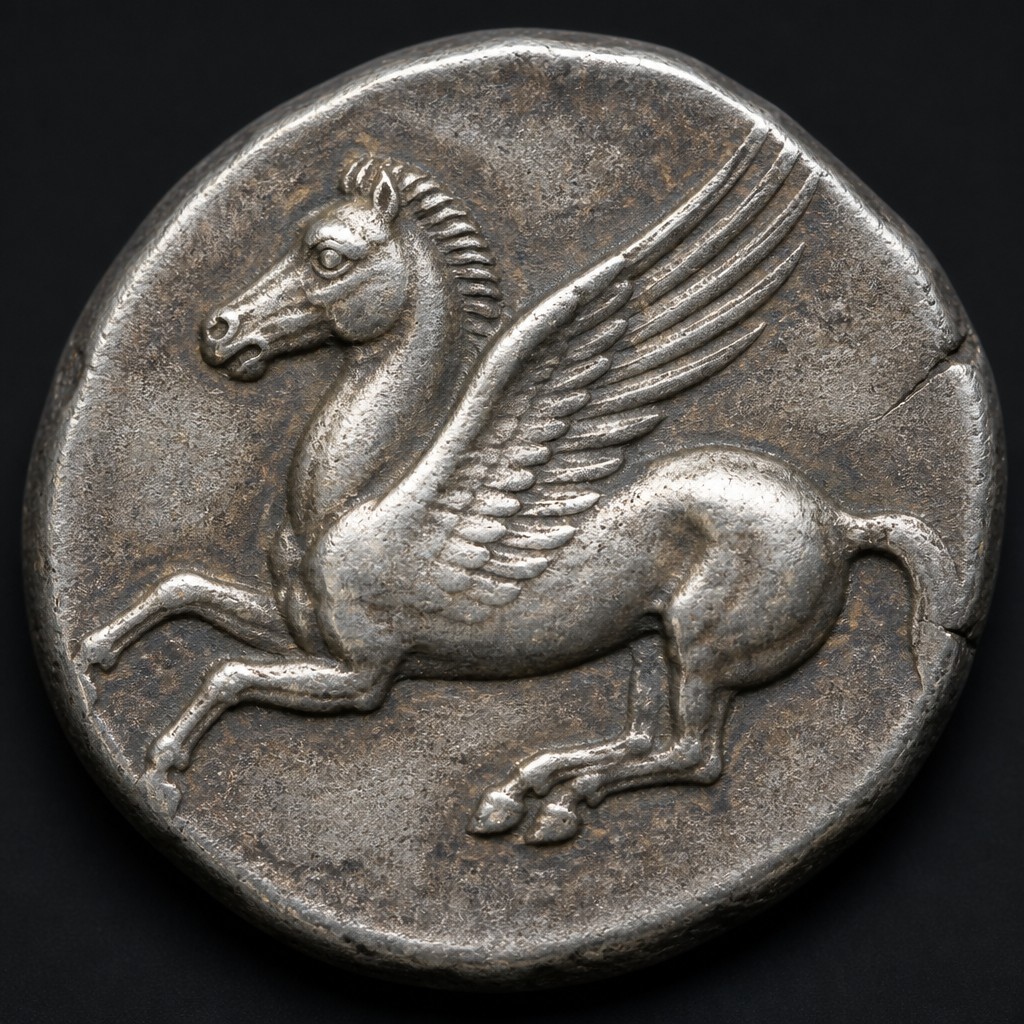
What Is the Coin
The Corinthian stater, often nicknamed a "Pegasus" after its obverse design, was struck by the city of Corinth and its colonies from the 6th through 4th centuries BC. It was one of the most widely circulated Greek coin types of its time, used extensively in trade throughout the Greek world.
Obverse Design
The obverse shows Pegasus, the mythical winged horse associated with Corinth, typically depicted flying or walking with wings raised. Beneath Pegasus, many issues include the letter koppa (Ϙ), an archaic Greek letter used as a shorthand identifier for Corinth.
Reverse Design
The reverse shows the helmeted head of the goddess Athena, usually facing left, wearing a Corinthian-style helmet often decorated with a coiled ornament. Early issues place this design within an incuse square, a holdover from the earliest Greek coinage technique, while later issues show Athena within a more refined, fully engraved reverse die.
Size, Weight, Metal & Edge
The coin is struck in silver and weighs approximately 8.6 g, following the "Corinthian" weight standard, with a diameter of roughly 18-20 mm. As a hand-struck ancient coin, it has no defined edge design.
Identifying Marks and Symbols
The koppa beneath Pegasus is the clearest quick identifier of Corinthian origin, though colonial mints (such as those in Corinthian colonies in Sicily and northwestern Greece) sometimes used variant symbols or letters in the same position, which collectors use to attribute a coin to a specific mint city rather than Corinth itself.
Telling It Apart From Similar Coins
Corinthian-standard staters were imitated and adapted by many Corinthian colonies, so a Pegasus-and-Athena design alone does not guarantee the coin was struck in Corinth proper; the specific field symbols and letter forms need to be checked. The type is also distinct from other winged-horse coinage of the ancient world by the specific pairing with a helmeted Athena head on the reverse.
Grading and Condition at a Glance
Because these coins circulated heavily as trade currency, moderate wear on Pegasus's wing and Athena's helmet crest is common even on collectible examples. Sharp definition in the helmet's decorative elements and a well-centered strike showing the full koppa symbol are marks of a better-preserved piece.
Authenticity Red Flags
Weight noticeably below 8.6 g, a poorly formed or missing koppa where one is expected for the claimed mint, or blurred, indistinct helmet and feather details are signs of a modern cast forgery rather than a genuine ancient strike. Cast copies often show a seam line around the edge or a slightly grainy surface texture that differs from the sharp, hand-engraved look of a genuinely struck coin. As with other ancient Greek types, comparing die style and weight to published references is the standard way to confirm attribution.
Frequently asked questions
Why is it called a 'Pegasus'?
The nickname comes from the winged horse Pegasus depicted on the obverse, a symbol closely associated with Corinth.
What does the koppa symbol mean?
It is an archaic Greek letter used beneath Pegasus as a shorthand identifier for Corinth as the issuing city.
What is on the reverse?
The helmeted head of the goddess Athena, sometimes set within an incuse square on earlier issues.
Were all Pegasus staters struck in Corinth?
No, many Corinthian colonies struck similar Pegasus-type staters, distinguished by variant symbols or letters in place of the koppa.