
How to Identify the Continental Dollar
A 1776 dollar-sized piece struck in pewter, brass, or silver bearing the sundial and 'FUGIO' motif, associated with the Continental Congress though its exact original purpose is still debated by historians.
Read the full Continental Dollar encyclopedia entry →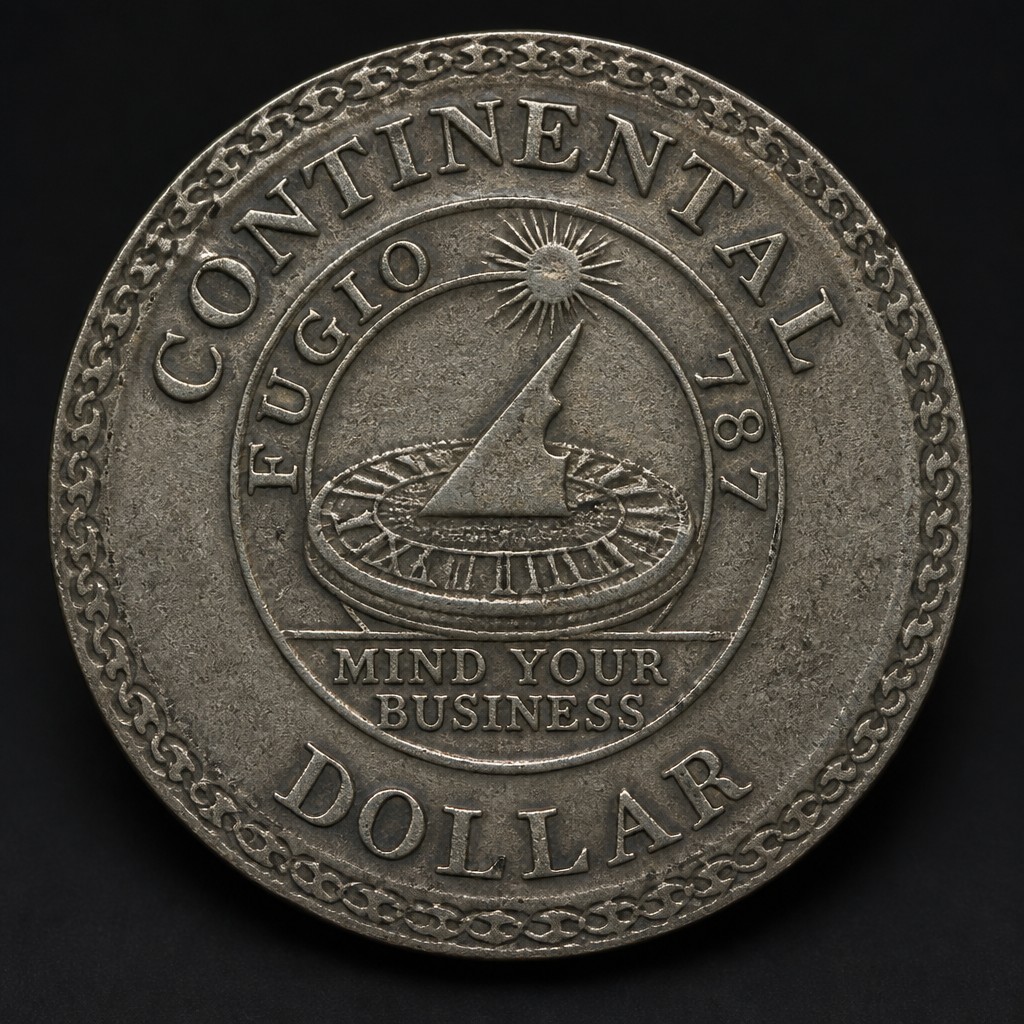
What It Is
The Continental Dollar is dated 1776 and is traditionally linked to the Continental Congress during the early days of American independence, though numismatic scholars continue to debate whether it was ever intended as a circulating dollar, a pattern piece, or even a later commemorative-style production. Most surviving examples are struck in pewter, with rarer versions known in brass and silver.
Obverse Design & Inscriptions
The obverse features a sundial with the sun above it, the word FUGIO ("I fly," a reference to time passing) beside the dial, and the phrase MIND YOUR BUSINESS below — a design attributed in concept to Benjamin Franklin, who used similar imagery on other contemporary pieces. The date 1776 also appears on the obverse.
Reverse Design & Inscriptions
The reverse shows thirteen interlinked rings, each inscribed with the name of one of the thirteen original states, surrounding the phrase WE ARE ONE and the outer legend AMERICAN CONGRESS. This design closely parallels the "Fugio cent" struck for the United States years later in 1787.
Size, Weight, and Metal
Continental Dollars are dollar-sized, roughly 38-40 mm in diameter, matching the size of Spanish milled dollars circulating at the time. Most known examples are pewter, a soft gray metal, though a small number were struck in brass or silver; the specific metal significantly affects rarity and value.
Mint Marks
There is no mint mark, as this piece was not struck at a government mint with formal minting infrastructure; production is generally attributed to private die-sinkers, with the exact minting location still not settled among historians. Identification instead relies on the distinctive sundial-and-links design.
Telling It Apart From Similar Coins
Several die varieties exist, including differences in the spelling of "CURENCY" versus "CURRENCY" and "FUGIO" placement, which collectors use to classify specific types. The design's close cousin, the 1787 Fugio cent, is much smaller (cent-sized) and was an officially authorized federal coin, so size alone helps separate the two despite their shared imagery.
Judging Condition at a Glance
Because pewter is a soft alloy, genuine Continental Dollars often show noticeable surface wear, scratches, or a slightly dull gray tone even on well-preserved examples. Look at the sundial rays and the linked rings for the crispest remaining detail, since these raised design elements wear down fastest with handling.
Authenticity Red Flags
Continental Dollars are heavily studied and, unfortunately, heavily reproduced, with many modern replicas sold as souvenirs or decorative items rather than as attempts to deceive, but some do enter the market misrepresented as genuine. Warning signs include a metal color inconsistent with true pewter (too shiny or silver-bright without being an accepted silver variety), overly crisp modern-looking lettering, and a weight that doesn't match documented genuine specimens. Given the complexity of this series and its historical uncertainty, expert evaluation is strongly recommended before treating any example as an authentic 18th-century strike.
Frequently asked questions
What metal is the Continental Dollar usually made of?
Most surviving examples are pewter, though rarer specimens are known in brass and silver.
Was the Continental Dollar actually used as money in 1776?
Historians are not fully certain; some believe it may have functioned as a pattern piece or even a later fantasy piece rather than a widely circulated dollar coin.
How is the Continental Dollar different from the Fugio cent?
The Continental Dollar is dollar-sized and dated 1776, while the Fugio cent is a smaller, officially authorized federal coin dated 1787, though both share the sundial and linked-rings imagery.
What does the reverse design symbolize?
The thirteen linked rings, each bearing a state name, represent the unity of the original states under the phrase WE ARE ONE.
Are there different varieties of the Continental Dollar?
Yes, collectors recognize several die varieties based on spelling differences like CURENCY versus CURRENCY and other small lettering variations.