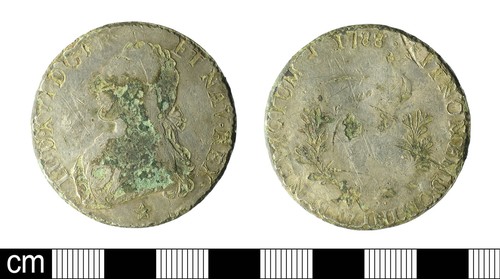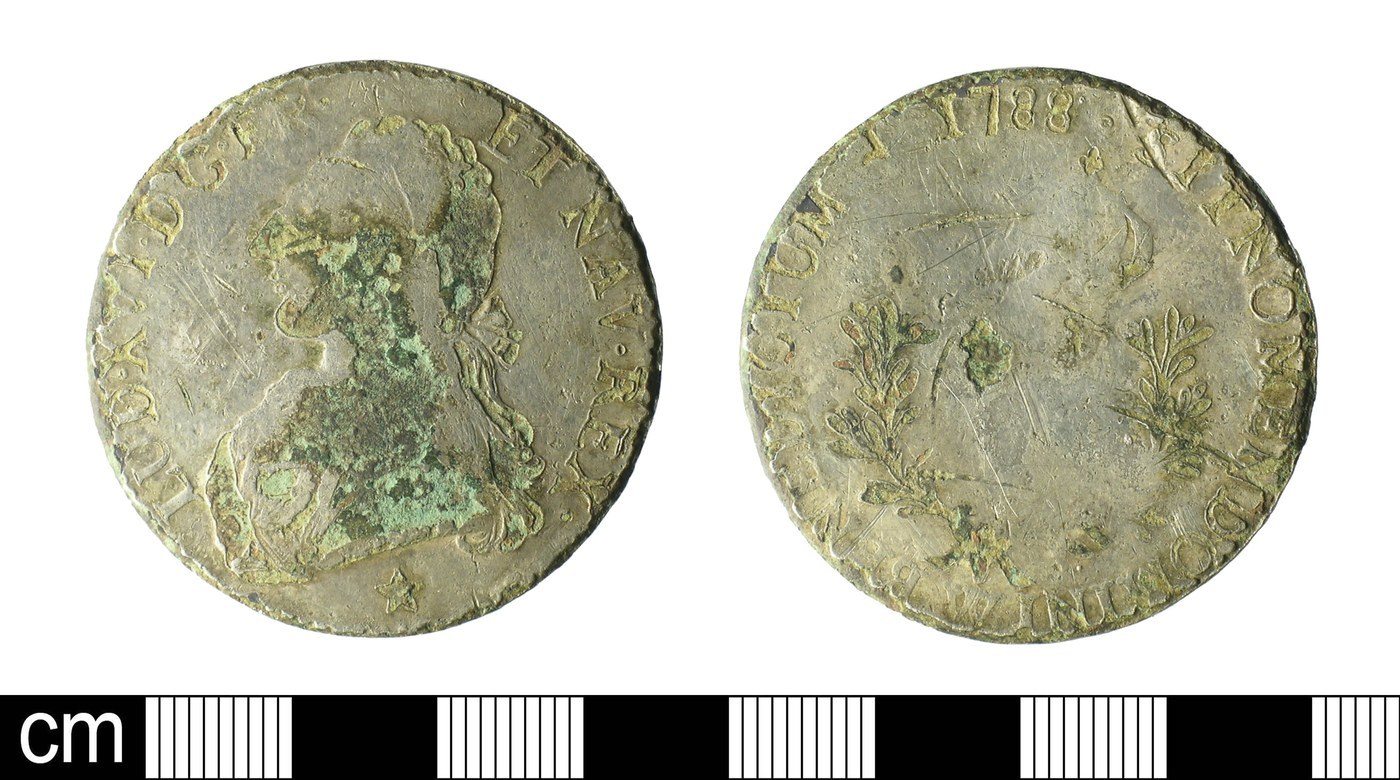
Contemporary Forgery of Louis XVI Ecu
A period-style counterfeit imitating a Louis XVI silver ecu: a copied royal portrait obverse and a copied standing-figure reverse dated about 1792.
- Country
- France
- Denomination
- 1 Ecu
- Metal
- Silver
Got a coin like this?
Identify any coin from a photo, free.
Overview
This is a contemporary forgery of a French silver ecu of the Louis XVI type—an imitation made to pass as a genuine large silver coin rather than an authentic royal issue. The obverse shows an attempted copy of the Louis XVI portrait with an accompanying inscription, and the reverse carries an attempted copy of a standing figure with a date of roughly 1792. The word "contemporary" here means the fake was made to circulate as money in or near its own era, not as a modern collector replica.
What defines this piece is that it copies a Louis XVI ecu but does not match a genuine one in workmanship. The design elements are recognizable—the royal bust, the surrounding legend, a standing allegorical figure—yet the execution, lettering and metal fall short of a struck French mint product. It is best understood as an imitation of the ecu type, valued and studied as a counterfeit rather than as the coin it pretends to be.
History & Background
The silver ecu was the large denomination of the French monetary system under the Bourbon kings, and coins bearing Louis XVI's portrait were struck from his accession in 1774 through the upheaval of the Revolution. By the early 1790s the monarchy was collapsing: the ecu of this era reflects the transitional, revolutionary period, when royal imagery sat uneasily alongside new republican symbolism such as standing figures representing Liberty or the nation.
Large silver coins have always attracted counterfeiters, because a convincing fake in base metal or debased silver could return a large profit. Contemporary forgeries of French ecus were produced by casting or by crude local striking, often using less silver than the genuine coin or a silver-washed base-metal core. Such pieces circulated among a public that judged coins by sight and weight rather than by assay.
A date around 1792 places this imitation at the very end of the royal coinage and the beginning of France's revolutionary currency. Whether made then or shortly after, it belongs to the long tradition of period counterfeits that shadowed every popular silver coin, and today it is collected and catalogued as a forgery of the Louis XVI ecu type.
How to Identify
Identify this piece by what it imitates and where it falls short. The obverse attempts to reproduce the Louis XVI portrait with a surrounding inscription, but on a forgery the bust is typically softer, flatter or oddly proportioned, and the legend is often uneven, misspelled or crudely lettered compared with a struck royal ecu. The reverse copies a standing figure with a date near 1792; here too the modelling of the figure and the surrounding text tend to look imprecise.
Because it is a counterfeit, expect the hallmarks of imitation rather than a mint strike. Cast forgeries can show a slightly grainy or porous surface, faint seams along the edge, and soft, mushy detail; crude struck fakes show weak or doubled lettering and shallow relief. The metal presents as silver or silver-colored, but the coin may ring dull, feel light or wrong in weight for its size, or show base metal where the surface is worn.
The safest reading is comparative: set the piece beside images of a genuine Louis XVI ecu and note the differences in portrait style, legend spacing, the standing figure, edge lettering and overall sharpness. Discrepancies in these areas—rather than a single feature—mark it as a contemporary forgery of the ecu rather than an authentic example.
Value & Collectibility
A contemporary forgery is not worth the value of a genuine Louis XVI ecu, and it should never be priced or sold as one. Its worth comes instead from interest as a historical counterfeit and from any silver content it happens to contain, both of which vary widely from piece to piece.
Demand exists among collectors who specifically study contemporary counterfeits, and a well-made or clearly period fake can carry modest collector interest. Crude or heavily worn examples are generally of little monetary value beyond curiosity. Condition, how convincingly the piece imitates the original, and any documented history all affect what a specialist collector might pay.
Because the whole point of such a coin was to deceive, treat any valuation cautiously and avoid buying it as a genuine ecu. If you are assessing one, have it examined by someone familiar with French coinage and contemporary counterfeits, and regard online figures as broad ranges tied to the specific piece rather than fixed prices.
Frequently asked questions
What is this coin?
It is a contemporary forgery of a French silver ecu of the Louis XVI type. It copies the royal portrait on the obverse and a standing figure dated about 1792 on the reverse, but it was made as a counterfeit rather than struck as a genuine coin.
Is it worth the same as a real Louis XVI ecu?
No. A forgery is worth far less than a genuine ecu and must not be sold as one. Its value comes from interest as a historical counterfeit and any silver it contains, which varies from piece to piece.
How can I tell it is a forgery and not the real coin?
Compare it to a genuine Louis XVI ecu. Forgeries usually show softer or oddly proportioned portraits, uneven or misspelled lettering, shallow or doubled detail, cast seams or porous surfaces, and often the wrong weight for the size.
Does it contain silver?
It may. Contemporary forgeries were often made in debased silver or a silver-washed base-metal core using less silver than the genuine coin. The exact content varies, so any silver value should be assessed on the specific piece.
Should I get it authenticated?
Yes, if you need to know what you have. A specialist in French coinage and contemporary counterfeits can confirm that it is a period forgery of the ecu type and give context, rather than relying on the design alone.
Contemporary Forgery of Louis XVI Ecu guides
In-depth guides for identifying, valuing, and collecting Contemporary Forgery of Louis XVI Ecu.