
How to Identify the Constantine CONSTANTINOPOLIS Commemorative
A bronze commemorative coin celebrating Constantine's new capital, identified by its helmeted bust labeled CONSTANTINOPOLIS and a Victory-on-prow reverse.
Read the full Constantine CONSTANTINOPOLIS Commemorative encyclopedia entry →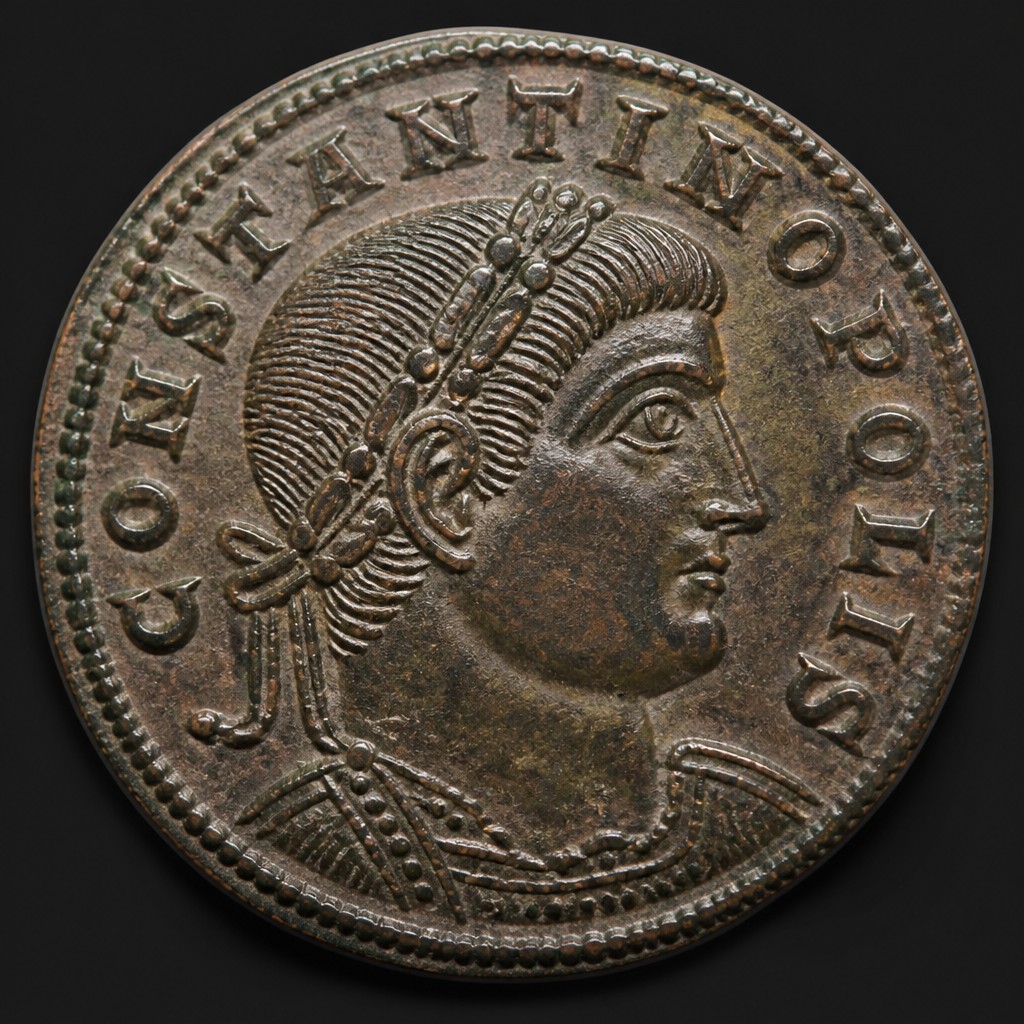
What This Coin Is
Struck as a companion piece to the Urbs Roma commemorative, this small bronze coin honors Constantinople, the city Constantine I founded and dedicated as a new imperial capital in 330 AD. Both series were issued across many mints for roughly two decades, making surviving examples widely available today.
Obverse Design & Inscriptions
The obverse presents a helmeted, draped bust personifying the city of Constantinople, facing left, often shown holding a scepter over the shoulder on some varieties. The legend reads CONSTANTINOPOLIS around the bust.
Reverse Design & Inscriptions
The reverse shows Victory standing left on the prow of a galley, holding a scepter or spear and resting a hand on a shield, sometimes with a captive bound at the base of the prow on certain varieties. As with the Roma companion piece, there is generally no legend surrounding the scene beyond a mint mark in the exergue.
Size, Weight, Metal, and Edge
This is a small bronze coin, typically 15-18mm in diameter and around 1.5-2.5 grams, matching the reduced follis standard of the period. The edge is plain, without reeding or lettering.
Mint Marks and Where to Find Them
Check the exergue for abbreviations such as SMANT (Antioch), CONS (Constantinople), TRS (Trier), or similar, often followed by a Greek or Latin officina letter marking the specific workshop that struck the coin.
Telling It Apart From Similar Coins
The obverse legend CONSTANTINOPOLIS distinguishes this from the URBS ROMA companion type, whose reverse shows a she-wolf and twins instead of Victory on a prow. Both busts are helmeted and roughly similar in style, so always confirm identification using the legend and reverse design together rather than the bust profile alone.
Judging Condition at a Glance
Look for a fully legible legend, a clear helmet outline, and a well-defined Victory figure with visible wings and drapery folds. Because the flans were small and sometimes struck off-center, complete, well-centered strikes with full legends are more desirable and easier to attribute confidently.
Authenticity Red Flags
Be wary of coins with blurred, indistinct lettering that looks smoothed rather than worn, unnaturally uniform coloring suggesting an artificial patina, or a visible casting seam along the edge. Genuine ancient bronzes typically show varied, organic toning and crisp underlying strike details even under moderate wear.
Frequently asked questions
What does the CONSTANTINOPOLIS legend commemorate?
It honors Constantinople, the new eastern capital city dedicated by Constantine I in 330 AD, personified here as a helmeted city goddess similar to Roma.
What does the Victory-on-prow reverse represent?
It symbolizes naval and military triumph associated with the new capital, showing Victory standing on the prow of a warship.
How is this different from the Urbs Roma type?
Check the obverse legend and reverse scene: CONSTANTINOPOLIS pairs with a Victory-on-prow reverse, while URBS ROMA pairs with a she-wolf and twins reverse.
Are these coins valuable?
They were mass-produced across many mints for years, so most examples are common and affordable, though condition and mint rarity can affect desirability.