
How to Identify the Connecticut Copper
Post-Revolutionary state coinage from Connecticut (1785-1788), featuring a bust obverse and seated figure reverse, with many die varieties due to multiple private mint contractors.
Read the full Connecticut Copper encyclopedia entry →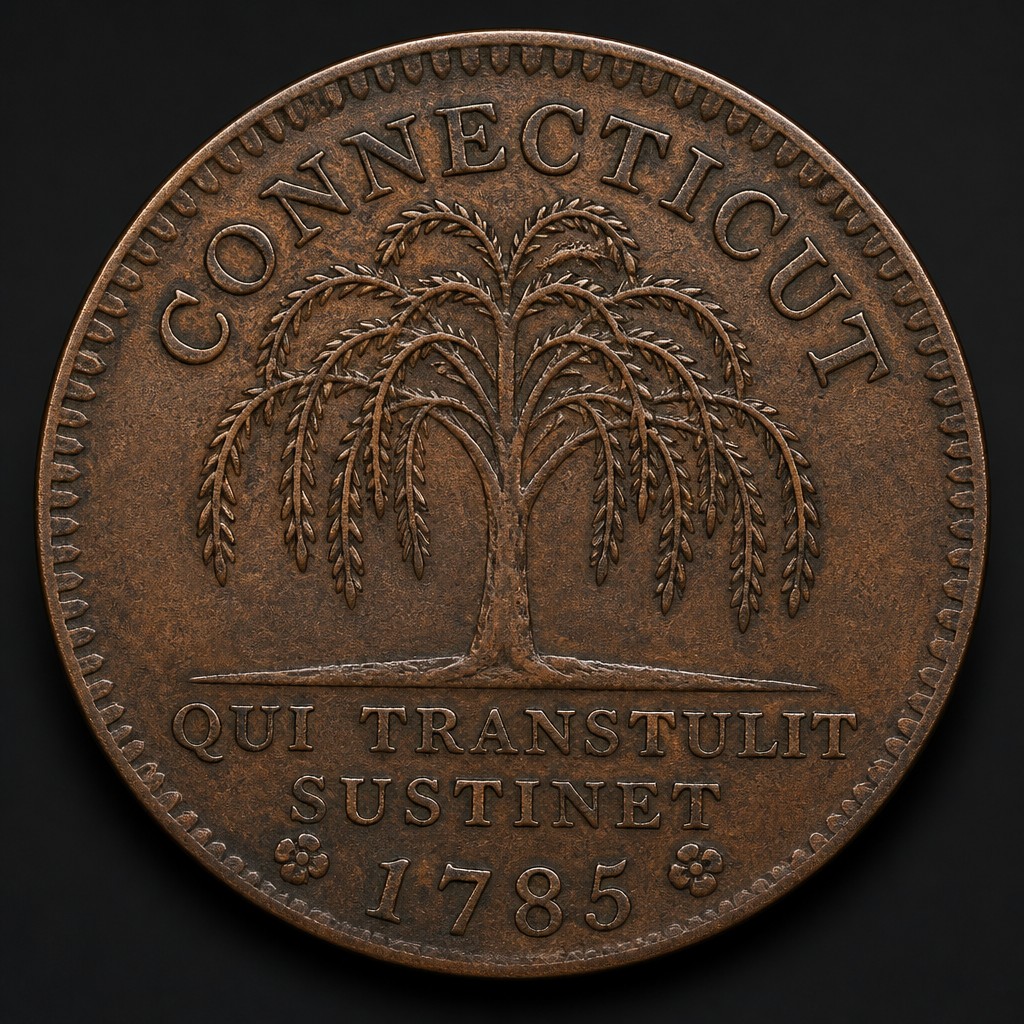
What It Is
Connecticut coppers were authorized by the state legislature between 1785 and 1788, during the period after the Revolutionary War when the young United States had no unified national coinage and individual states issued their own copper coins to address a shortage of small change. Several private contractors struck Connecticut coppers under license, leading to a large number of die varieties within the series.
Obverse Design & Inscriptions
Most Connecticut coppers show a right-facing or left-facing draped or mailed bust, generally intended to loosely resemble a classical or royal figure, surrounded by the Latin legend "AUCTORI CONNEC" (by the authority of Connecticut), often abbreviated or spaced differently across varieties.
Reverse Design & Inscriptions
The reverse typically depicts a seated figure (commonly identified as Liberty or a symbolic figure holding a branch and sword or similar attributes) with the Latin legend "INDE ET LIB" (an abbreviation referencing independence and liberty), along with the date.
Size, Weight, Metal & Edge
These are copper coins roughly comparable in size to a British halfpenny of the period, with weight varying somewhat due to the loosely regulated private minting process. Edges are plain, without machine reeding, consistent with contemporary hand-operated screw-press striking.
Mint Marks & Where to Find Them
There is no formal mint-mark system; instead, numismatists identify the specific striking source and die pairing through detailed die-variety cataloging based on small differences in lettering style, bust design, and date placement, since multiple contractors produced coppers under the same general state authorization.
Telling It Apart From Similar Coins
Connecticut coppers are often confused with other contemporary state coppers, particularly those of Massachusetts, New Jersey, and Vermont, all produced during the same post-war period to fill the same practical need. The clearest distinguishing feature is the specific legend text: "AUCTORI CONNEC" and "INDE ET LIB" are unique to the Connecticut series and do not appear on the other states' coppers, which use their own distinct mottoes and central designs.
Judging Condition at a Glance
Copper coins from this era often show corrosion, porosity, or environmental damage in addition to normal circulation wear, so judge condition by looking at both the sharpness of the bust and seated-figure details and the overall surface quality, since a coin can be lightly worn but still heavily corroded, or vice versa. Well-preserved examples show clear facial features and full leg and drapery details on the seated figure.
Authenticity Red Flags
Because of the large number of legitimate die varieties in this series, unusual examples are not automatically suspect, but genuinely fake or altered pieces do exist, particularly attempts to pass off common varieties as rarer ones by altering date digits or letter spacing. Warning signs include tool marks or file lines around the date area suggesting alteration, a weight or diameter well outside the normal range for genuine Connecticut coppers, and lettering styles that do not match any documented die variety for the series. Given the complexity of this series, comparison against detailed variety references is especially important.
Frequently asked questions
Why were Connecticut coppers issued by the state instead of the federal government?
Between 1785 and 1788, the United States had no unified national coinage yet, so individual states like Connecticut authorized their own copper coins to relieve a shortage of small change.
Why are there so many different varieties of this coin?
The state licensed multiple private contractors to strike the coppers, and each used somewhat different dies, resulting in a large number of documented die varieties within the series.
What do the Latin legends on the coin mean?
'Auctori Connec' translates roughly to 'by the authority of Connecticut,' while 'Inde Et Lib' abbreviates a phrase referencing independence and liberty, reflecting the coin's post-Revolutionary context.
How can I tell a Connecticut copper apart from a Vermont or New Jersey copper of the same era?
Check the specific legend text and central design; each state used its own distinct mottoes and figures, so 'Auctori Connec' paired with a bust-and-seated-figure design is specific to Connecticut.