
How to Identify the Congress Bicentennial Silver Dollar
A collector's checklist for confirming a genuine 1989 Congress Bicentennial silver dollar by its imagery, size, silver content, and finish.
Read the full Congress Bicentennial Silver Dollar encyclopedia entry →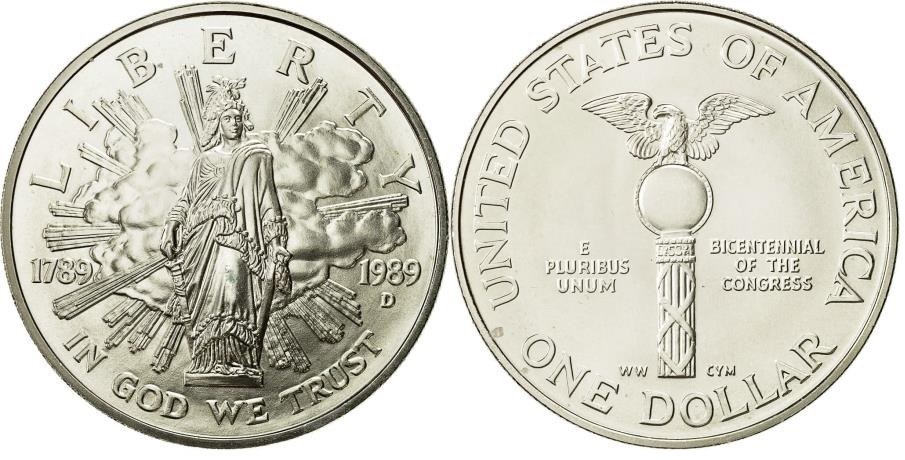
Start with the two designs, because they identify this coin quickly. The obverse must show a standing Liberty-style figure with a raised hand or object, a shield, and architectural detailing at the sides. The reverse must show an eagle above the domed U.S. Capitol building along with a Bicentennial inscription and the usual United States legends. If either side differs, you are looking at a different commemorative.
Check the date and denomination. A genuine coin is dated 1989 and reads ONE DOLLAR. Because this design was issued for only one year, any other date rules it out immediately. The 1989 program also included a smaller clad half dollar and a five-dollar gold coin, so confirm you are holding the dollar-size silver piece and not one of its companions.
Measure and weigh it. The silver dollar is about 38.1 mm across and roughly 26.7 grams, struck in 90% silver with a reeded edge. That diameter and weight separate it from the lighter, smaller half dollar and from the gold coin, which is far heavier for its size. A coin that is markedly off on size or weight is a warning sign.
Examine the surface and mint mark. Look for a small mint mark on the obverse; both the uncirculated and proof versions carry one. A mirror-like field with frosted devices signals a proof, while a satiny finish signals the uncirculated strike. Do not treat a mint mark's presence as suspicious here, and remember that original Mint packaging with a certificate supports authenticity.
Be cautious with condition and authentication. This coin was sold widely to collectors, so genuine pieces are common and heavily counterfeited high-value fakes are unusual, but altered dates, cleaned surfaces, or damaged proofs can affect value. For any coin you intend to buy or sell at a premium, rely on trusted dealers or third-party grading (such as PCGS or NGC) rather than appearance alone.
Frequently asked questions
How do I tell the silver dollar from the other 1989 Congress coins?
The silver dollar is the large 38.1 mm, roughly 26.7-gram piece in 90% silver. The half dollar is smaller and clad, and the five-dollar coin is small but heavy gold. Size, weight, and color separate them.
Should the presence of a mint mark worry me?
No. Both the uncirculated and proof Congress dollars carry a small mint mark on the obverse. Its presence is normal and expected, not a sign of a fake.
How can I tell if mine is a proof?
A proof has deeply reflective, mirror-like fields with frosted raised details, often called cameo contrast. If the surface is satiny and matte rather than mirrored, it is the uncirculated version.
How do I confirm a coin is authentic before paying a premium?
Check that it is dated 1989, matches the correct size and weight, and shows the right imagery. For extra assurance, buy from reputable dealers or choose coins certified by PCGS or NGC.