
How to Identify the Classic Head Half Eagle ($5)
A $5 gold coin struck from 1834 to 1838, identified by Liberty's plain headband portrait, a motto-free reverse, and the absence of mint marks except on the final 1838 issues.
Read the full Classic Head Half Eagle ($5) encyclopedia entry →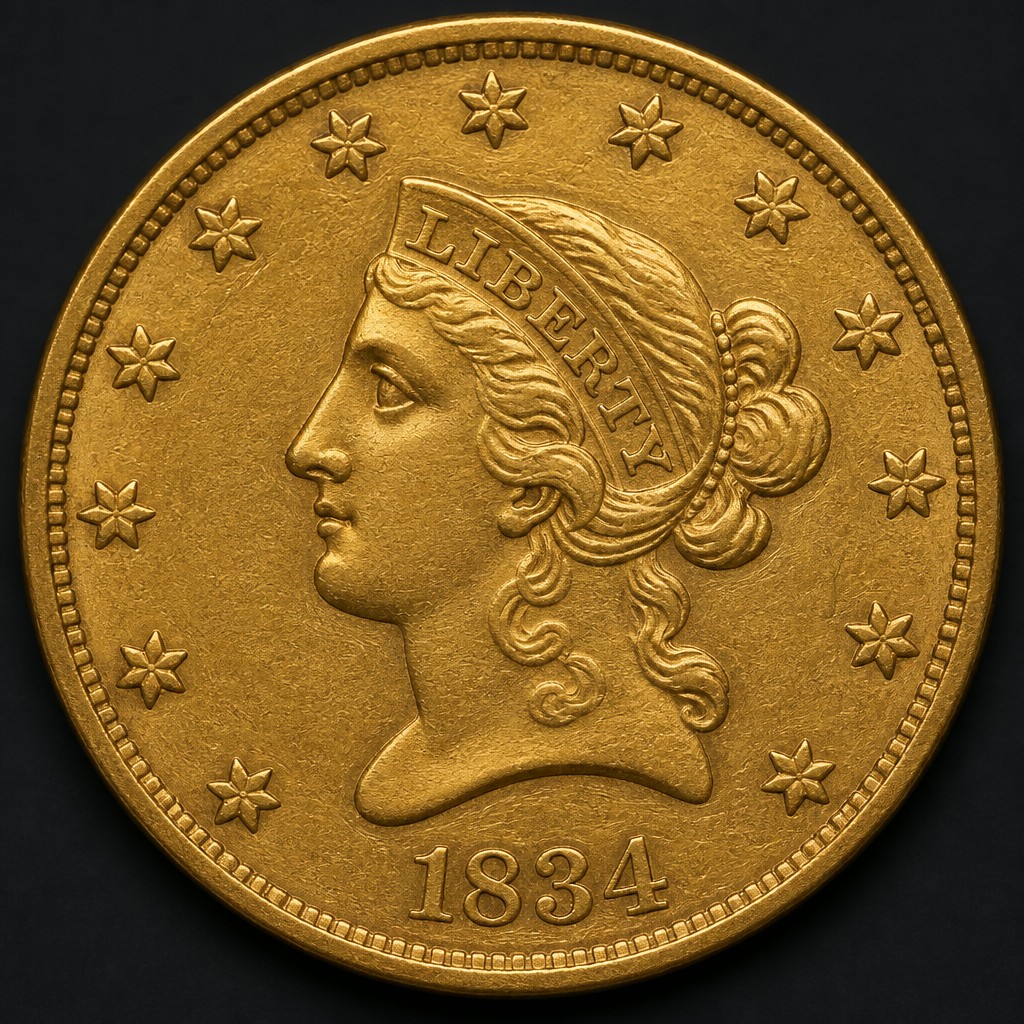
What It Is
The Classic Head half eagle is a $5 gold coin designed by William Kneass and struck from 1834 to 1838. It followed the Coinage Act of 1834, which reduced the gold content and overall weight of U.S. gold coins to curb the widespread melting of earlier, heavier gold pieces, and it introduced a simpler design meant to visually signal the change.
Obverse Design
The obverse shows Liberty's head facing left with curly hair, wearing a plain headband inscribed "LIBERTY" rather than the more ornate cap seen on earlier Capped Bust half eagles. Stars surround the portrait and the date sits below.
Reverse Design & Inscriptions
The reverse depicts an eagle with wings raised, holding an olive branch and arrows, without a shield on its breast. "UNITED STATES OF AMERICA" arches around the top and "5 D." appears below the eagle. Notably, this design carries no motto at all — "IN GOD WE TRUST" would not appear on gold coinage until decades later, and this type also lacks the "E PLURIBUS UNUM" seen on the earlier Capped Bust design.
Size, Weight, Metal, and Edge
Following the 1834 weight reduction, the coin weighs about 8.36 grams at approximately .899 fine gold, measures 22.5 mm in diameter, and has a reeded edge — noticeably lighter than half eagles struck before 1834.
Mint Marks and Where to Find Them
Classic Head half eagles from 1834 through 1837 carry no mint mark, having been struck only in Philadelphia. In 1838, the Charlotte and Dahlonega branch mints opened and struck their first gold coins, so 1838-dated examples may show a "C" or "D" mint mark on the obverse, above the date — a distinctive placement compared to the reverse mint mark locations used on most later gold coins.
Telling It Apart From Similar Coins
Compare this type to the earlier Capped Bust half eagle by looking for a plain headband instead of a soft cap, and by the complete absence of any motto on the reverse. Compare it to the Liberty Head (Coronet) half eagle that followed in 1839 by looking for a coronet inscribed "LIBERTY" and a shield on the eagle's breast on the later design — features absent from the Classic Head type.
Judging Condition at a Glance
Check Liberty's hair curls and the headband for flattening, along with the eagle's wing tips and neck feathers on the reverse, for the earliest wear on this short-lived design.
Authenticity Red Flags
Because 1838-C and 1838-D are the only branch-mint issues and carry real premiums as first-year coins from those mints, examine the obverse mint mark area above the date closely for signs of an added or altered letter. Confirm weight and diameter against the reduced 1834-standard specifications, since a coin matching pre-1834 weight standards would be inconsistent with a genuine Classic Head half eagle.
Frequently asked questions
Why does this coin have no motto at all?
It predates the addition of 'IN GOD WE TRUST' to U.S. gold coinage and also dropped the 'E PLURIBUS UNUM' used on the earlier Capped Bust half eagle, giving the reverse a plainer look.
Where is the mint mark on an 1838 Classic Head half eagle?
On the obverse, above the date — unlike most later gold coins, which place the mint mark on the reverse.
Which mints struck this coin besides Philadelphia?
Only in 1838, when the newly opened Charlotte ('C') and Dahlonega ('D') mints struck their first gold coins.
How is this different from the Coronet (Liberty Head) half eagle that followed?
The Classic Head type has a plain headband and no shield on the eagle, while the Liberty Head type that started in 1839 has a coronet inscribed 'LIBERTY' and a shield on the eagle's breast.