
How to Identify the Chola Dynasty Gold Kahavanu
A South Indian gold coin of the medieval Chola Empire, identified by its dynastic tiger, fish, and bow emblems or standing royal figure.
Read the full Chola Dynasty Gold Kahavanu encyclopedia entry →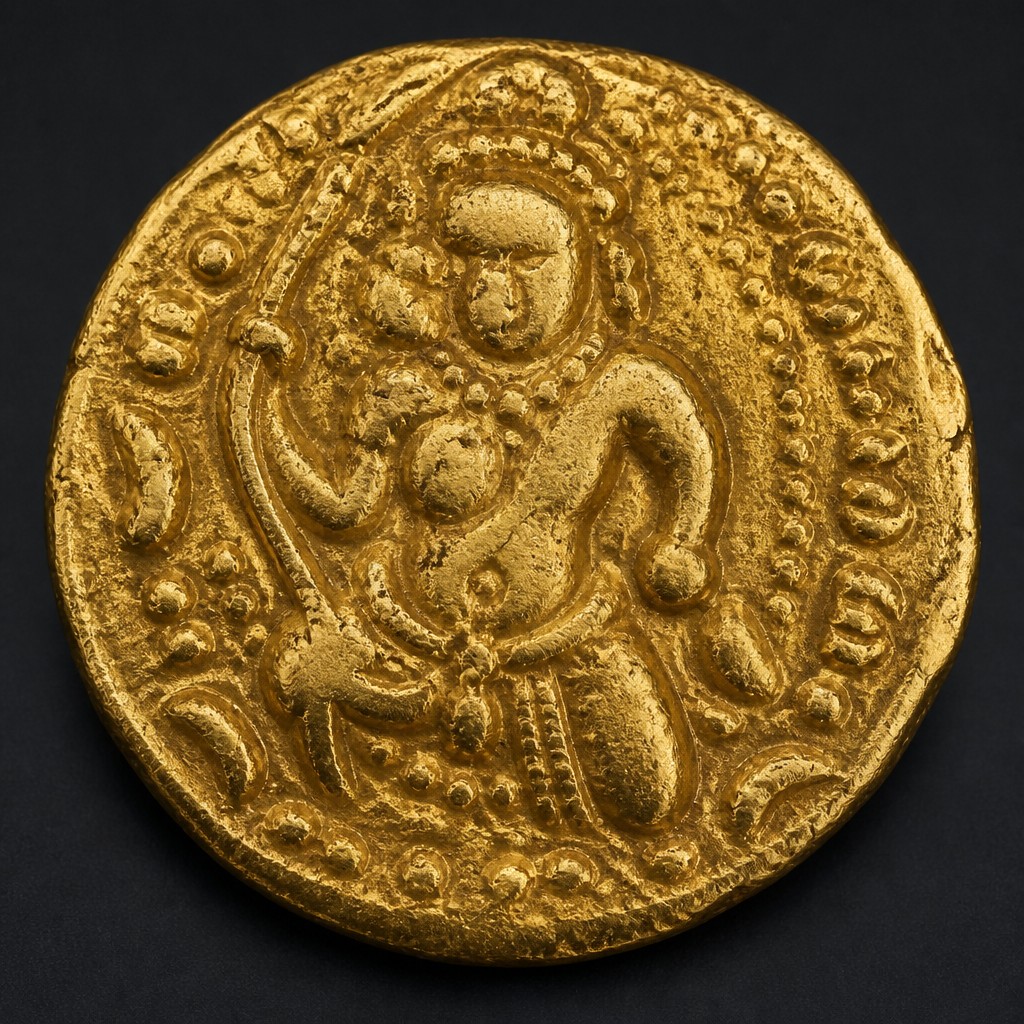
What the Coin Is
The kahavanu, also referred to as "pon," was a gold coin issued by the Chola dynasty, which dominated South India and parts of Southeast Asia from roughly the 9th to 13th centuries CE. It represents one of the major gold currencies of medieval South India, produced in a distinctive dumpy, thick flan style typical of the region's coinage.
Obverse Design
Many Chola gold issues show the dynasty's royal emblem cluster: a standing tiger, the primary Chola royal symbol, often paired with a fish, associated with the Pandya dynasty, and a bow, associated with the Chera dynasty, sometimes beneath a canopy or with attendant symbols like a parasol or lamp. Some types instead depict a standing king holding a mace or making a gesture, particularly on issues with certain regional connections.
Reverse Design & Inscriptions
The reverse commonly carries a legend in Tamil or Nagari-derived script recording the issuing king's name or title, and on some types this is combined with additional dynastic symbols. Legends can be brief, often just a royal epithet, rather than a full descriptive inscription.
Size, Weight, Metal, Edge
Chola gold kahavanu coins are typically small, thick, and dumpy rather than broad and flat, generally in the range of 10-16 mm in diameter, with weight varying by specific denomination but often in the range of a few grams. The metal is high-purity gold, and the edge is irregular and unmilled, reflecting hand-struck production on a small, thick flan.
Telling It Apart from Similar Coins
The tiger-fish-bow emblem grouping is distinctive to the Chola dynasty and its regional influence, differing from the pure fish emblem of standalone Pandya coinage or the bow-only emblem of Chera issues. Compared to the later Vijayanagara gold pagoda, which usually depicts Hindu deities like Balakrishna rather than dynastic animal emblems, the Chola kahavanu's design vocabulary is more heraldic and symbolic than devotional. Within the Chola series itself, subtle changes in emblem arrangement and accompanying legend wording across different reigns are what specialists use to narrow a coin to a particular king or period.
Judging Condition at a Glance
Because these coins are small, thick, and struck by hand, look for how clearly the central emblem or emblems stand out and whether the legend, if present, is legible. Wear tends to flatten the raised emblem first, so a coin where the tiger, fish, and bow are all still distinct is considered a well-preserved example.
Authenticity Red Flags
Modern reproductions may get the proportions or arrangement of the tiger-fish-bow group wrong, use a gold color or luster that looks artificial, or show casting bubbles and seams inconsistent with genuine hand-struck coinage. A legend that doesn't match known Chola-period script forms, or a flan shape unusually flat and broad compared to the typical dumpy Chola format, should also raise suspicion.
Frequently asked questions
What do the tiger, fish, and bow symbols mean?
They represent the Chola, Pandya, and Chera dynasties respectively; their combined appearance on Chola coinage reflects Chola political dominance over these neighboring South Indian kingdoms.
Why are Chola gold coins so small and thick?
South Indian gold currency of this period was typically struck on small, thick, dumpy flans rather than broad thin ones, a regional stylistic and practical minting tradition.
Is every Chola gold coin marked with all three emblems?
No, some issues show only some of the emblems, a standing royal figure, or other symbols depending on the specific king and period.
How is this different from a Vijayanagara pagoda?
The Vijayanagara pagoda typically shows Hindu deities such as Balakrishna or a deity couple, while the Chola kahavanu more often uses the tiger-fish-bow dynastic emblem group or a standing royal figure.
What script appears in the legend?
Legends are generally in Tamil or Nagari-derived script, usually naming or referencing the issuing king.