
How to Identify the Chinese Spade Money (Bu Coin)
An ancient Chinese bronze currency shaped like a stylized farming spade, cast mainly during the Zhou Dynasty's Spring and Autumn and Warring States periods before round cash coinage became standard.
Read the full Chinese Spade Money (Bu Coin) encyclopedia entry →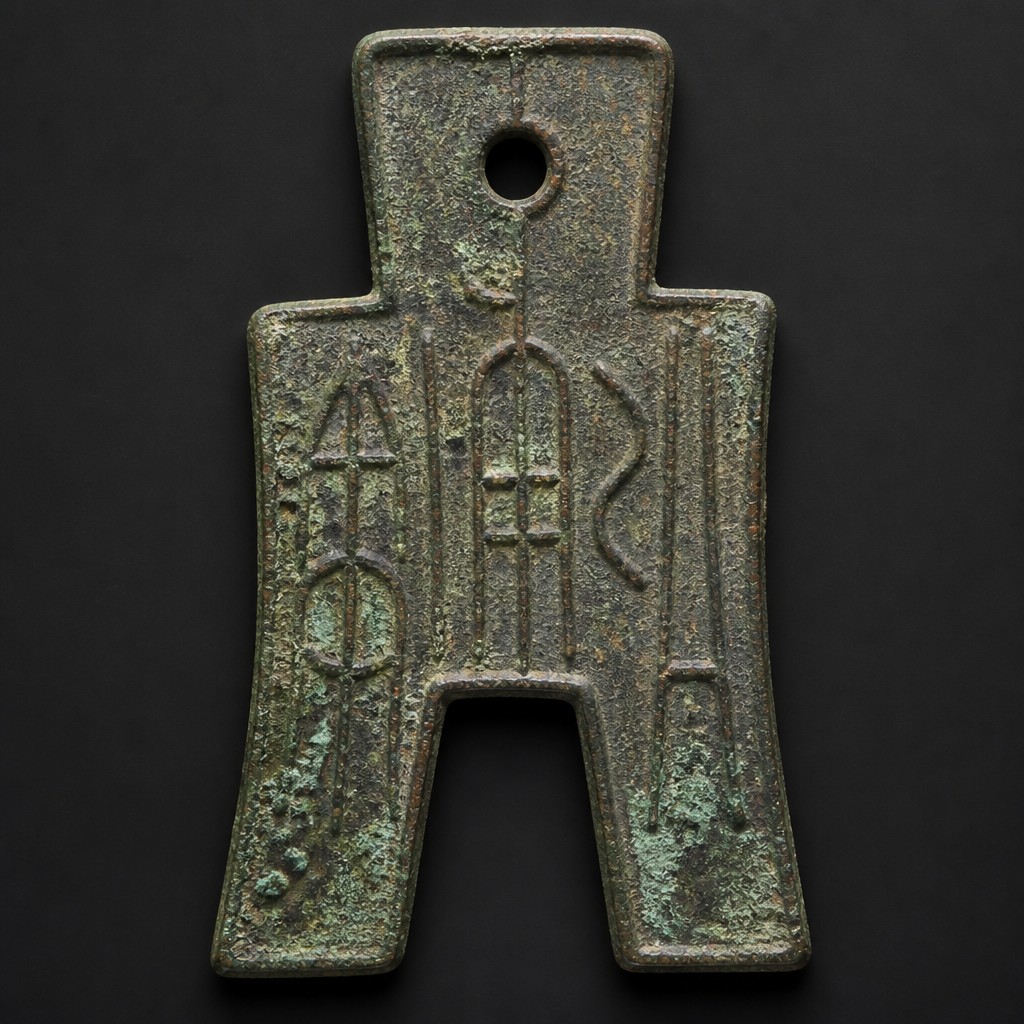
What It Is
Spade money, also called "bu" or "bubi," was cast bronze currency shaped like a small stylized agricultural spade or shovel, circulating mainly during China's Spring and Autumn and Warring States periods, roughly the 7th through 3rd centuries BC, well before the country's unification and the eventual standardization of round cash coinage. It descended in form from actual bronze farming tools that had once served as a practical barter medium before being formalized into token currency.
Obverse Design
Spade money has a flat, spade-shaped body with a socket at the top, a holdover from the tool's original design where a wooden handle would have been inserted. Many spade coins bear one or a few cast Chinese characters near the top indicating a place name, often the city-state or mint town that issued the piece, while others carry a numeral or weight designation instead.
Reverse Design
The reverse is usually plain or carries only minimal additional marks. Earlier "hollow-handle" spade types have an actual functional hollow socket, visible looking into the top of the piece, while later "flat-handle" (ping shou bu) types are cast as solid, flat pieces with no real socket, having become purely symbolic, token-based currency by that stage.
Size, Weight, Metal, and Edge
Size varies considerably by type and period, ranging roughly from 40mm up to 160mm in length. Hollow-handle types tend to be larger and heavier, while later flat-handle types are generally smaller and lighter. All are cast bronze, flat, with no round hole of any kind (a clear visual difference from later round cash coins), and often show a raised rim or a seam line left over from the two-part casting mold.
Mint Marks and Attribution
The cast place-name characters function as the coin's equivalent of a mint mark, identifying the issuing city-state, with many different towns across the Jin, Wei, Zhao, and Han regions of ancient China having issued their own spade money. Attribution to a specific city generally requires comparing the inscribed characters against specialist reference catalogs.
Telling It Apart from Similar Coins
Knife money, another ancient Chinese currency form from the same general era, is easily distinguished by its curved blade shape rather than a spade's flatter, foot-like base. Among spade money itself, sub-types such as square-foot, pointed-foot, and arched-foot spades are distinguished mainly by the shape of the two "feet" at the bottom and the style of the handle/socket at top.
Judging Condition at a Glance
Because the thin edges and pointed feet are fragile, completeness is a major factor: excavated examples are commonly found broken or chipped at these vulnerable points. Casting sharpness, legibility of the inscribed characters, and patina quality all factor into an overall condition assessment.
Authenticity Red Flags
Genuine ancient spade money typically shows a mineralized, crusty archaeological patina, often mottled green or brown from centuries buried in the ground, along with casting seams consistent with ancient piece-mold bronze technology. This coin type is very heavily reproduced for the curio and souvenir trade, so an artificially uniform "antique" coloring, overly crisp and uncorroded surfaces, or incorrect and nonsensical inscriptions are all common signs of a modern fake. Given how widespread reproductions are in this market, extra caution is warranted.
Frequently asked questions
Why is this coin shaped like a farming tool?
Spade money evolved directly from real bronze agricultural spades that were originally used as a practical barter medium, and the shape was retained even after the objects became purely symbolic token currency.
What's the difference between hollow-handle and flat-handle spade money?
Hollow-handle spades have an actual functional socket at the top where a real handle could once be inserted and tend to be larger and heavier, while later flat-handle spades are solid, flat castings that are smaller, lighter, and purely symbolic.
What do the characters cast into the coin mean?
They usually indicate a place name, identifying the specific city-state that issued the piece, and are the main clue used to attribute a given spade coin to its region of origin.
How do I tell spade money apart from knife money?
The overall shape is the simplest distinguishing feature: spade money has a flatter, foot-shaped base resembling a shovel, while knife money has a curved blade shape resembling a knife.
Why should I be extra cautious buying spade money?
This coin type is very heavily reproduced for the curio and souvenir market, so pieces with an unnaturally even fake patina, overly crisp uncorroded surfaces, or garbled inscriptions are common and worth scrutinizing carefully.