
How to Identify the Chinese Pei Yang (Peiyang) Arsenal Dragon Dollar
A late-Qing silver dollar struck at the Pei Yang Arsenal mint in Tientsin, identified by its dual Chinese/English legends and coiled dragon reverse.
Read the full Chinese Pei Yang (Peiyang) Arsenal Dragon Dollar encyclopedia entry →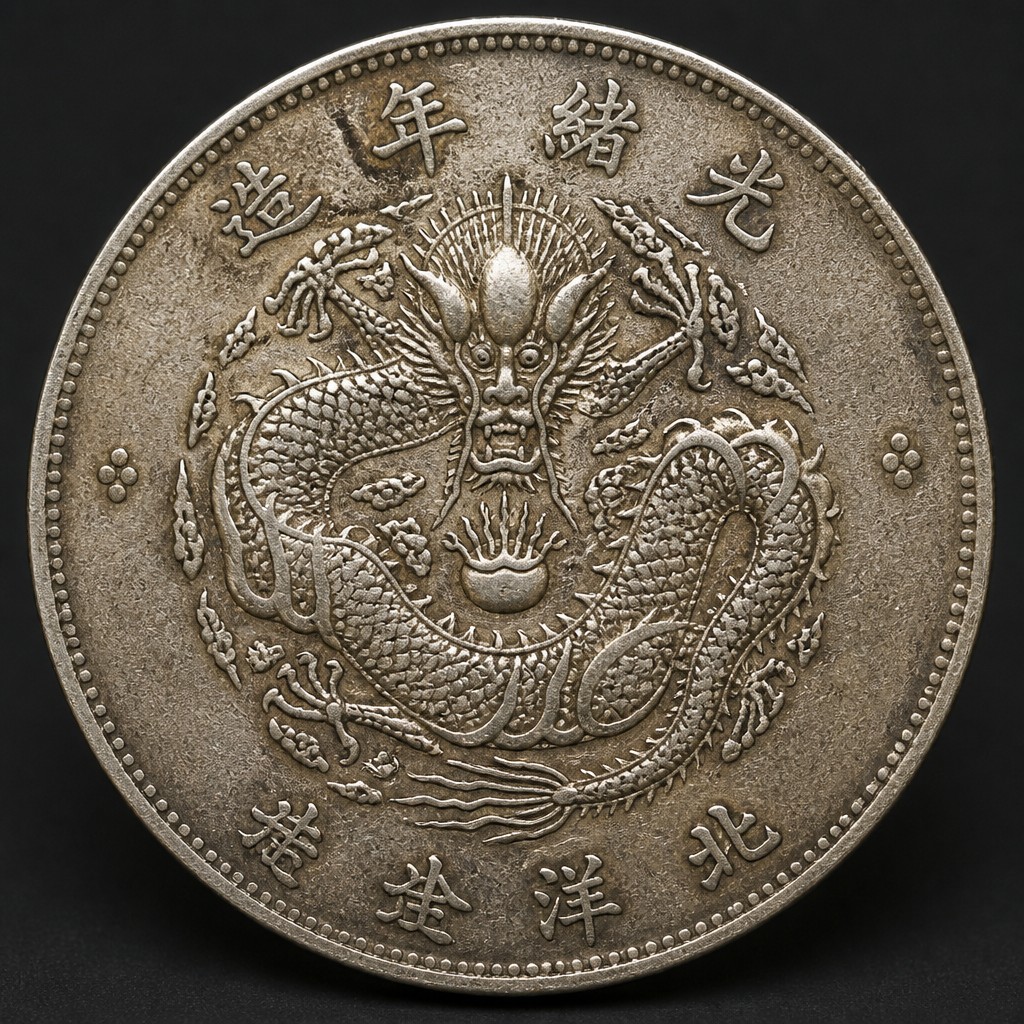
What It Is
This silver dollar was struck by the Pei Yang (Beiyang) Arsenal mint in Tientsin (modern Tianjin) under Qing dynasty authority. It belongs to the broader family of "dragon dollars" produced by several provincial mints in the late 19th and early 20th centuries, valued at 7 Mace and 2 Candareens, roughly matching foreign trade dollars circulating in China at the time. These provincial dollars were part of China's gradual shift away from irregular sycee silver ingots toward standardized, machine-struck coinage that could circulate more predictably in daily commerce. The Pei Yang mint, tied to a regional arsenal and self-strengthening industrial program, was one of the more prolific and long-running of these provincial issuers, so its coins turn up fairly often on the collector market today.
Obverse Design & Inscriptions
The obverse carries Chinese characters naming the mint ("Pei Yang" / "Made by the Pei Yang Arsenal"), often paired with Manchu script, arranged around a beaded circle. An outer legend in English typically reads something like "PEI YANG ARSENAL" along with the Guangxu reign year written out (for example, "34TH YEAR OF KUANG HSU").
Reverse Design & Inscriptions
The reverse shows a coiled dragon facing left amid stylized clouds, with a flaming pearl above its head and stylized waves along the bottom border. A Chinese weight inscription reading "Kuping 7 mace 2 candareens" typically appears near the top rim.
Size, Weight, Metal & Edge
It is a silver dollar-sized coin, about 39mm in diameter and roughly 26.7-27 grams, with fineness commonly in the .868-.900 range depending on the specific issue year. The edge is reeded.
Mint Marks & Where to Find Them
There is no separate mint-mark symbol; the mint identity is spelled out directly in the obverse legend. Look for the Pei Yang / Peiyang wording and the small Chinese reign-year characters near the rim to pin down the exact issue.
Telling It Apart from Similar Coins
Many provinces struck visually similar dragon dollars. Compare the obverse mint-name legend carefully, since Pei Yang, Fengtien, Kiangnan, and Hupeh issues all used the same general layout but different wording and slightly different dragon artwork. It also helps to compare the beading around the rim and the precise curl of the dragon's whiskers, since these small engraving details differ between provincial dies even when the overall composition looks similar at a glance.
Judging Condition at a Glance
Check the dragon's central body scales, the flaming pearl, and the sharpness of the Chinese characters. Original mint luster tends to survive longest in protected areas near the legend, while the dragon's spine and pearl flatten first with wear.
Authenticity Red Flags
This series is heavily counterfeited due to strong collector demand. Be cautious of coins with soft or mushy design details, incorrect weight or diameter, a dull gray or unnaturally yellow tone, or visible casting seams along the edge under magnification. Compare the thickness and clarity of the Chinese characters to references; blurred or malformed strokes suggest a modern replica rather than an original strike.
Frequently asked questions
What does "7 Mace and 2 Candareens" mean?
It is a traditional Chinese weight-based denomination equal to one silver dollar, matching the approximate weight of trade dollars circulating in China at the time.
How can I tell a Pei Yang dollar from a Fengtien or Kiangnan dragon dollar?
Read the mint-name legend on the obverse; each province spelled out its own name in Chinese and English, so wording like "Pei Yang" or "Peiyang Arsenal" identifies this specific mint.
Is the dragon design identical on every Pei Yang dollar?
No, the dragon's style varies slightly between issue years, though the general coiled-dragon-with-pearl layout stays consistent across most Guangxu-era Pei Yang dollars.
Why are fakes of this coin so common?
Chinese dragon dollars are highly collectible, which makes them frequent targets for cast counterfeits; check weight, diameter, and design sharpness carefully before assuming a piece is genuine.
Does the coin show a Western calendar date?
No, the date is expressed as a Qing dynasty Guangxu reign year in Chinese numerals rather than a Gregorian year.