
How to Identify the Chinese Knife Money (Ming Dao)
An ancient Chinese bronze currency shaped like a curved knife blade, cast mainly in northeastern Zhou-era states and named for a distinctive character resembling 'ming' inscribed on the blade.
Read the full Chinese Knife Money (Ming Dao) encyclopedia entry →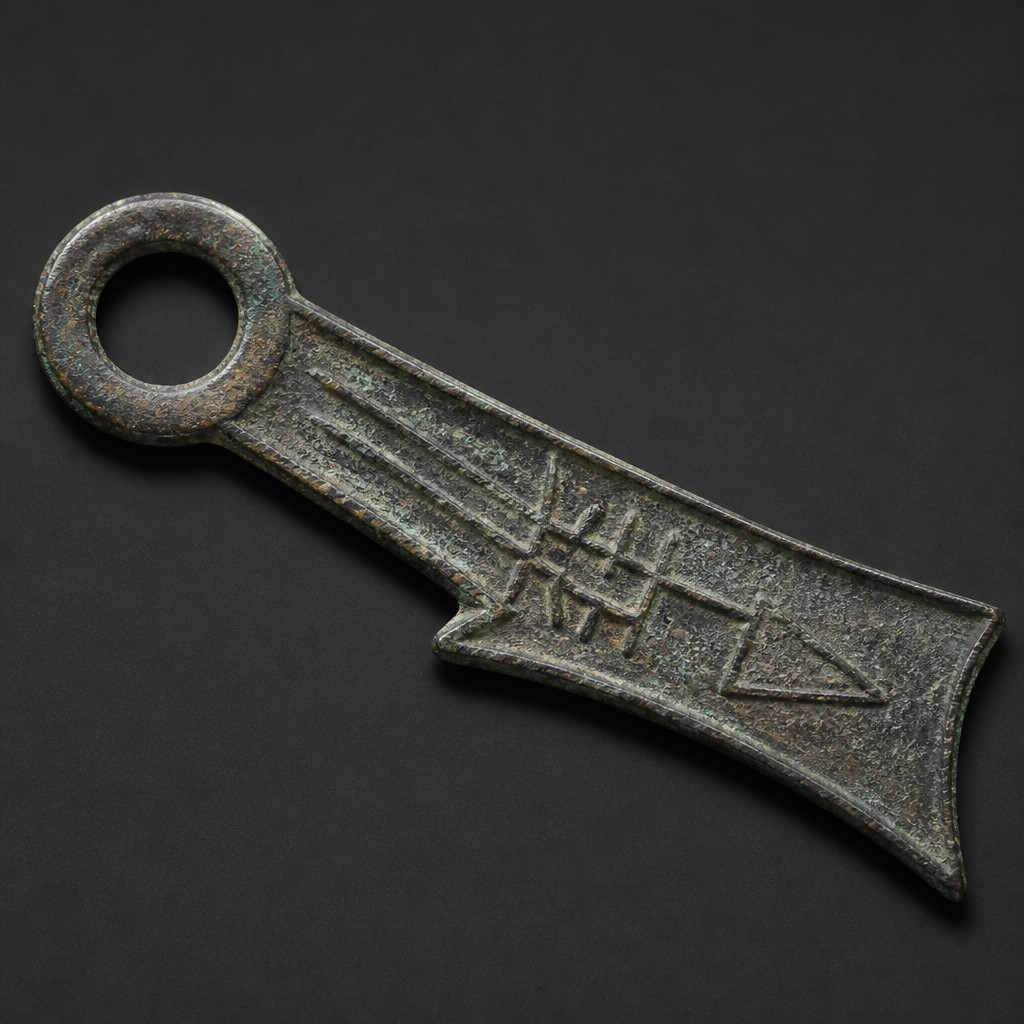
What It Is
Knife money was ancient Chinese bronze currency cast in the shape of a knife, used mainly in the northeastern and eastern states of Zhou-era China, notably the state of Qi and later types associated with Yan and Zhao, during the Spring and Autumn and Warring States periods. Like spade money, it evolved from genuine bronze knife tools into purely symbolic, token-based currency. The specific "Ming Dao" (bright or inscribed knife) type takes its name from a distinctive large character on the blade.
Obverse Design
Knife money has an elongated, curved blade shape with a ring at the handle end, allowing pieces to be strung together on a cord. Cast Chinese characters run along the blade: Ming Dao knives show a prominent single character near the top of the blade, interpreted variously by scholars as "ming" or "yi," while other knife types, especially the large, early "Qi Fa Hua" knives, carry much longer inscriptions naming the issuing city and sometimes proclaiming the legitimacy of the currency.
Reverse Design
The reverse typically has few or no inscriptions, sometimes just a numeral or short mark, and shows the characteristic curved profile and spine of the knife blade shape.
Size, Weight, Metal, and Edge
Sizes vary by type, with most knife money running roughly 130-200mm in length. The early Qi "Qi Fa Hua" knives are notably large and heavy, while the later, more widely circulated Ming Dao types tend to be somewhat smaller and lighter, reflecting a move toward more standardized currency. All are cast bronze with a thin, flat blade and a ring or loop at the handle end, and a mold seam is often visible running along the blade's edges.
Mint Marks and Attribution
The inscribed characters serve as the equivalent of a mint or place attribution. A full city name (as seen on early Qi knives) versus the shorter, more abstract single "ming" character (found on the later, more broadly circulated Ming Dao type, issued by multiple states across a wider region) is the main clue to a piece's type and rough place of origin.
Telling It Apart from Similar Coins
Spade money is easily distinguished by its flatter, foot-shaped base rather than a curved blade. Among knife money sub-types, inscription length and blade proportions separate the varieties, such as the large "three-character" or "six-character" Qi knives compared to the simpler, shorter-inscribed Ming Dao or pointed-tip knives.
Judging Condition at a Glance
Completeness is especially important for this type, since the thin curved blade and the ring at the handle end are prone to breakage or loss in excavated examples, so an intact, unbroken specimen is notably more desirable. Casting sharpness of the inscription and overall patina also factor into condition.
Authenticity Red Flags
Genuine excavated knife money typically shows a naturally mineralized, uneven archaeological patina and casting seams consistent with ancient piece-mold bronze technology. Like spade money, this type is very heavily reproduced for the curio and tourist trade, so overly uniform "aged" coloring, unnaturally crisp and uncorroded surfaces, incorrect character forms, or suspiciously perfect symmetry are all red flags pointing to a modern fake rather than a genuine ancient piece.
Frequently asked questions
Why is this currency shaped like a knife?
Knife money evolved from real bronze knife tools that were originally used in barter exchange, and the distinctive blade shape was retained even after the objects became purely symbolic token currency.
What does the large character on the Ming Dao blade mean?
It's a prominent single character, interpreted by scholars variously as ming or yi, that gives this specific knife money type its name and distinguishes it from other knife types that carry longer, multi-character inscriptions.
How is knife money different from the large early Qi Fa Hua knives?
The early Qi Fa Hua knives are notably larger and heavier and carry longer inscriptions naming the issuing city, while the later Ming Dao type is generally smaller, lighter, and marked with just the single distinctive character, reflecting a shift toward more standardized currency.
Why do so many surviving examples look broken or incomplete?
The thin curved blade and the ring at the handle end are fragile points that are commonly broken or chipped on excavated examples, so complete, unbroken specimens are considered notably better preserved.
What should I watch out for when evaluating a piece for sale?
Because knife money is heavily reproduced for the curio trade, be cautious of examples with an unnaturally uniform aged coloring, overly crisp uncorroded surfaces, or inscriptions with incorrect or garbled character forms.