
How to Identify the Chinese Ban Liang Cash
The Ban Liang is China's first unified round coin, cast in bronze with a square center hole and the two-character inscription meaning 'half tael.'
Read the full Chinese Ban Liang Cash encyclopedia entry →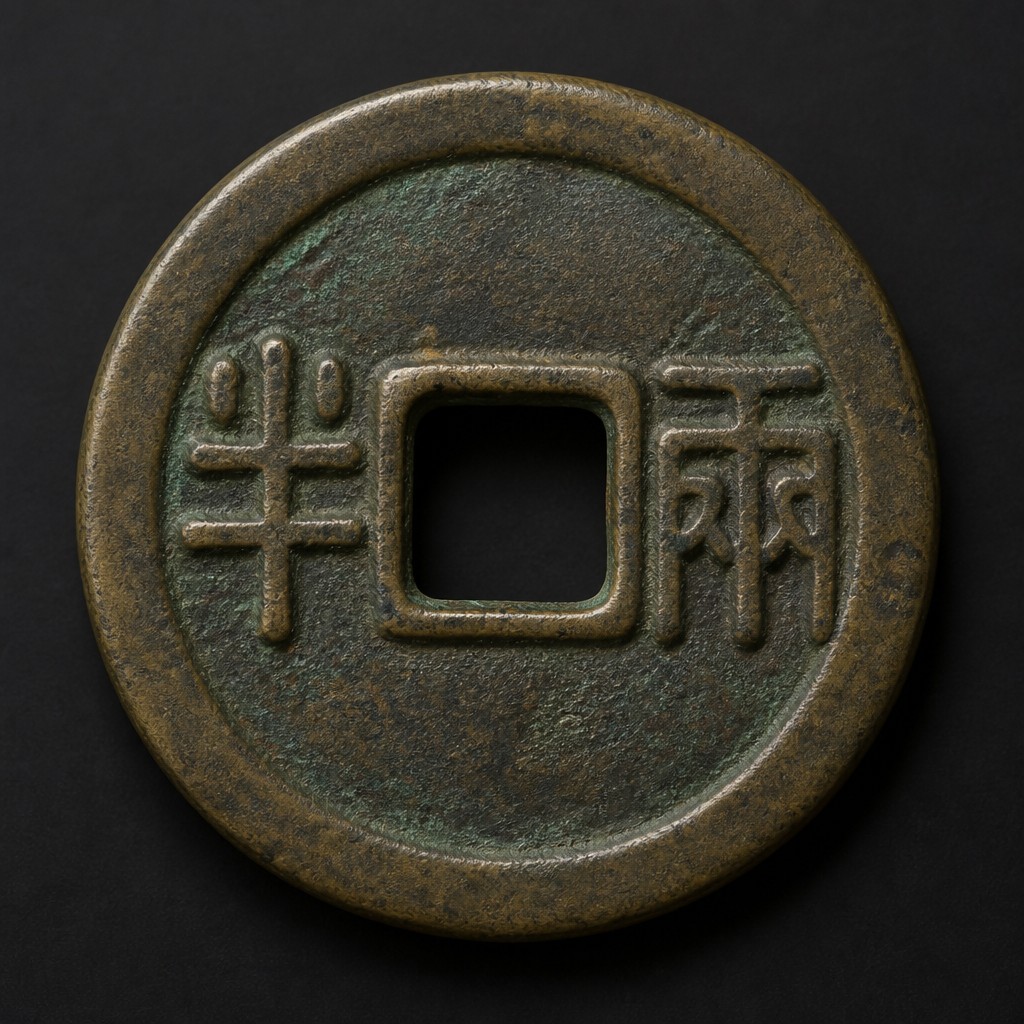
What It Is
The Ban Liang (半兩, "half tael") was introduced as the standardized coinage of the Qin dynasty after China's unification in 221 BC, replacing the varied knife money, spade money, and other regional coin shapes used previously. Its round-with-square-hole format became the template followed by Chinese cash coins for the next two thousand years.
Obverse Design
The obverse carries only the two cast characters "半兩" (Ban Liang), arranged to the right and left of the central square hole, rendered in an early seal-script style. There is no portrait, image, or additional decoration—identification rests entirely on recognizing these two characters and their placement.
Reverse Design
The reverse of genuine early Ban Liang cash is plain and blank, without a raised rim or any inscription. A flat, featureless back is one of the coin's most identifying traits when compared to later Chinese cash types.
Size, Weight, and Metal
Ban Liang coins are cast in bronze and show notably inconsistent size and weight across their production span, since standards were only loosely enforced across different regions and later Han-dynasty continuations of the type; diameters commonly range from about 22mm up to over 34mm on heavier early issues, with weight varying accordingly. The coin has no defined "edge" in the modern sense, as it was produced by pouring molten metal into a mold rather than being struck.
Mint Marks
Ban Liang cash carry no mint marks, city names, or dates of any kind—only the denomination inscription. Any attribution to a specific period or region relies on stylistic details of the casting, character form, and hole shape rather than an explicit mark.
Telling It Apart From Similar Coins
The Ban Liang is most easily confused with the later Wu Zhu cash, but the inscriptions differ clearly: Wu Zhu coins read "五銖" and typically have a raised rim on both sides, while genuine Ban Liang issues usually lack rims and read "半兩." Casting quality and character style can also help separate an early Qin-period Ban Liang from a looser, cruder Han-period continuation of the same design.
Judging Condition at a Glance
Because these are cast rather than struck coins, "condition" is judged by how crisp the mold-cast characters remain and how much of the coin's edge is intact, since cast bronze cash often chips or corrodes at the rim. A dark, even patina is normal and expected on a genuinely ancient bronze coin, while bright, shiny metal on a coin claimed to be over two thousand years old is unusual.
Authenticity Red Flags
Modern reproductions of Ban Liang cash are common in tourist and souvenir markets. Warning signs include unnaturally sharp, machine-like character edges, a hole that is laser-cut or perfectly uniform rather than hand-finished, a uniformly bright or artificially treated dark surface, and a weight or diameter far outside the wide but still bounded range documented for genuine Qin and early Han issues.
Frequently asked questions
What does the inscription on a Ban Liang coin mean?
The two characters read 'Ban Liang,' meaning 'half tael' (half of a traditional Chinese weight unit), referring to the coin's nominal weight standard rather than a mint or date.
Why is there a square hole in the middle?
The square hole allowed coins to be strung together on a cord for carrying and counting, and also helped hold the coin steady while its edges were filed smooth after casting.
How do I tell a Ban Liang from a Wu Zhu cash coin?
Read the inscription: Ban Liang coins say 半兩, while Wu Zhu coins say 五銖. Wu Zhu coins also typically have a raised rim around the hole and edge, which early Ban Liang coins usually lack.
Why do Ban Liang coins vary so much in size?
Casting standards were inconsistently enforced across regions and over the roughly century-long span these coins were produced, so diameter and weight vary considerably between individual pieces.
Should the metal look shiny or dark?
Genuine ancient bronze Ban Liang cash typically shows a dark, uneven patina from centuries of oxidation; a bright, clean, shiny surface is a common indicator of a modern reproduction.