
How to Identify the Charles II Shilling
A collector's walkthrough for attributing a Charles II silver shilling by its right-facing laureate bust, crowned shields, edge, provenance marks and metal.
Read the full Charles II Shilling encyclopedia entry →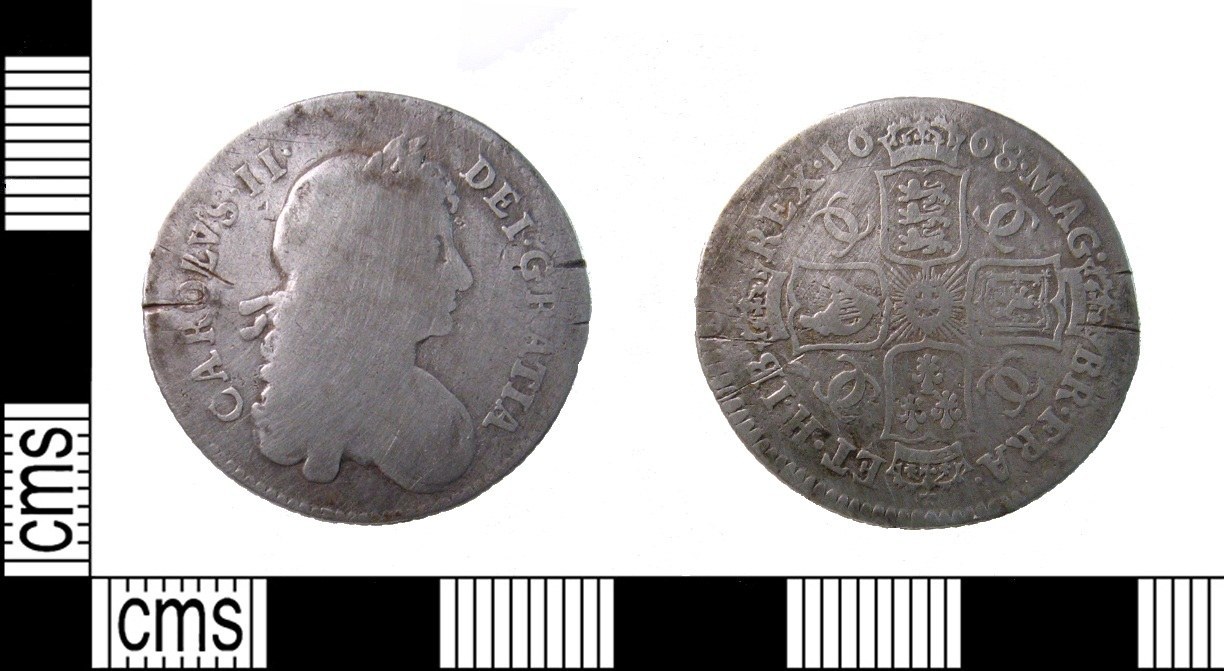
Start with the denomination and metal. A Charles II Shilling is a silver coin roughly the size of a modern smaller crown-type piece, larger than a sixpence of the same reign. The milled issues are struck on a round, even flan with sharp, uniform detail, while the early 1660-1662 issues are hammered and more irregular. Note that this coin carries no mark of value in the field, so do not expect an XII; the denomination is judged from size, weight and design.
Read the obverse next. You should see a laureate, draped bust of Charles II in profile facing right, with a Latin legend running around the edge naming him as king. The right-facing laureate bust, without a crown and without a value mark, is the core signature of the type and immediately separates it from the left-facing crowned, XII-marked shillings of Charles I. Compare the bust style against reference plates, as the portrait was modified across the reign.
Turn to the reverse. Confirm the royal arms displayed on four shields arranged as a cross, each topped by a crown, representing England, Scotland, France and Ireland, with the interlinked royal initials in the angles between the shields. This cruciform arrangement of crowned shields is standard for the milled Charles II shilling and differs clearly from the single quartered shield of many earlier hammered issues.
Check the edge and the field below the bust. Milled coins have a decorated or grained edge rather than the plain edge of a hammered coin, which is a useful authenticity check. Look below the bust for small plumes or an elephant device: these provenance marks record Welsh silver or African Company silver and both narrow the attribution and affect value. The date, where present, together with the bust variety, pins down the exact issue.
Be alert to look-alikes and pitfalls. The shillings of James II and William and Mary that follow carry different portraits and legends, and the earlier Commonwealth and Charles I silver is quite different again. Because these coins are old and often circulated, expect honest wear, but watch for cast surfaces, casting seams, soft mushy detail, tooling, or the wrong weight, all of which can indicate a forgery or an altered coin. For anything beyond a common worn date, seek confirmation from a specialist in milled English silver or a reputable auction record.
Frequently asked questions
Which way does the bust face on a Charles II Shilling?
The bust faces right and wears a laurel wreath. This right-facing laureate portrait, with no value mark, is one of the quickest ways to distinguish it from the left-facing crowned bust of a Charles I shilling.
How can I tell a milled Charles II Shilling from a hammered one?
Milled shillings, struck from 1663, are round and evenly struck with a decorated or grained edge, while the early 1660 to 1662 hammered shillings are more irregular in flan and have a plain edge. Both name Charles II in the legend.
What are the small symbols under the bust?
They are provenance marks. Plumes indicate silver from Wales, and an elephant or elephant-and-castle indicates silver from the African (Guinea) Company. Identifying them against a reference helps attribute the issue and can raise the value.
How do I avoid buying a fake?
Check that the coin is struck rather than cast, with crisp detail and no casting seams, that the milled edge is present on later issues, and that the weight is right for silver. Mushy surfaces, wrong colour, tooling or wrong weight are warning signs; for valuable pieces, buy from a specialist or trusted auction.