How to Identify the Charles I Twenty Pence
A collector's guide to recognizing Charles I's small hammered silver twenty pence by its crowned portrait, rose-and-thistle reverse, and Latin legends.
Read the full Charles I Twenty Pence encyclopedia entry →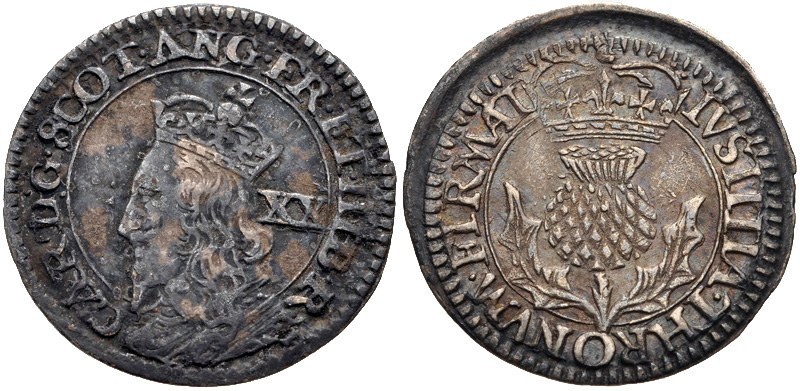
Begin with the portrait. The obverse of a Charles I Twenty Pence shows the king crowned and in left-facing profile, with the curled hair typical of his coin portraits. Around the rim runs an abbreviated Latin legend naming Charles as king by the grace of God (elements such as CARO, DG, and BRITT are often the most legible on worn pieces). A clear crowned royal bust with this style of legend is the first confirmation of the type.
Turn to the reverse. Look for a heraldic design built around a crowned shield with rose and thistle badges, framed by a Latin motto invoking Christ (a CHRISTO legend on this coin). The pairing of a crowned Stuart portrait with a rose-and-thistle heraldic reverse is the core diagnostic; both sides should be checked together before attributing the coin.
Assess fabric and size. This is a small, thin hammered silver coin, so expect an irregular flan, off-center striking, and hand-cut lettering rather than the sharp, uniform edges of milled coinage. Weigh and measure the piece and compare against published specifications for the denomination; a badly underweight coin may be clipped or damaged, which affects both authenticity confidence and value.
Watch for look-alikes. Charles I struck many silver denominations with similar crowned portraits and heraldic reverses, so read the legends and confirm the denomination rather than relying on the portrait alone. Small twenty-pence pieces can be confused with other minor silver of the Stuart period; the specific rose-and-thistle reverse and coin size help separate them.
Be cautious with authentication. Hammered silver is faked, and cast copies, tooled surfaces, and modern replicas exist. Look for casting seams, bubbles, unnaturally smooth fields, or lettering that lacks the variation of genuine hand engraving. For any coin of meaningful value, seek an opinion from a specialist in English hammered coinage or a reputable grading service before purchase.
Frequently asked questions
Which side is the obverse?
The side with the crowned left-facing portrait of Charles I is the obverse; the heraldic rose-and-thistle design is the reverse. Both must be present to confirm the type.
How do I tell it apart from other Charles I silver?
Many Charles I coins share a crowned portrait, so confirm the denomination by size and by the specific rose-and-thistle reverse. Reading the legends helps separate the twenty pence from larger or smaller silver pieces.
How can I tell it isn't a cast copy?
Genuine coins are hand-struck, showing uneven flans and hand-cut lettering. Watch for casting seams, air bubbles, mushy detail, or incorrect weight, and seek professional authentication when value is at stake.
Do the worn or unreadable legends mean it is fake?
No. Partly legible legends are normal for hammered coins that circulated centuries ago. Weak or off-center lettering reflects hand striking and wear, not necessarily a problem with authenticity.
Charles I Twenty Pence identified by the community
Recent Charles I Twenty Pence coins identified with Coin Identifier.