
How to Identify the Charles I Sixpence
A collector's walkthrough for attributing a hammered Charles I silver sixpence by bust, value mark, shield, motto, and mint mark.
Read the full Charles I Sixpence encyclopedia entry →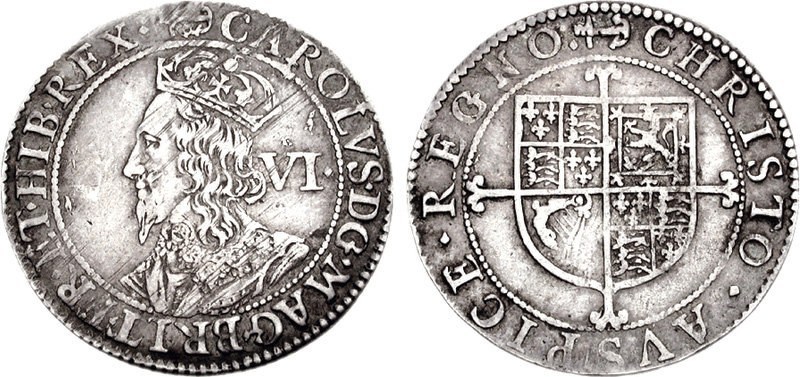
Start with the denomination and metal. A Charles I Sixpence is a small hammered silver coin struck on a thin, slightly irregular flan, distinctly smaller and lighter than a shilling of the same reign and larger than the tiny threepence or half-groat. It should feel and look like silver; a piece that is far too large, too heavy, or the wrong color is likely a different denomination or a problem coin. The clearest single confirmation of the sixpence is the mark of value, a small VI, usually placed in the field beside the crowned bust.
Read the obverse next. You should see a crowned profile bust of Charles I facing left, with the long curled hair typical of his portraits, and a Latin legend around the edge naming him as king in a contracted form such as CARO ... D G BRITT REX. On the reverse, confirm the heraldic shield of arms with its cross-and-quartering design and any floral garnishing, encircled by a Latin motto.
Use the reverse motto and the mint mark together to narrow the attribution. A Declaration-type motto referring to religion, the laws of England, and the liberty of Parliament points to wartime royalist coinage of the 1640s, while the earlier peacetime religious motto is more typical of Tower issues. A small mint mark at the start of the legend identifies the mint and period; matching that mark, the bust style, and the motto to a standard reference on Charles I coinage is the reliable route to a precise attribution.
Be alert to look-alikes and pitfalls. Sixpences of James I and later Commonwealth silver can resemble a worn Charles I piece at a glance, so the bust style, the VI value mark, and the legend naming Charles are decisive. Because hammered coins are irregular, weak strikes and off-center legends are expected, but watch for casting seams, soft mushy detail, a wrong weight, or unnatural surfaces, which can indicate a forgery. Clipping around the edge and later tooling of the portrait both reduce authenticity and value.
For anything beyond a common low-grade example, seek confirmation from a specialist in hammered English coinage or a reputable auction record. Attribution of Charles I silver rewards careful comparison against published plates, and a second expert opinion is worthwhile before paying a premium for a scarce mint or an unusually well-preserved coin.
Frequently asked questions
Where is the value mark on a Charles I Sixpence?
Look for a small VI in the field of the obverse, usually beside or behind the crowned bust. This numeral confirms the six-pence denomination and helps distinguish the coin from the shilling, which shows XII.
How do I find and use the mint mark?
The mint mark is a small symbol at the very beginning of the legend, on the obverse and sometimes the reverse. Matching it against a Charles I reference helps establish the mint and the approximate date, which is especially important for the many Civil War issues.
How can I avoid buying a fake?
Check that the coin is struck rather than cast, with crisp die detail and no casting seams, and that the weight is right for a silver sixpence. Irregular flans are normal, but mushy surfaces, the wrong color, or the wrong weight are warning signs. For valuable pieces, buy from a specialist or trusted auction.