
How to Identify the Centenionalis of Constans
A collector's guide to reading the curly-haired Constans portrait, the FEL TEMP REPARATIO hut scene, size, and mint marks.
Read the full Centenionalis of Constans encyclopedia entry →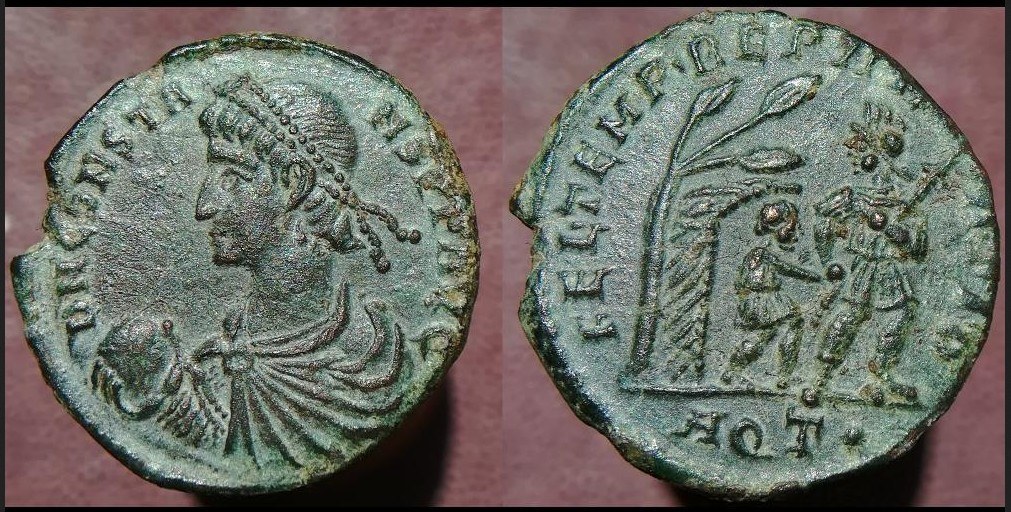
Start with the obverse portrait and legend. This coin shows Constans as a young, beardless emperor with noticeably curly hair, wearing a pearl diadem, in a draped and cuirassed bust facing right. Read the legend around the edge: it should include CONSTANS, most often in the form DN CONSTANS PF AVG. Because several Constantinian-dynasty rulers share a similar youthful style, the name in the legend is what confirms the emperor rather than the face alone.
The reverse is the key diagnostic. Look for the legend FEL TEMP REPARATIO around a helmeted Roman soldier who reaches down toward a small figure emerging from a hut or from beneath a tree. This "soldier and captive at a hut" composition is distinct from the far more common "fallen horseman" type, where the soldier spears a rider falling from a horse; confusing the two is the most frequent identification error with this series.
Check size and metal. This is a bronze coin struck on a hand-made flan; the earlier, heavier module of the reform typically runs about 20-23 mm across, and later strikes of the wider series tend to be smaller and lighter. Surfaces are usually an earthy brown or green patina, and some pieces preserve faint traces of an original silvering wash. Irregular flan shape, slightly off-center strikes, and legends running partly off the edge are all normal for the period.
Find the mint mark. In the exergue (the flat area at the bottom of the reverse) look for a short group of letters, sometimes with additional field letters or symbols beside the figures; these identify the issuing mint and officina and are essential for a full attribution. Matching the portrait, reverse variety, and mint mark against a reference such as RIC pins down the exact issue.
Be cautious about authentication. Genuine late Roman bronzes show hand-struck detail, natural patina, and metal flow consistent with ancient minting. Warning signs of cast copies include a seam around the edge, a soft or bubbly surface, repeating flan flaws, and a portrait or legend style that does not match known types. Modern tourist replicas and tooled surfaces exist; for a significant purchase, prefer coins with clear provenance or attribution from a specialist in late Roman coinage.
Frequently asked questions
How do I tell this from the common fallen-horseman FEL TEMP type?
Look at the reverse action. Here the soldier reaches down to lead a small figure out of a hut. In the fallen-horseman type the soldier spears a rider tumbling from a horse. Both share the FEL TEMP REPARATIO legend, so the scene is what separates them.
How can I be sure the emperor is Constans and not Constantius II?
Read the obverse legend for the name. Constans and his brother Constantius II struck very similar FEL TEMP coins with comparable youthful portraits, so CONSTANS versus CONSTANTIVS in the legend is the reliable distinction.
Where do I find the mint mark?
Check the exergue at the bottom of the reverse for a short line of letters, sometimes with extra letters or symbols in the field. This identifies the mint and officina and is needed for a precise attribution.
The coin looks brown and rough. Is that normal?
Yes. These are ancient bronzes, so brown or green patina and slightly irregular, off-center strikes are expected. Be more cautious about a visible casting seam, a bubbly surface, or repeating flaws, which can indicate a modern cast copy.