
How to Identify the Celtic Gold Stater
The Celtic gold stater is an Iron Age coin known for its abstract, stylized imagery derived from Greek prototypes, often showing a disintegrated head design and a stylized horse.
Read the full Celtic Gold Stater encyclopedia entry →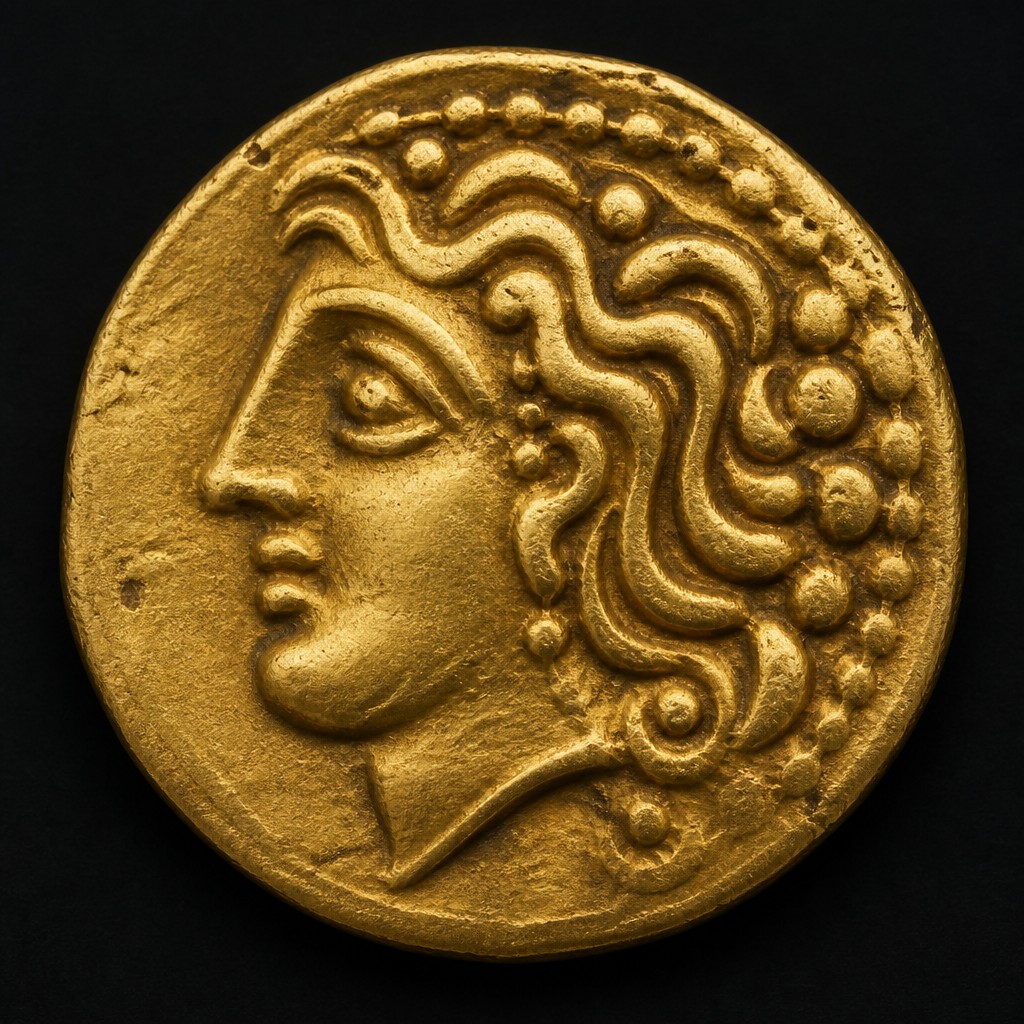
What It Is
Celtic gold staters were struck by various Iron Age tribes across continental Europe and Britain from roughly the 3rd century BC through the early 1st century AD, adapting the design of Macedonian gold staters (originally featuring Apollo and a chariot) that circulated widely as mercenary pay and trade currency. Over generations of copying, the original Greek imagery became increasingly abstract and stylized in Celtic hands.
Obverse Design
Early Celtic staters show a recognizable, if simplified, laureate head of Apollo copied from the Macedonian original. As the design was recopied by successive die engravers over time, the head progressively dissolved into an abstract arrangement of curls, dots, crescents, and disconnected features, a phenomenon numismatists often describe as "disintegration" of the original classical image.
Reverse Design
The reverse similarly derives from a Macedonian two-horse chariot but becomes, through the same process of stylization, a single abstract horse (sometimes with additional symbols like wheels, stars, or boars floating in the field), rendered with exaggerated or fragmented anatomy quite different from any naturalistic horse image.
Size, Weight, and Metal
Struck in gold (sometimes debased with silver or copper into electrum as local supplies and standards varied), Celtic staters typically weigh around 5.5 to 6.5 grams with a diameter close to 17-20mm. Edges are plain and hand-struck, often with a noticeably domed or slightly irregular flan shape typical of Iron Age striking technique.
Mint Marks
Most Celtic staters carry no inscriptions or mint names at all, consistent with their origins as an oral, non-literate coinage tradition; however, some later British issues (from tribes such as the Atrebates, Trinovantes, and Catuvellauni) began adding short Latin-alphabet legends naming individual rulers, such as Tasciovanus, Cunobelin, or Verica, which greatly assists in attribution.
Telling It Apart From Similar Coins
Because the underlying design ultimately derives from the same Macedonian prototype, different Celtic tribal issues are told apart mainly by the specific pattern of abstraction on the obverse "head" and the arrangement of secondary symbols around the reverse horse, both of which were regionally and tribally distinctive. Inscribed British staters are far easier to attribute directly by reading the ruler's name where present.
Judging Condition at a Glance
Because the imagery is already abstract by design, condition assessment focuses less on recognizing fine figural detail and more on the sharpness of the punch/die impression overall, the completeness of the flan, and whether the metal shows any deliberate ancient clipping or damage versus a full, well-centered strike.
Authenticity Red Flags
Look for a weight noticeably outside the roughly 5.5-6.5 gram range, a die style that mixes design elements from documented tribes or regions that would not plausibly appear together, or unnaturally smooth, sharp-edged relief inconsistent with the somewhat irregular hand-struck look of genuine Iron Age dies. A color that looks too uniformly yellow for a period alloy known to include some silver or copper content is also worth checking.
Frequently asked questions
Why does the design look so abstract compared to Greek coins?
Celtic die engravers repeatedly copied earlier Macedonian gold staters over many generations without direct access to the Greek originals, and small copying changes accumulated into an increasingly stylized, abstract version of the original head and chariot imagery.
Do all Celtic staters lack inscriptions?
No. While most continental and early British issues are uninscribed, some later British tribal coins from rulers such as Cunobelin or Tasciovanus include short Latin-letter names, making those specific issues easier to attribute.
What was the original design these coins are based on?
A gold stater of Philip II of Macedon, showing a laureate head of Apollo on the obverse and a two-horse chariot on the reverse, which circulated widely and was extensively imitated across Iron Age Europe.
What is a typical weight for a Celtic gold stater?
Roughly 5.5 to 6.5 grams, though this varies by tribe, period, and local gold supply and alloy standards.
How can different tribal issues be told apart without inscriptions?
By the specific pattern of abstraction in the obverse head design and the arrangement of secondary symbols (stars, wheels, boars, and similar marks) around the reverse horse, which tend to be regionally distinctive.