
How to Identify the Celtic Gold Stater of the Parisii
An Iron Age gold coin from the Parisii tribe of ancient Gaul, showing a highly abstracted, stylized head and horse derived from Greek prototypes.
Read the full Celtic Gold Stater of the Parisii encyclopedia entry →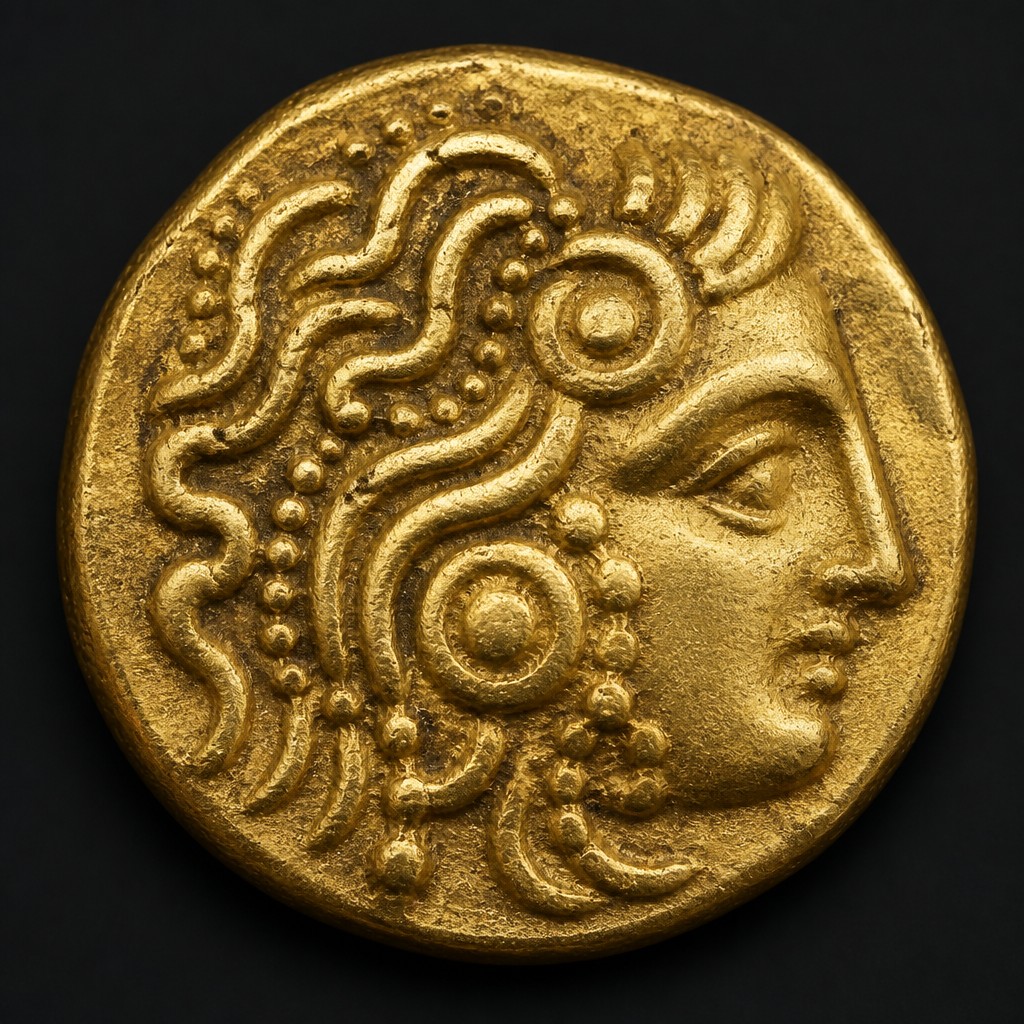
What the Coin Is
The gold stater of the Parisii was struck by the Iron Age Gallic tribe centered around what is now Paris, France, in the last few centuries BCE. Like much Celtic coinage, it ultimately derives from Greek prototypes, specifically gold staters of Philip II of Macedon, but transforms the original design through generations of increasingly abstract, stylized copying.
Obverse Design
The obverse presents a highly stylized human head, distantly derived from the laureate head of Apollo on the original Macedonian prototype, but rendered by Parisii die engravers as a striking arrangement of abstract curls, dots, and geometric patterning rather than a naturalistic portrait. Individual Parisii staters are prized by collectors specifically for this bold, almost modern-looking abstract artistry.
Reverse Design
The reverse shows a similarly stylized horse, derived from the two-horse chariot on the Macedonian original but reduced by the Celtic engravers to a single, elegant, disjointed horse composed of separated geometric elements, often accompanied by small symbols, pellets, or a stylized charioteer or rider fragment in the field.
Size, Weight, Metal, Edge
These staters are struck in gold, sometimes with some silver alloy content, with weight generally in the range of 6 to 8.5 grams and a diameter of roughly 17-20 mm. The edge is plain and irregular, typical of ancient hand-struck flans, and the flan itself is often noticeably irregular or slightly cupped in shape.
Telling It Apart from Similar Coins
Distinguishing Parisii staters from those of neighboring Gallic tribes, such as the Ambiani, Bellovaci, or other regional groups, relies on comparing the specific stylization of the head and horse, the placement and style of accompanying symbols, and known findspot patterns, since many Celtic tribes independently derived their coinage from the same Macedonian prototype but developed distinct artistic conventions over time. The overall abstraction level and specific decorative details, such as pellet clusters or particular curl patterns, are the main clues for narrowing a stater to the Parisii specifically rather than a related Gallic tribe.
Judging Condition at a Glance
Because the design is already abstract, condition assessment focuses on strike quality and centering: a well-struck example shows crisp, well-defined geometric elements on both sides, while a weak or off-center strike can make an already-abstract design nearly unreadable. Natural gold color and luster should be even, without unnatural or overly bright coloration.
Authenticity Red Flags
Because the design is already unusual, forgeries can be harder for non-specialists to judge purely on style; instead, focus on physical clues such as casting bubbles or seams, which indicate a cast fake rather than a struck coin, a weight or gold color inconsistent with genuine ancient examples, or file marks and tooling suggesting a piece has been reworked. Comparisons to well-documented genuine examples of Parisii staters, including known control symbols and stylistic details, are the most reliable way to assess an example in hand.
Frequently asked questions
Why does the design look so abstract?
Celtic engravers repeatedly copied earlier Greek/Macedonian coin designs over generations, gradually transforming the original naturalistic portrait and chariot into increasingly stylized, geometric patterns.
What was the original design based on?
It derives ultimately from gold staters of Philip II of Macedon, which showed the head of Apollo and a two-horse chariot.
How can I tell a Parisii stater from another Gallic tribe's stater?
Compare fine details of the head's stylization, the horse's shape, and accompanying symbols against documented examples, and consider findspot context, since several neighboring tribes issued similarly derived but stylistically distinct coinage.
What should the weight and metal be?
Genuine examples are struck in gold, sometimes lightly alloyed, typically weighing around 6-8.5 grams.
What's the best way to spot a fake?
Look for casting bubbles, seams, incorrect weight or gold color, and tooling marks, and compare stylistic details to well-documented genuine Parisii examples.