
How to Identify the Celtic Gold Quarter Stater
A collector's guide to recognizing an Iron Age British gold quarter stater by its small size, gold fabric, curled head, and abstract pelleted reverse.
Read the full Celtic Gold Quarter Stater encyclopedia entry →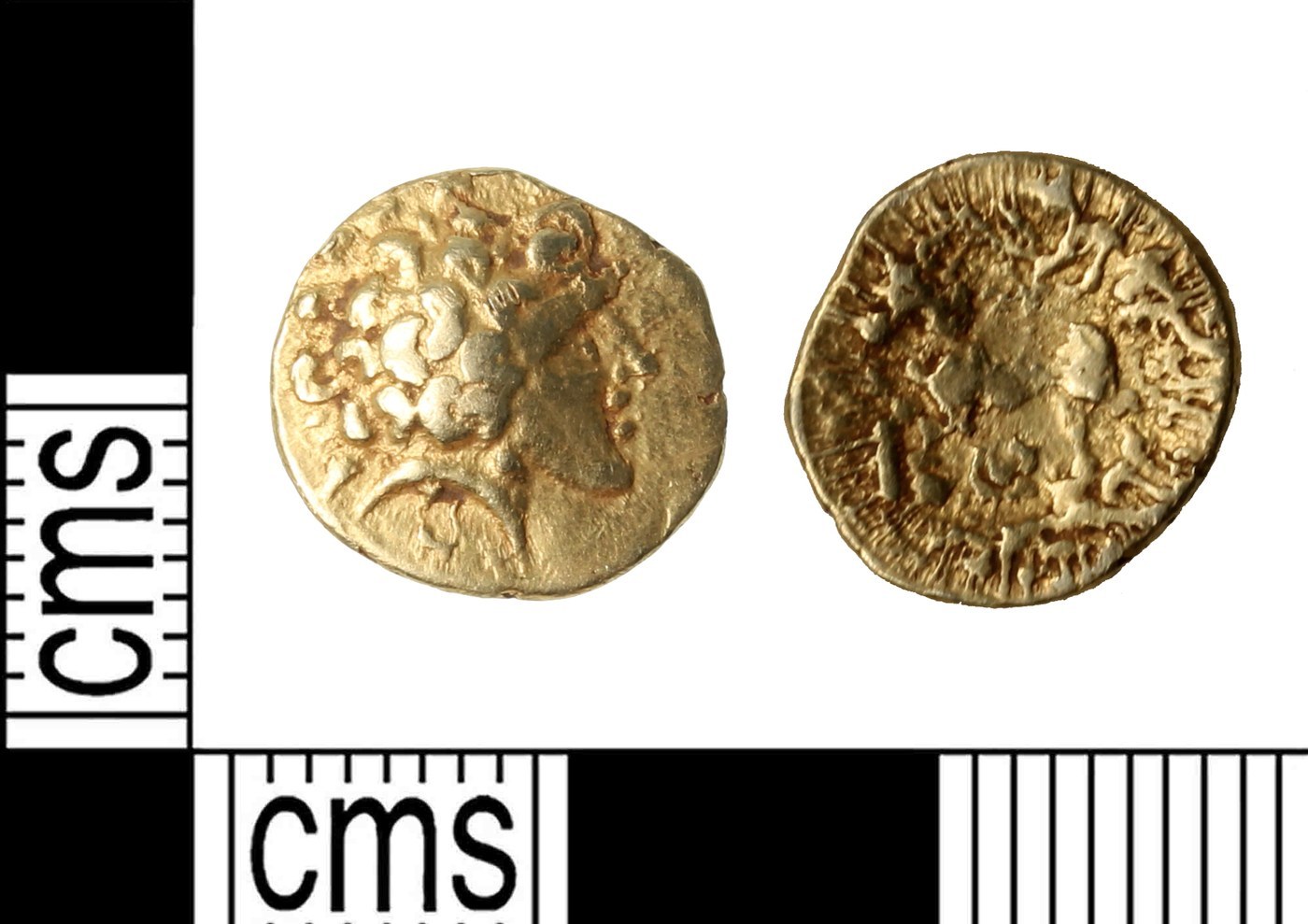
Start with size and metal, because these place the coin faster than the design. A quarter stater is small, generally about 10 to 15 mm across and light, usually near 1 to 1.5 grams, and struck in gold or gold alloy. Hold it against a full stater and the difference in module is obvious. Note the color as well: bright yellow gold suggests an earlier, higher-purity issue, while a pale, more silvery tone points to a debased later striking. That gold fabric at this small size is the core diagnostic of a quarter stater.
Read the obverse as a pattern, not a portrait. On this series the head faces right and is reduced to bold curling locks, often surrounded by pellets, crescents, or wreath fragments, the abstracted remains of the Apollo head that Celtic coinage inherited from Macedonian gold. Do not expect a realistic face; look instead for the rhythm of curls and the scatter of pellets. Because coins were struck by hand on small flans, part of the design frequently runs off the edge, so examine what survives rather than expecting a complete image.
Turn to the reverse for the geometric composition. Quarter staters typically carry an ornamental arrangement of pellets, lines, and crescents, sometimes with a fragmented horse, wheel, or other motif dissolved into the pattern. The precise layout of these elements is what distinguishes one tribal issue from another, so record it carefully. Matching the motif arrangement against a specialist reference such as Van Arsdell or the Ancient British listings in standard catalogues is the route to attributing the coin to a specific tribe and type.
Separate the quarter stater from its look-alikes. The full stater shares the same visual language but is markedly larger and heavier, so size settles that quickly. Gallic and other Continental Celtic quarter staters can look similar and require reference to distinguish. Be aware that later British issues can be silvery from debasement and may be mistaken for silver units, so weigh and test the metal rather than judging by color alone.
Finally, treat authentication seriously, since Celtic gold is a favored target for forgers. Genuine coins show hand-struck fabric, honest wear consistent with the high points, and gold of a plausible weight and color. Warning signs include a seam around the edge indicating a cast, a soft or bubbly surface, an unnaturally uniform tone, and weight outside the normal range. For any higher-value example, favor coins with documented provenance and consider independent expert authentication before purchase.
Frequently asked questions
How do I tell a quarter stater from a full stater?
Mainly by size and weight. A quarter stater is much smaller, roughly 10 to 15 mm and about a gram or so, while a full stater is larger and heavier. Both share the same abstract Celtic design language, so the module is the reliable separator.
The face looks like random curls and dots. Is that normal?
Yes. The obverse is a heavily stylized descendant of a Greek Apollo head, reduced by Celtic die-cutters to curling locks and pellets. An abstract, pattern-like head right is exactly what to expect on this series.
How can I identify which tribe struck it?
Compare the exact arrangement of motifs on both sides against a specialist reference for Ancient British coinage. The specific pattern of curls, pellets, and reverse elements, not the general look, is what ties a coin to a particular tribe and type.
How do I avoid buying a fake?
Check for hand-struck rather than cast fabric, plausible gold weight and color, and honest wear. Avoid coins showing an edge seam, a bubbly or uniform surface, or an odd weight, and for valuable pieces insist on provenance and independent authentication.