
How to Identify the Cartwheel Twopence (1797)
The Cartwheel Twopence is a massive 1797 copper coin weighing two full ounces, the largest denomination struck for British circulation, sharing its design with the Cartwheel Penny.
Read the full Cartwheel Twopence (1797) encyclopedia entry →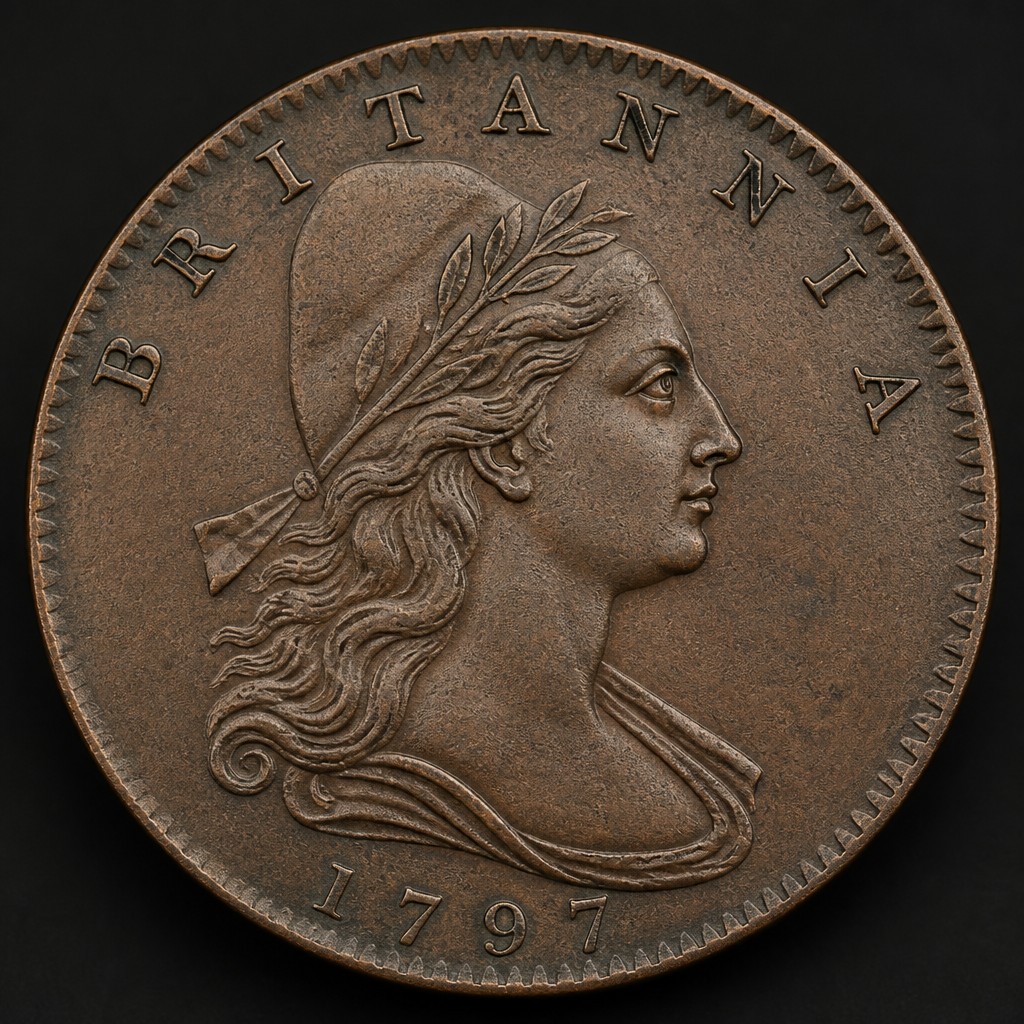
What Is It
The Cartwheel Twopence is the larger companion to the Cartwheel Penny, struck in the same year, 1797, at Matthew Boulton's Soho Mint in Birmingham under George III. It holds the distinction of being the largest and heaviest coin ever struck for general circulation in British history, and like the penny, it takes its nickname from its broad, protective raised rim.
Obverse Design
The obverse shows the same laureate bust of George III facing right, engraved by Conrad Heinrich Kuchler, with the legend GEORGIUS III D G REX surrounding the portrait, matching the style of the companion Cartwheel Penny.
Reverse Design
The reverse depicts Britannia seated on a rock, holding an olive branch and trident, with a ship in the background, and the legend BRITANNIA arched above, with the date 1797 in the exergue, again matching the design used on the penny but rendered on a much larger scale.
Size, Weight, and Metal
The Cartwheel Twopence is struck in copper and weighs exactly two troy ounces, approximately 56.7 grams, with a diameter of about 41mm, making it noticeably larger and considerably heavier than the Cartwheel Penny. As with the penny, a broad raised rim with incuse lettering runs around the edge, protecting the design from wear.
Mint Marks and Where to Find Them
Like the penny, the Twopence was struck only in 1797 at the Soho Mint rather than the Royal Mint, as part of the same modernization effort using steam-powered coining presses. No branch mint marks appear, since production was limited to this single facility and year.
Telling It Apart from Similar Coins
The Cartwheel Twopence is immediately distinguishable from the Cartwheel Penny by its noticeably larger diameter and greater weight, even though the two share nearly identical design elements. No other British circulating coin of the era approaches its size and heft, making correct identification straightforward once the coin is weighed or measured.
Judging Condition at a Glance
Wear appears first on Britannia's raised arm and shield and on the high points of George III's hair and cheek, the same areas that wear on the penny. Because the coin was large, heavy, and considered impractical for everyday use, many examples saw only limited circulation, and moderately well-preserved specimens are not unusual, though heavily worn or edge-damaged examples also exist from those pieces that stayed longer in commercial use.
Authenticity Red Flags
Given its fame as the largest British circulating coin ever struck, genuine examples should weigh close to 56.7 grams and measure about 41mm in diameter, with sharply defined incuse lettering on the protective rim; any example significantly lighter or smaller, or lacking crisp rim lettering, should be treated with suspicion as a possible reproduction or novelty piece rather than an authentic 1797 Soho Mint issue.
Frequently asked questions
How heavy is a genuine Cartwheel Twopence?
It weighs exactly two troy ounces, approximately 56.7 grams, making it the heaviest coin ever struck for general circulation in Britain.
Why was the Cartwheel Twopence unpopular in everyday use?
Its large size and considerable weight made it cumbersome to carry and use compared with ordinary coinage, which limited its practicality despite its official denomination.
How can I tell a Cartwheel Twopence from a Cartwheel Penny?
The Twopence is noticeably larger and heavier, at about 41mm and 56.7 grams compared with the Penny's 36mm and 28.3 grams, even though both share the same George III and Britannia designs.
Where and when was the Cartwheel Twopence made?
It was struck in 1797 at Matthew Boulton's Soho Mint in Birmingham, using steam-powered coining presses as part of a broader modernization of British copper coinage.