
How to Identify the Cartwheel Penny (1797)
The Cartwheel Penny is a large, heavy 1797 copper penny with a broad raised rim, struck by Matthew Boulton's steam-powered Soho Mint under George III.
Read the full Cartwheel Penny (1797) encyclopedia entry →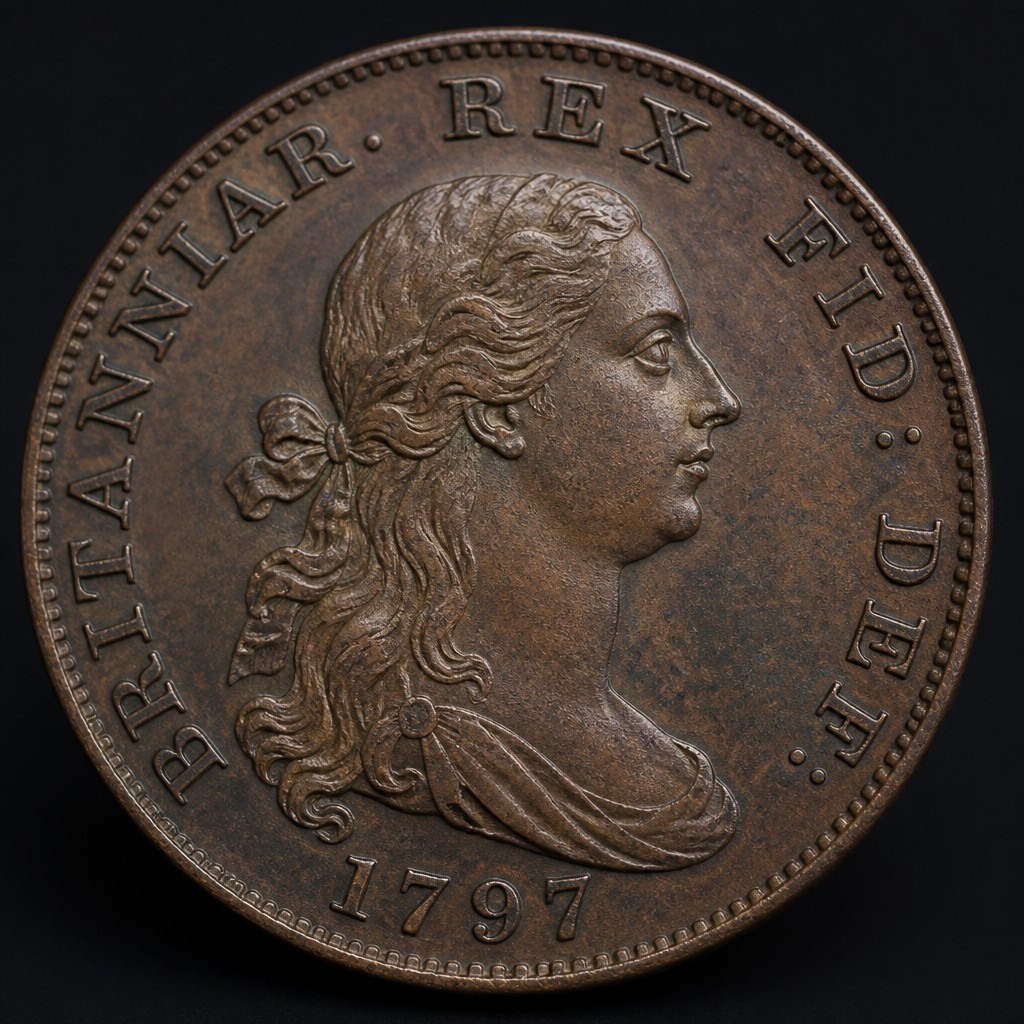
What Is It
The Cartwheel Penny is the popular name for the large copper penny dated 1797, struck under King George III at Matthew Boulton's Soho Mint in Birmingham using new steam-powered coining presses. It earned its nickname from its unusually broad, thick raised rim, which resembles the rim of a cart wheel, along with its overall large size and heavy weight compared with previous copper pennies.
Obverse Design
The obverse shows a laureate bust of George III facing right, engraved by Conrad Heinrich Kuchler, with the legend GEORGIUS III D G REX around the rim. A tiny incuse "K" for Kuchler can sometimes be found below the bust, a small detail collectors look for.
Reverse Design
The reverse depicts Britannia seated on a rock facing left, holding an olive branch and a trident, with a ship visible in the background on the sea, and the legend BRITANNIA arched above. The date, 1797, appears in the exergue at the bottom.
Size, Weight, and Metal
The Cartwheel Penny is struck in copper and famously weighs exactly one troy ounce, approximately 28.3 grams, with a diameter of about 36mm. Its broad, raised rim, incorporating incuse lettering, was a deliberate design feature meant to protect the coin's surfaces from wear during circulation, an innovation of the Soho Mint's steam-press technology.
Mint Marks and Where to Find Them
The Cartwheel Penny was struck only in 1797 (along with related pattern pieces) at the Soho Mint rather than the Royal Mint itself, reflecting a period when private contract minting was used to modernize British copper coinage. No branch mint marks are present, since this was a single, specific production run.
Telling It Apart from Similar Coins
The Cartwheel Penny's broad raised rim and substantial one-ounce weight make it easy to distinguish from earlier, thinner, and lighter 18th-century copper pennies, as well as from later 19th-century pennies, which returned to a more conventional size and thickness. Its companion coin, the Cartwheel Twopence, shares the same design elements but is considerably larger and heavier still.
Judging Condition at a Glance
Wear typically appears first on Britannia's raised arm, shield, and the high points of George III's portrait, particularly his hair and cheek. Because the protective rim helped shield the design from edge wear, many surviving Cartwheel Pennies show comparatively well-preserved central details even when moderately circulated, though heavily worn examples with a smooth Britannia figure are also common given over two centuries of potential handling.
Authenticity Red Flags
Because the Cartwheel Penny's design is well known and its large size distinctive, novelty reproductions and souvenir strikes with a similar look are sometimes sold or passed off as genuine; a real 1797 piece should weigh close to 28.3 grams and measure about 36mm, with sharply defined incuse lettering on the raised rim. A coin significantly lighter, made from a different-colored metal, or with a poorly defined or missing raised rim is not a genuine Soho Mint Cartwheel Penny.
Frequently asked questions
Why is it called the Cartwheel Penny?
The nickname comes from its unusually broad, thick raised rim and large overall size, which resembles the rim and heft of a cart wheel.
Where was the Cartwheel Penny made?
It was struck in 1797 at Matthew Boulton's Soho Mint in Birmingham, using new steam-powered coining presses rather than the Royal Mint's traditional facilities.
How heavy is a genuine Cartwheel Penny?
It weighs exactly one troy ounce, approximately 28.3 grams, a deliberate and distinctive specification for this issue.
What is the purpose of the raised rim on the coin?
The broad raised rim, with incuse lettering, was designed to protect the coin's surface details from wear during everyday circulation.