
How to Identify the Carson City Morgan Dollar (CC Mint)
A Morgan silver dollar struck at the Carson City, Nevada mint, identified by the small 'CC' mintmark on the reverse and prized for its Old West mining history.
Read the full Carson City Morgan Dollar (CC Mint) encyclopedia entry →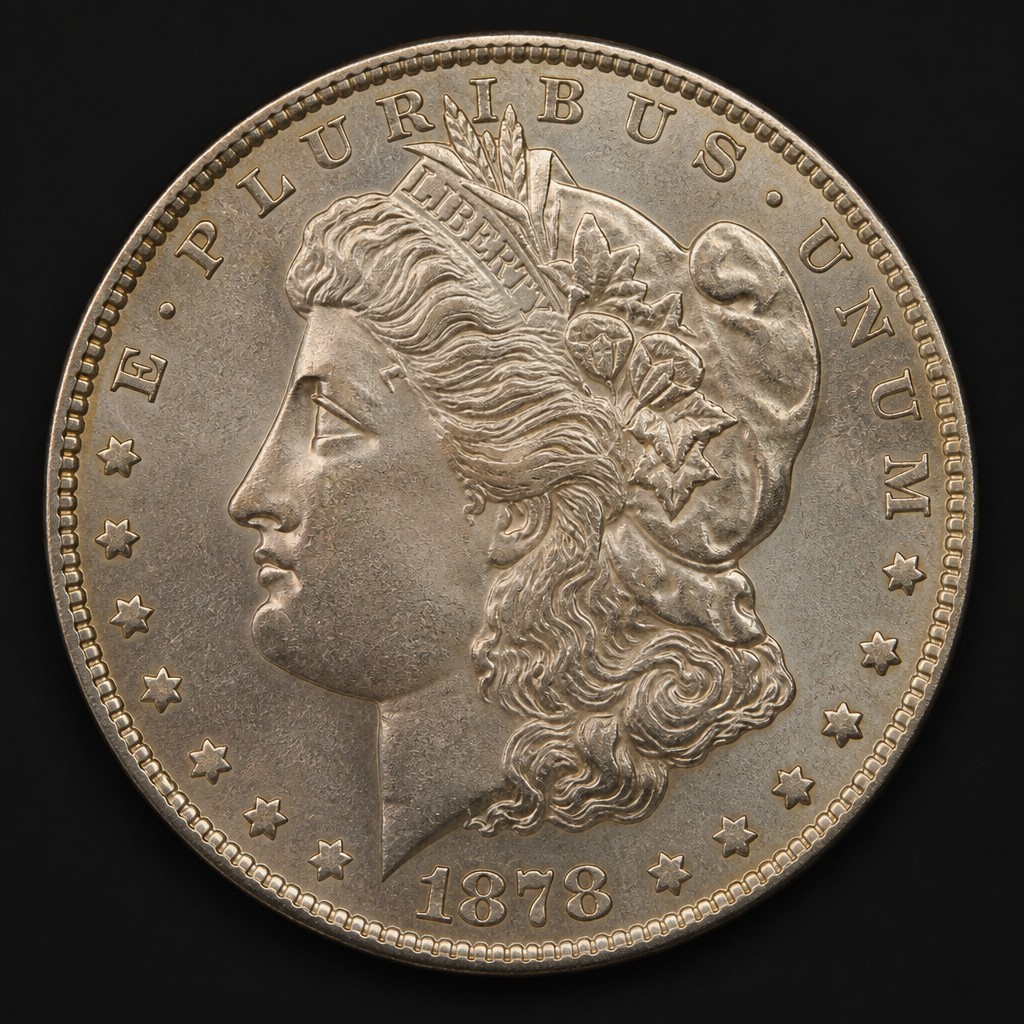
What It Is
The Carson City Morgan Dollar is a standard Morgan silver dollar (minted 1878-1904, and again in 1921) that was struck specifically at the U.S. Mint branch in Carson City, Nevada. The Carson City mint operated from 1870 to 1893 and struck Morgan dollars in most years of that span, with a gap from 1886 through 1888. Because of the mint's short lifespan and lower production runs, CC-marked Morgans are generally scarcer and more sought after than the same dates struck in Philadelphia, New Orleans, or San Francisco.
Obverse Design
The obverse, designed by George T. Morgan, shows a left-facing profile of Lady Liberty wearing a cap inscribed LIBERTY, with a band of wheat and cotton in her hair. Thirteen stars line the upper rim, and the date appears at the bottom center.
Reverse Design
The reverse depicts an eagle with wings spread, holding an olive branch and arrows, encircled by a wreath. IN GOD WE TRUST arches above the eagle, UNITED STATES OF AMERICA wraps around the rim, and ONE DOLLAR sits at the bottom. A small ribbon reading E PLURIBUS UNUM crosses above the eagle's head.
Size, Weight, and Metal
Every Morgan dollar, regardless of mint, weighs 26.73 grams, measures 38.1 mm in diameter, is struck in 90% silver and 10% copper, and has a reeded edge.
Finding the CC Mint Mark
The mintmark is the key to identification. Look on the reverse, just below the wreath and above the "DO" in DOLLAR, for a small "CC." Use a loupe if the coin has wear, since the mark sits low on the design and can be weak on softly struck examples.
Telling It Apart From Other Mints
Compare the same spot on Philadelphia strikes (no mintmark at all), New Orleans coins ("O"), Denver coins ("D," 1921 only), and San Francisco coins ("S"). Only the double-C mark confirms Carson City. Because CC coins carry a premium, this exact spot is also where added or altered mintmarks are most often attempted, so examine the mark's shape and how it sits against the surrounding metal.
Judging Condition at a Glance
Check the high points first: Liberty's hair above the ear and cheek, and the eagle's breast feathers. Full, sharp feather and hair detail with no flat spots suggests light circulation; smoothing and merging of these details indicates heavier wear. Many CC dollars survive in mint state because large hoards sat untouched in Treasury vaults for decades, so uncirculated examples are more common for this mint than the mintage numbers alone might suggest.
Authenticity Red Flags
Because CC dollars trade at a premium over common-date Morgans, added mintmarks are the most frequent form of tampering. Warning signs include a mintmark that looks slightly raised, oddly shaped, misaligned with genuine die varieties for that date, or shows tooling marks around its edges under magnification. Weight and diameter that fall outside the normal tolerances, a dull or grainy surface texture, or a mushy, indistinct strike can also indicate a counterfeit or altered coin. When in doubt, comparing the suspect coin's mintmark size, font, and placement against verified reference images for that specific date is a reasonable first check.
Frequently asked questions
Where exactly is the CC mintmark located?
On the reverse, below the wreath and just above the letters 'DO' in DOLLAR, near the bottom of the design.
Which years were Carson City Morgan dollars struck?
1878 through 1885, and again from 1889 through 1893. No Morgan dollars were struck at Carson City from 1886 to 1888.
Why do many CC Morgans look uncirculated even though they're old?
Large numbers sat in U.S. Treasury vaults for decades and were never released into circulation, preserving their original mint luster.
How can I tell a real CC mintmark from an added one?
Compare the mintmark's size, font, and placement to verified references for that date, and look under magnification for tooling marks, odd raised edges, or a mismatched surface texture around the mark.
Does a weak strike mean the coin is fake?
Not necessarily. Carson City dies sometimes produced softer strikes, especially on Liberty's hair and the eagle's breast, so a weak strike alone is not proof of a problem coin.