
How to Identify the Capped Bust Right Half Eagle
The first U.S. $5 gold coin design, struck 1795-1807, showing Liberty facing right in a soft cap, with either a small perched eagle or heraldic shield-eagle reverse.
Read the full Capped Bust Right Half Eagle encyclopedia entry →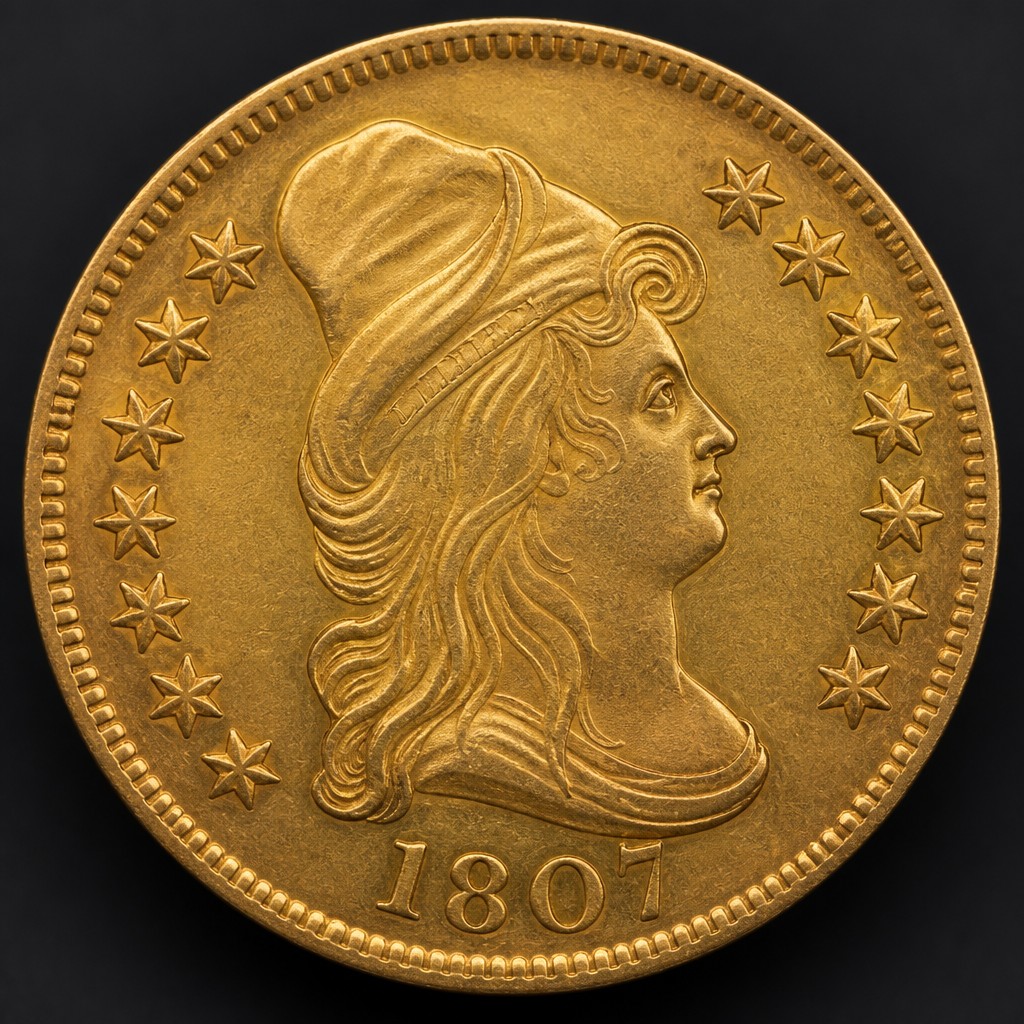
What It Is
The Capped Bust Right Half Eagle is the original design for the $5 gold half eagle, the first gold denomination struck by the United States Mint beginning in 1795. It was produced through 1807 before John Reich redesigned it facing the opposite direction.
Obverse Design
Liberty faces right, hair flowing from beneath a soft cap, LIBERTY inscribed above her head, stars flanking the portrait, and the date below.
Reverse Design
The Small Eagle variety (1795-1798) shows a perched eagle on a branch holding a wreath, with no shield or motto. The Heraldic Eagle variety (used alongside the Small Eagle in 1795 and exclusively from 1797-1807) shows a shield-bearing eagle with arrows, an olive branch, clouds and stars above, and a ribbon reading E PLURIBUS UNUM in its beak. UNITED STATES OF AMERICA surrounds the design.
Size, Weight, Metal & Edge
25mm diameter, 8.75 grams, .9167 fine gold, reeded edge. No numeral denomination appears on the coin.
Mint Marks
None. All examples were struck at the Philadelphia Mint, the only mint operating at the time.
Telling It Apart From Similar Coins
The half eagle's 25mm diameter is noticeably smaller than the Turban Head/Draped Bust eagle's 33mm, which helps confirm denomination when the designs look similar. Distinguish the Small Eagle from the Heraldic Eagle reverse the same way as on the eagle denomination: look for a shield and motto ribbon. Distinguish this type from the later Capped Draped Bust Left half eagle (1807 onward) by the direction Liberty faces — this type always faces right, while the 1807 redesign faces left.
Judging Condition at a Glance
Check the hair curls and cap ribbon on the obverse, and the eagle's wing and shield high points on the reverse, for the earliest wear.
Authenticity Red Flags
This early type is scarce and valuable in every grade, making it a target for cast counterfeits and altered dates. Confirm the coin's diameter and weight match the figures above precisely, and be wary of soft, indistinct design details that suggest a cast reproduction rather than a genuine struck coin.
Frequently asked questions
How is this different from the Capped Bust Half Eagle (1807-1812)?
This earlier type (1795-1807) shows Liberty facing right. The 1807-1812 redesign by John Reich turns her to face left with a more draped cap.
What are the two reverse types on this coin?
The Small Eagle (1795-1798) shows a simple perched eagle. The Heraldic Eagle (1795 and 1797-1807) shows a shield-bearing eagle based on the Great Seal, with a motto ribbon in its beak.
Does this coin show a mintmark?
No. It was struck only at the Philadelphia Mint, the sole U.S. mint operating during this period.
How can I tell it apart from an eagle of the same era?
Compare the diameter. This half eagle measures about 25mm, noticeably smaller than the 33mm Turban Head/Draped Bust eagle.