How to Identify the Capped Bust Half Dollar
A step-by-step look at the capped Liberty head, heraldic-eagle reverse, large silver size, the telltale lettered edge, and look-alikes to rule out.
Read the full Capped Bust Half Dollar encyclopedia entry →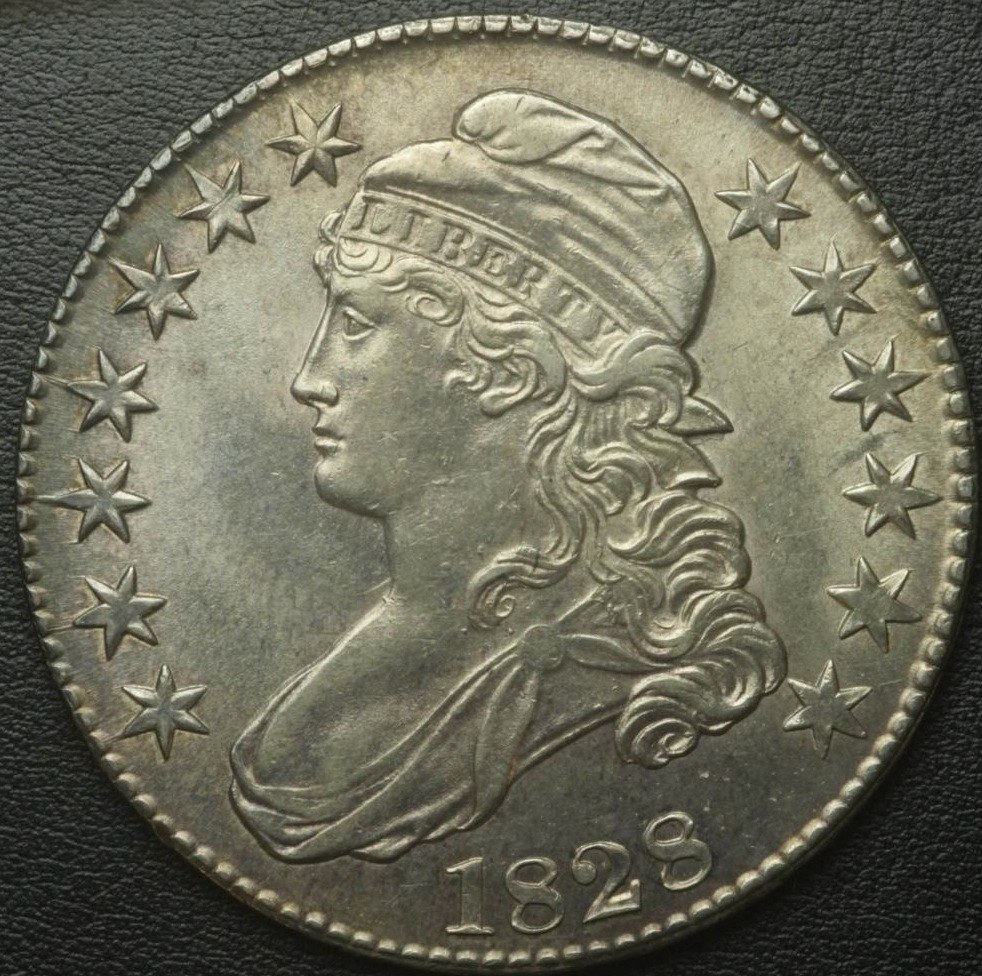
Start With the Obverse
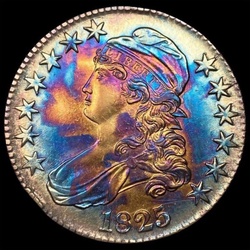
Look for a left-facing bust of Liberty wearing a soft cloth cap—the Phrygian or "liberty" cap—with the word "LIBERTY" across the band and loose curls at the neck. Thirteen stars ring the rim and the four-digit date sits at the bottom; our example reads 1822. The high points of Liberty's cap and hair, and the central star detail, are the first areas to wear, so their sharpness is a quick gauge of grade.
Check the Reverse Eagle
Turn the coin over and confirm a heraldic eagle with a striped shield on its breast, holding an olive branch in one talon and a bundle of arrows in the other. A ribbon overhead reads "E PLURIBUS UNUM," "UNITED STATES OF AMERICA" curves around the top, and the denomination appears below the eagle. On the 1807–1836 lettered-edge coins this reads "50 C."; on the later 1836–1839 reeded-edge coins it reads "HALF DOL." This shield-and-eagle reverse, not a wreath, marks the larger silver denominations.
Confirm Size, Metal, and the Lettered Edge
The Capped Bust half is a large coin: about 32–33 mm in diameter, roughly 13.4 grams, and 89.2% silver with a gray silver tone. The single most useful diagnostic for the 1807–1836 issues is the edge—turn the coin on its side and look for raised incused lettering, "FIFTY CENTS OR HALF A DOLLAR," rather than the vertical grooves of a reeded edge. An 1822 coin should show this lettered edge; a reeded edge on an 1822-dated half is a warning sign.
Mint Marks and Die Varieties
Expect no mint mark on an 1822 coin—Philadelphia struck the vast majority of the series and used none. Only the final 1838–1839 New Orleans reeded-edge halves carry an "O." Beyond date and mint, collectors identify these halves by die marriage using the Overton (O-) numbering system, matching tiny differences in star placement, date spacing, and letter positions. Cataloguing the exact variety can matter a great deal to value on scarcer marriages.
Watch for Look-Alikes and Fakes
Don't confuse the Capped Bust half with the Draped Bust half that preceded it (a different Liberty portrait and small-eagle or heraldic reverse) or with the Seated Liberty half that replaced it in 1839 (a full seated figure of Liberty). Because these are large, valuable silver coins, be alert to cast or altered fakes, added mint marks, and re-cut dates; a genuine lettered edge and correct weight are strong first tests. For any scarce date or high-grade example, rely on a reputable third-party grading service to confirm authenticity and variety.
Frequently asked questions
How do I confirm my coin is a half dollar and not a quarter?
Check size and edge. The Capped Bust half is large—about 32–33 mm and near 13.4 grams—with a lettered edge on the 1807–1836 issues and "50 C." below the eagle, whereas the smaller Capped Bust quarter reads "25 C."
What is the lettered edge and why does it matter?
The 1807–1836 halves have "FIFTY CENTS OR HALF A DOLLAR" stamped into the edge instead of grooves. It confirms the correct type and is a useful authenticity check, since many fakes get the edge wrong.
What is an Overton number?
It is the catalog reference for a specific die marriage in the Capped Bust series. Collectors use tiny differences in star, date, and letter placement to attribute each coin to an Overton (O-) variety, which can affect value.
Should I clean a Capped Bust Half Dollar?
No. Cleaning scratches the soft silver and removes original surfaces that collectors value. Examine it under good light and magnification, and leave any conservation to professionals.
Capped Bust Half Dollar identified by the community
Recent Capped Bust Half Dollar coins identified with Coin Identifier.