
How to Identify the Capped Bust Eagle
A collector's guide to recognizing the 1795–1804 $10 gold eagle by its capped Liberty bust, eagle reverses, size, and hand-cut die details.
Read the full Capped Bust Eagle encyclopedia entry →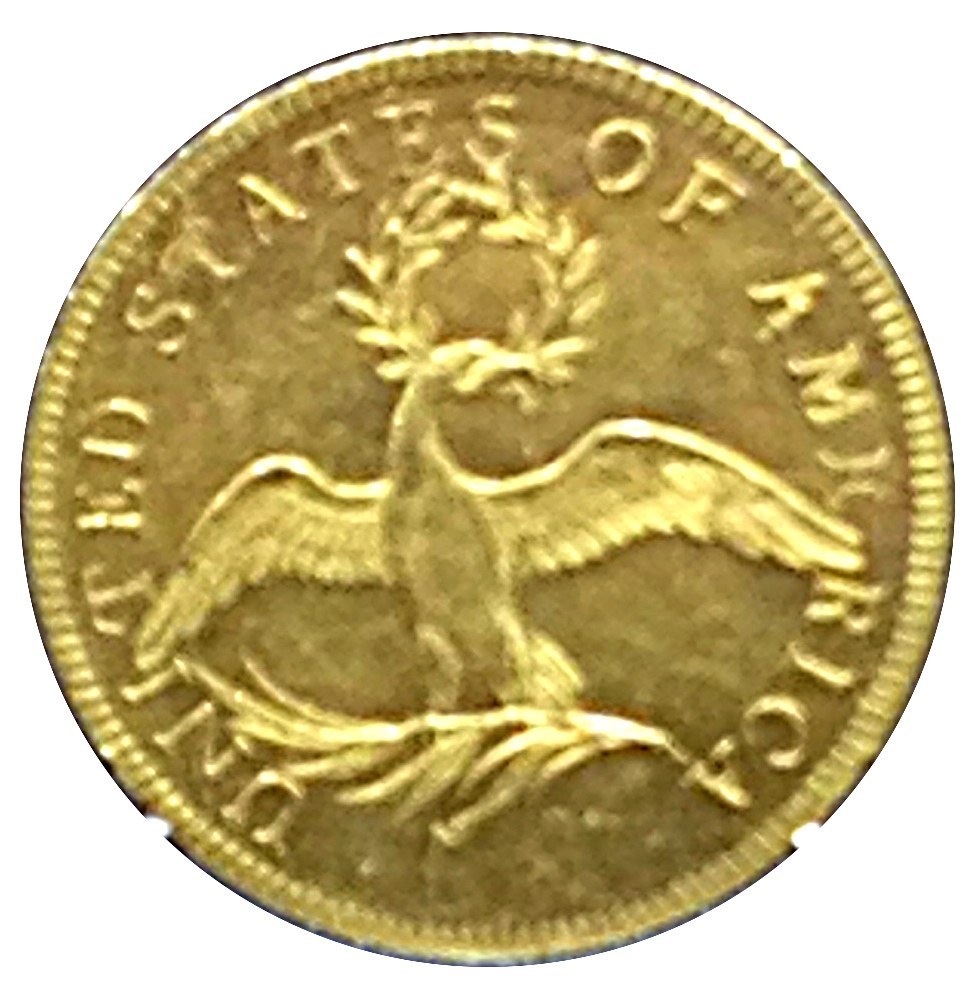
Start with the obverse portrait. A genuine Capped Bust Eagle shows Liberty facing right in a soft, draped cap, surrounded by stars with the date at the bottom. The "capped bust to right" orientation and the cap (sometimes called a turban) are the fastest way to separate this type from the later Coronet/Liberty Head eagles (1838 onward), which show Liberty in a beaded coronet reading LIBERTY, and from the Indian Head eagle (1907–1933).
Next, read the reverse. Two designs are correct for this type: the Small Eagle (1795–1797), a thin eagle perched on a palm branch holding a wreath, with no motto; and the Heraldic Eagle (1797–1804), a spread-winged eagle with a shield on its breast, an olive branch and arrows in the talons, and E PLURIBUS UNUM on a ribbon above. A shield-and-motto reverse like the one photographed is the heraldic style. Note that die varieties differ in the number of stars, arrows, and leaves, so leaf and star counts help attribute a specific variety rather than confirm the type.
Check the physical specifications. The coin should be about 33 mm across, weigh roughly 17.5 grams, and be struck in yellow gold of .9167 fineness with a reeded edge. There is no stated denomination and no mint mark anywhere on the coin; the only inscriptions are LIBERTY-era stars, the date, and UNITED STATES OF AMERICA. Weight and diameter that fall well outside these figures are a warning sign.
Be alert to authentication concerns. Early U.S. gold is heavily counterfeited, and cast copies, tooled surfaces, and altered dates exist. A particularly important caution: the standard 1795 eagle uses the Small Eagle reverse, so a piece dated 1795 that shows a shield-and-E PLURIBUS UNUM heraldic reverse warrants extra scrutiny and may be a replica, novelty, or altered piece. Given the high values involved, treat certification by a major third-party grading service as essential before buying or selling.
Finally, compare against look-alikes. Modern bullion, souvenir, and replica "1795 gold eagle" pieces are common; genuine coins show hand-cut lettering with minor irregularities, honest circulation wear, and correct weight, while replicas often have mushy details, seams, incorrect weight, or the word COPY.
Frequently asked questions
How do I tell a Capped Bust Eagle from a later Liberty Head eagle?
The Capped Bust type (1795–1804) shows Liberty in a soft cap with a plain star border, while the later Coronet/Liberty Head eagle (1838–1907) shows her in a beaded coronet inscribed LIBERTY.
Is a 1795-dated eagle with a shield reverse normal?
Standard 1795 eagles use the Small Eagle reverse without a shield or motto. A 1795 piece showing a heraldic shield reverse with E PLURIBUS UNUM should be examined carefully and authenticated, as it may be a replica or altered coin.
Where is the mint mark?
There is none. All Capped Bust Eagles were struck at Philadelphia, which used no mint mark.
Should I have one authenticated?
Yes. Because early gold eagles are valuable and frequently counterfeited, certification by a reputable third-party grading service is strongly advised before any transaction.