
How to Identify the Brutus & Plaetorius Denarius
A collector's guide to the EID MAR denarius: reading the Brutus portrait, the daggers-and-cap reverse, the legend, and the many forgeries to avoid.
Read the full Brutus & Plaetorius Denarius encyclopedia entry →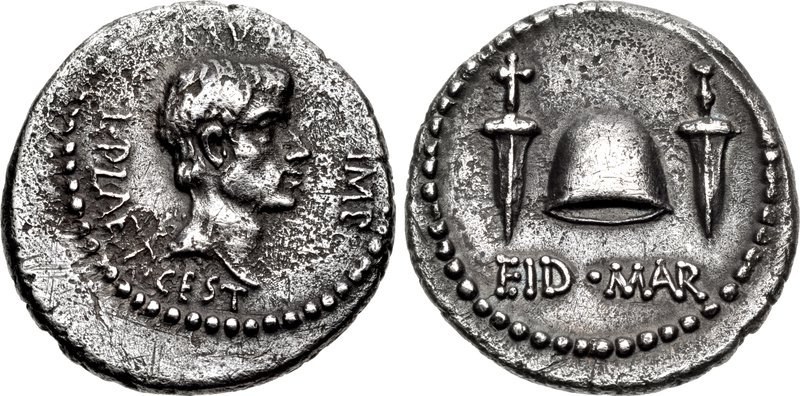
Start with the reverse, because it is the single most diagnostic element in all of ancient numismatics. A genuine Brutus denarius shows a Phrygian liberty cap, the pileus, standing between two upright daggers, with the legend EID MAR in the exergue below. No other Roman coin pairs these three motifs, so this combination is the definitive identifier of the type, catalogued as Crawford 508/3.
Then read the obverse. It carries a bare, right-facing portrait of Marcus Junius Brutus rather than a deity, with his name and the name of the moneyer L. Plaetorius Cestianus in abbreviated legends around the head. A living human portrait, not a god, is itself a strong clue, since only a handful of late-Republican issues show a contemporary Roman's face.
Confirm the physical format. This is a small, hand-struck silver denarius, broadly in the range of about 3.5 to 4 grams and roughly the diameter of a small modern coin, with a slightly irregular flan typical of ancient hammered coinage. Extremely rare gold aurei of the same type exist, but a base-metal or heavy, perfectly round piece is a warning sign rather than a genuine denarius.
Exercise extreme caution, because this is one of the most forged coins in the world. Beware of cast copies with soft detail and a faint mold seam, modern struck fakes and museum replicas, and tooled or altered coins. The overwhelming majority of pieces offered casually as EID MAR denarii are reproductions. Given the sums involved, never accept an example as authentic without die-study comparison, documented provenance, and evaluation by recognized ancient-coin experts or a major auction house.
Frequently asked questions
What single feature confirms this is an EID MAR denarius?
The reverse: a Phrygian liberty cap between two daggers with EID MAR beneath. This exact combination appears on no other Roman coin, so it is the definitive identifier of the type.
How do I tell a genuine coin from the many fakes?
Given its value, assume any example needs expert authentication. Genuine coins are hand-struck with slightly irregular flans and are frequently die-matched to known specimens; casts show grainy surfaces and seams, and replicas often look too uniform. Documented provenance is essential.
What should the coin weigh and measure?
It is a silver denarius, typically in the broad range of about 3.5 to 4 grams and roughly the diameter of a small modern coin. A piece well outside that weight, or made of base metal, is likely a fake or a different item.
Is a gold version possible?
Yes, but extremely rare. A small number of gold EID MAR aurei are known and are among the rarest ancient coins in existence. The great majority of genuine examples, including the type shown here, are silver denarii.