
How to Identify the Brutus EID MAR Denarius
A guide to the extremely rare EID MAR denarius struck by Brutus commemorating Caesar's assassination, covering its cap-and-daggers reverse, Brutus's portrait, and heavy forgery risk.
Read the full Brutus EID MAR Denarius encyclopedia entry →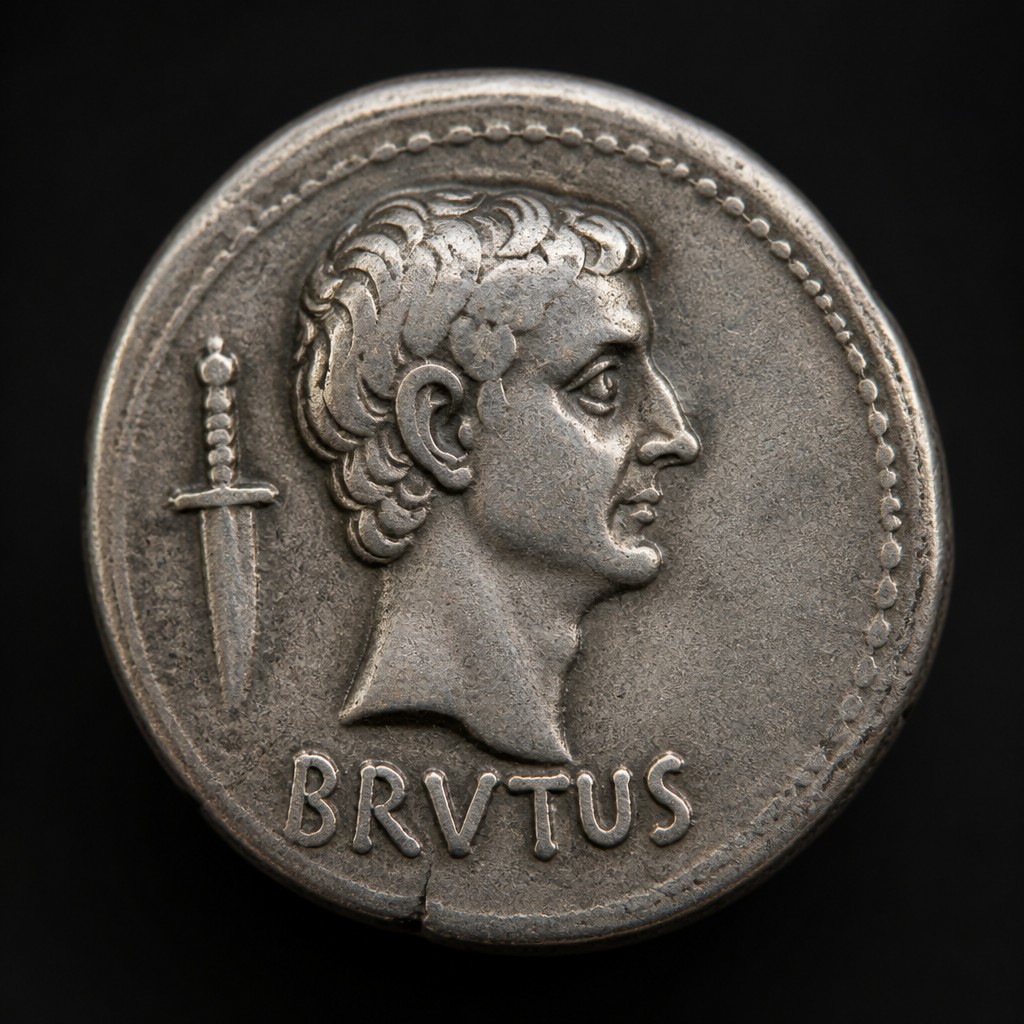
What This Coin Is
This is an extraordinarily rare silver denarius struck by Marcus Junius Brutus's military mint around 43-42 BC, explicitly commemorating the assassination of Julius Caesar on the Ides of March, 44 BC. It is among the most famous and historically loaded coins from antiquity.
Obverse Design
The obverse shows a bare head of Brutus facing right, a realistic contemporary portrait. The legend reads BRVT IMP, meaning Brutus, Imperator, along with L PLAET CEST or a similar form naming the moneyer Lucius Plaetorius Cestianus, who oversaw the issue.
Reverse Design
The famous and unmistakable design shows a pileus, the soft conical cap traditionally given to freed slaves and used as a symbol of liberty, placed between two daggers, with the legend EID MAR (Ides of March) below, directly referencing the date and manner of Caesar's death.
Size, Weight, and Metal
These denarii measure roughly 18-19mm across and weigh around 3.8-3.9 grams, consistent with the late Republican military-issue denarius standard, struck at a military campaign mint rather than in Rome itself.
Where This Was Struck
It was produced by a traveling military mint accompanying Brutus's forces in the eastern provinces, associated with the region of modern Greece or Asia Minor, in the run-up to the Battle of Philippi, rather than at a fixed civic mint with a conventional mint mark system.
Telling It Apart From Similar Coins
No other genuine Roman coin combines a living conspirator's portrait with an explicit reference to a specific murder date, making the design itself highly distinctive. That same distinctiveness, however, makes it one of the most commonly counterfeited ancient coin types.
Grading at a Glance
Given its extreme rarity, most known genuine specimens are individually documented in scholarly and auction literature. Check the pileus and dagger details for sharpness, and confirm the EID MAR legend's letter spacing and style match published genuine dies.
Authenticity Red Flags
Given how few genuine examples exist and how iconic the design is, extreme caution is warranted. Cast copies, modern struck fantasy pieces, and old plated forgeries are all in circulation. Genuine examples are exhaustively documented, so any example lacking a clear, traceable ownership and publication history should be treated with significant skepticism.
Frequently asked questions
What do the two daggers and the cap represent?
The daggers reference the weapons used to kill Caesar, while the pileus, a freedman's cap, symbolizes the liberty Brutus and his co-conspirators claimed to have restored to Rome by ending Caesar's rule.
What does EID MAR stand for?
It abbreviates Eidibus Martiis, Latin for 'on the Ides of March,' the date, March 15, 44 BC, on which Caesar was assassinated.
Where was this coin minted?
It was struck by a military field mint traveling with Brutus's army in the eastern Mediterranean in the year or two before the Battle of Philippi, rather than at a fixed city mint.
Why should I be especially cautious with this coin type?
It is one of the most famous and valuable ancient coin types in existence, and its instantly recognizable design has made it a frequent target for forgers for centuries, so any example should be checked very carefully against documented genuine specimens.