
How to Identify the Brutus Aureus
A collector's guide to recognizing the gold EID MAR coin of Brutus by its portrait, daggers-and-cap reverse, metal, and the many copies to beware of.
Read the full Brutus Aureus encyclopedia entry →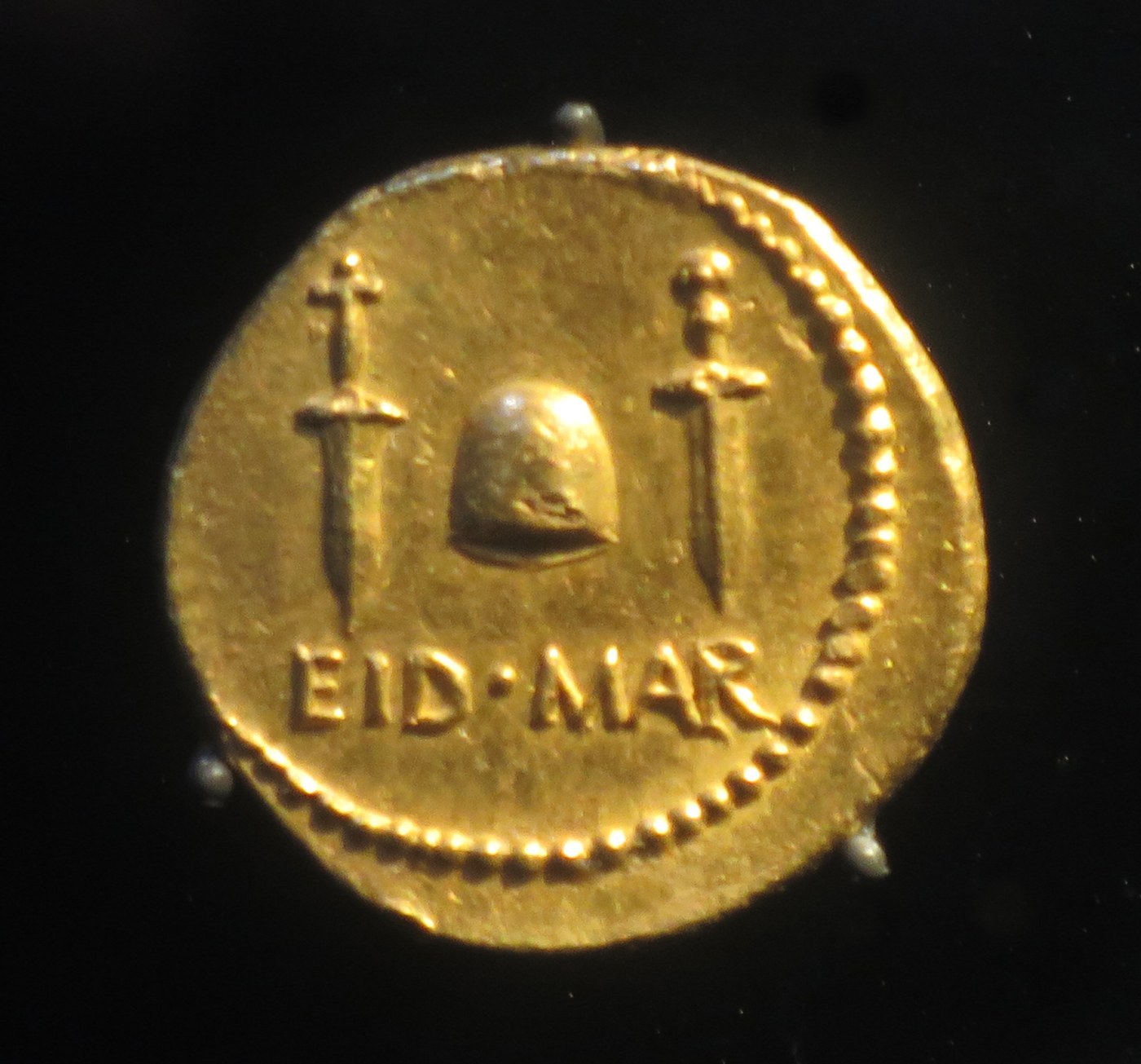
Begin with the reverse, which is the signature of the type. Look for the legend EID MAR spelled out in Roman capitals, positioned below a soft rounded cap (the pileus, or cap of liberty) that is flanked by two downward-pointing daggers or short swords. The two blades are frequently rendered as slightly different shapes, with distinct hilts. No other Roman coin combines this exact cap-and-daggers device with the EID MAR inscription.
Turn to the obverse and confirm a right-facing male portrait, the head of Brutus, typically bare or lightly diademed, ringed by a legend giving his name and a title. A genuine ancient piece will show naturalistic late-Republican portrait style and hand-cut lettering rather than the crisp, uniform look of machine-made modern strikes.
Confirm the metal and size. The aureus is the gold denomination and is small, thick, and noticeably heavy for its diameter, on the order of roughly eight grams. This is the single most important separation, because the same EID MAR design exists as a silver denarius, and a heavier gold flan is the mark of the far rarer aureus. Weigh and measure any candidate rather than judging color alone, since plated and gilt fakes are common.
Be extremely cautious with look-alikes and authentication. EID MAR is one of the most reproduced designs in the world, sold as museum replicas, souvenir tokens, and outright forgeries in both silver and gold. Genuine gold aurei number in the single digits, so the realistic expectation for any unattributed piece is that it is a copy. Do not rely on eye appeal: a real specimen carries documented provenance and grading from a recognized ancient-coin authority, and any gold EID MAR coin should be submitted to expert authentication before it is treated as genuine.
Frequently asked questions
What is the fastest way to recognize this coin?
The reverse: the letters EID MAR under a rounded liberty cap set between two daggers. That specific combination identifies the type. The obverse then shows a right-facing portrait of Brutus.
How do I tell the gold aureus from the silver denarius?
They share the identical design, so it comes down to metal, weight, and size. The aureus is gold and is small but heavy, around eight grams. A lighter silver piece of the same design is the far more common denarius.
Why should I assume an EID MAR coin is fake?
Because genuine gold examples are almost nonexistent and the design is endlessly copied as replicas and forgeries. Statistically, an unattributed piece is a copy. Only professional authentication and a documented pedigree can prove otherwise.
Are there mint marks to look for?
These were struck at traveling military mints, not a fixed civic mint, so identification relies on the portrait, the EID MAR reverse, and the moneyer or title in the legend rather than a mint mark. Let an expert read the legends on any suspected genuine piece.