
How to Identify the Brunswick 1/3 Thaler
Confirm a Brunswick 1/3 thaler by its leaping Saxon steed obverse, standing saint-and-cross reverse, silver fractional-thaler size, and 17th-century strike.
Read the full Brunswick 1/3 Thaler encyclopedia entry →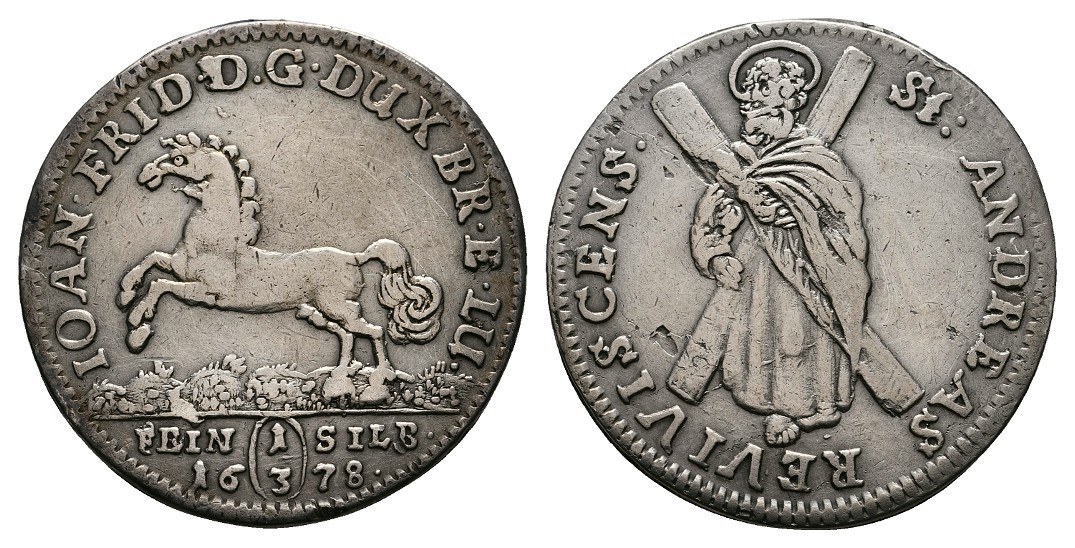
Start with the two main devices. The defining pair is a rearing, leaping horse facing left on one side — the Saxon steed of the Brunswick dukes — and a standing saintly figure holding a cross in a flowing gown on the other. If a silver coin shows this combination, you are very likely looking at a Welf/Brunswick issue rather than another German state.
Read the legend and date. Look around the rim for a Latin legend and the year; the example here is dated 1678. The denomination is a 1/3 thaler (Drittelthaler), so expect a mid-sized silver piece — clearly smaller than a full thaler but larger than minor coins. A value mark or fraction may appear near the reverse figure.
Check size and metal. These are silver coins, so a genuine piece should be non-magnetic and show a natural silver tone or old grey toning. Weigh and measure it against published specifications for the specific issue; a coin that is magnetic, distinctly under- or over-weight, or has a glassy cast surface points to a replica.
Rule out look-alikes. Many German states used similar saints and heraldic animals, and Brunswick itself split into several lines (Wolfenbüttel, Lüneburg-Celle and others) with related designs. Do not identify from the horse alone — confirm the standing saint reverse, the one-third-thaler size, and the legend naming the Brunswick ruler and mint before settling on an attribution.
Authenticate with care. Expect hand-struck characteristics from the 1600s: slightly irregular flans, minor striking weakness, and period lettering. Be wary of cast copies with soft detail, seams on the edge, or lettering that looks too crisp and uniform. For any higher-value example, compare against reference images of the exact date and line, and seek a specialist or third-party opinion.
Frequently asked questions
How do I tell this from another German-states coin?
The leaping Saxon steed points specifically to Brunswick-Lüneburg and the House of Welf. Confirm it alongside the standing saint reverse, the legend, and the 1/3-thaler size rather than relying on any single feature.
What quick checks help spot a fake?
Confirm the coin is silver and non-magnetic, weigh and measure it against the known specifications, and inspect the edge and surfaces for cast seams or soft, blurry detail that would indicate a copy.
Why do Brunswick 1/3 thalers vary so much?
The Brunswick lands were divided among several Welf lines using different mints and legends over many years, so dates, ruler names, and small design details differ from issue to issue and affect both attribution and value.