
How to Identify the British Silver Threepence
Collector checks for the tiny Victorian silver 3d: portrait, legend, size and metal, reverse design, and telling it from the later brass threepence.
Read the full British Silver Threepence encyclopedia entry →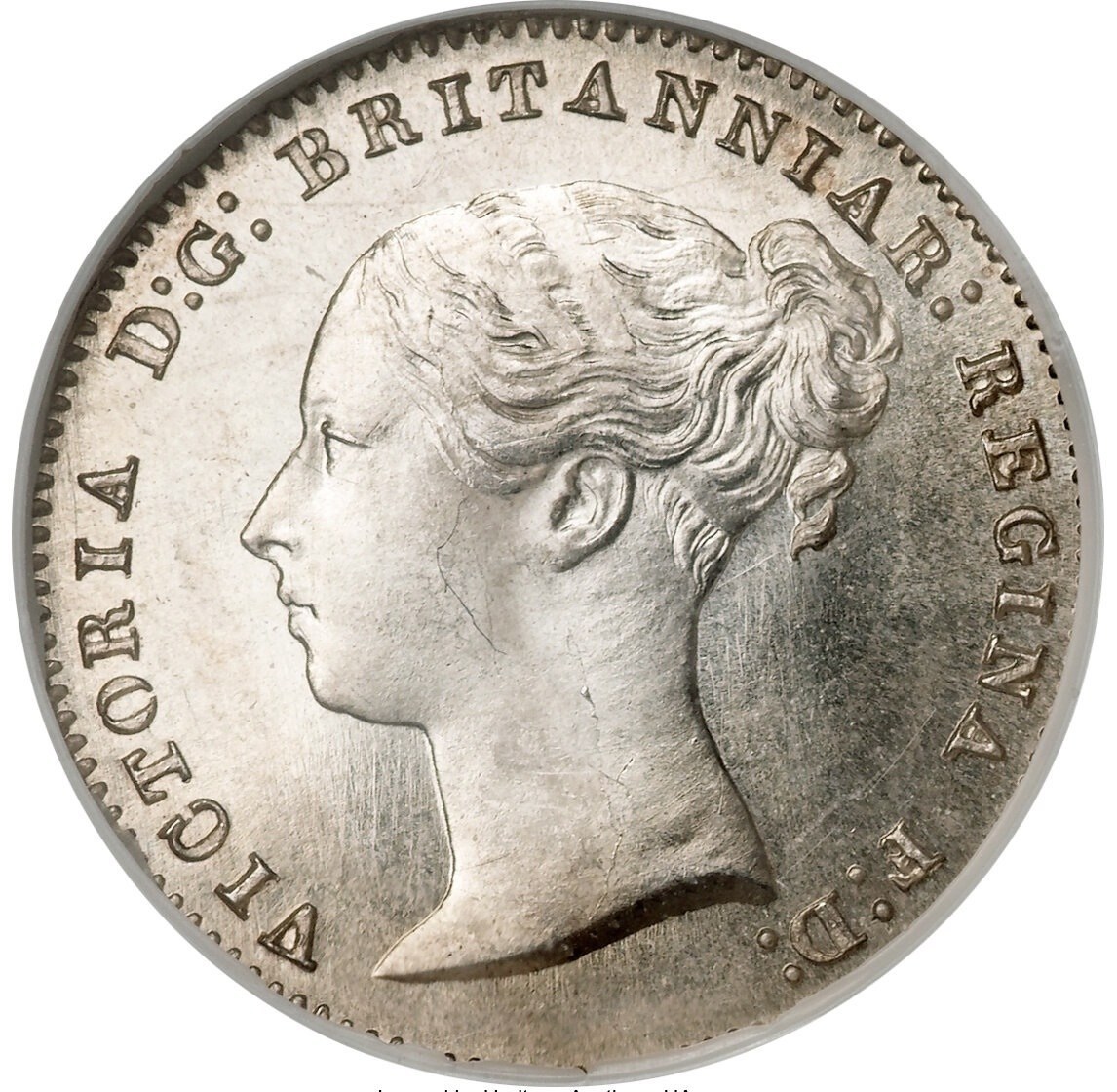
Begin with size and colour, because they rule out the most common confusion at a glance. A silver threepence is tiny, about 16 mm across and only around 1.4 grams, and it is white-silver in tone. If your coin is large, thick, twelve-sided, and yellow, it is the later nickel-brass threepence, not this silver type.
Read the obverse. The type shown here carries a young, left-facing Queen Victoria with an abbreviated Latin legend; on worn coins you may only make out the ending ...BRITANNIA, but the complete legend is VICTORIA D G BRITANNIAR REGINA F D. A different portrait style or a king's name points to a later reign or a different denomination entirely, so match the bust and legend together.
Turn the coin over for the date and value. On Victorian young-head silver threepences the reverse is typically an ornate crowned numeral 3 in a wreath with the date; this coin reads 1858. Because the reverse is not in the photo here, confirm that design and date before finalising the attribution, and be aware the portrait was later changed to the Jubilee and Old Head types.
Cross-check the metal. Sterling threepences are non-magnetic and, on early Victorian coins, 0.925 silver; issues from 1920 are a 50% silver alloy that can tone differently. A jeweller's scale is useful, since the coin is so light that even small wear or damage is easy to spot against the roughly 1.4-gram standard.
Watch two pitfalls. First, currency and Maundy threepences of the same year share the design and are routinely mixed up; a specialist can separate them by strike quality and provenance. Second, the coin's small size makes worn dates and legends hard to read, so use good magnification, and for any coin you believe is scarce or high grade, get a second opinion from a reputable dealer before relying on the identification.
Frequently asked questions
How do I tell the silver threepence from the brass one?
By size, shape, and colour. The silver threepence is small, round, thin, and white-silver; the later threepence is large, thick, twelve-sided, and yellow brass.
Where is the date on this coin?
On the reverse. The Victorian young-head silver threepence normally shows a crowned numeral 3 in a wreath with the date, here 1858, rather than a spelled-out value.
What should a genuine silver threepence weigh?
About 1.4 grams at roughly 16 mm across, struck in sterling (0.925) silver on early Victorian coins and non-magnetic. Large deviations or a magnetic response indicate a different coin or a fake.
Could a small silver threepence be a Maundy coin?
Yes. The same design was used for ceremonial Maundy threepences of the same year, so a small silver 3d may be either a currency or a Maundy piece; an expert can distinguish them.