How to Identify the British India Silver Rupee (Victoria Empress)
A silver rupee struck for British India after 1877 showing Queen Victoria as 'Empress of India,' identified by her veiled bust obverse and a floral wreath framing the denomination on the reverse.
Read the full British India Silver Rupee (Victoria Empress) encyclopedia entry →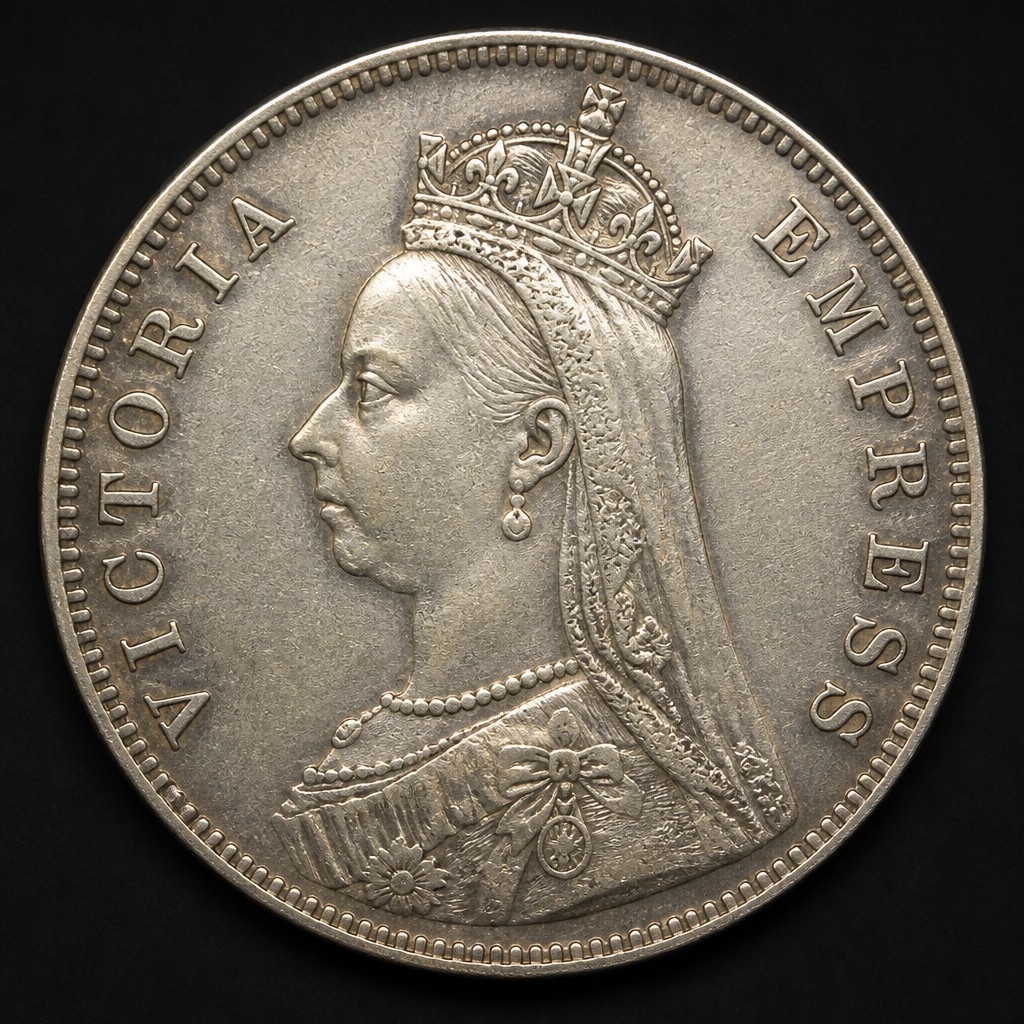
What This Coin Is
The Victoria Empress rupee was struck for British India after Queen Victoria was formally proclaimed Empress of India in 1876. It replaced earlier "Victoria Queen" rupees and circulated widely across the subcontinent into the early twentieth century, remaining legal tender for years afterward. It is one of the most commonly encountered pieces of colonial-era Indian silver.
Obverse Design
The obverse shows a left-facing, veiled and crowned bust of Queen Victoria wearing a widow's veil and small diadem, a portrait style adopted after her husband Prince Albert's death. The legend around the rim reads "VICTORIA EMPRESS," distinguishing this type from the earlier "VICTORIA QUEEN" rupees that lack the imperial title.
Reverse Design
The reverse is dominated by a large "ONE RUPEE" denomination inside a decorative wreath, with the date below. Around the rim, the value and country name are repeated in multiple scripts used across British India, including Persian/Urdu, Bengali, Telugu, and Devanagari, reflecting the coin's use across many linguistic regions.
Size, Weight, Metal, and Edge
The rupee is struck in .917 fine silver, weighs approximately 11.66 grams, and measures about 30.5mm in diameter. The edge is reeded (milled).
Mint Marks and Where to Find Them
Coins struck at the Calcutta mint generally carry no mintmark, while Bombay-struck coins show a small "B" below the bust's truncation, sometimes accompanied by a tiny dot or diamond privy mark used to track die pairs. These marks are small and best viewed with magnification near the base of the neck.
Telling It Apart from Similar Coins
Confusion most often arises with the earlier "Victoria Queen" rupee (legend reads "QUEEN" instead of "EMPRESS") and with later George V or George VI rupees, which show a male portrait. Indian princely state rupees of similar size may also carry a Victoria-style bust but will show a different local legend or symbol rather than the standard British India reverse wreath.
Grading at a Glance
Well-preserved examples show sharp definition in Victoria's hair curls and veil folds, and the wreath leaves on the reverse remain crisp. Circulated coins typically show flattening across the highest points of the portrait and softened wreath detail; heavily worn pieces may have the date partially obscured.
Authenticity Red Flags
Because these rupees were struck in large numbers and silver value fluctuates, cast counterfeits exist, identifiable by a grainy or pitted surface, a seam line around the edge, or noticeably soft, mushy lettering compared to the crisp strike of a genuine machine-struck coin. Be cautious of pieces with an unusually light weight or a magnetic response, since silver is not magnetic.
Frequently asked questions
What does 'Victoria Empress' mean on the coin?
It refers to Queen Victoria's title as Empress of India, adopted in 1876, and distinguishes this later rupee type from earlier 'Victoria Queen' rupees.
How can I tell Calcutta from Bombay mint rupees?
Bombay coins usually show a small 'B' mintmark below the bust; Calcutta coins typically have no mintmark at all.
Is this coin made of pure silver?
No, it is .917 fine silver (sterling standard), not pure silver, alloyed with copper for durability.
Why are there multiple scripts on the reverse?
British India covered many language regions, so the denomination was repeated in scripts like Persian, Bengali, and Telugu for wide legibility.
British India Silver Rupee (Victoria Empress) identified by the community
Recent British India Silver Rupee (Victoria Empress) coins identified with Coin Identifier.