
How to Identify the British Columbia Centennial Dollar
A collector's walkthrough for confirming the 1958 totem-pole dollar by its design, dates, size, and silver content.
Read the full British Columbia Centennial Dollar encyclopedia entry →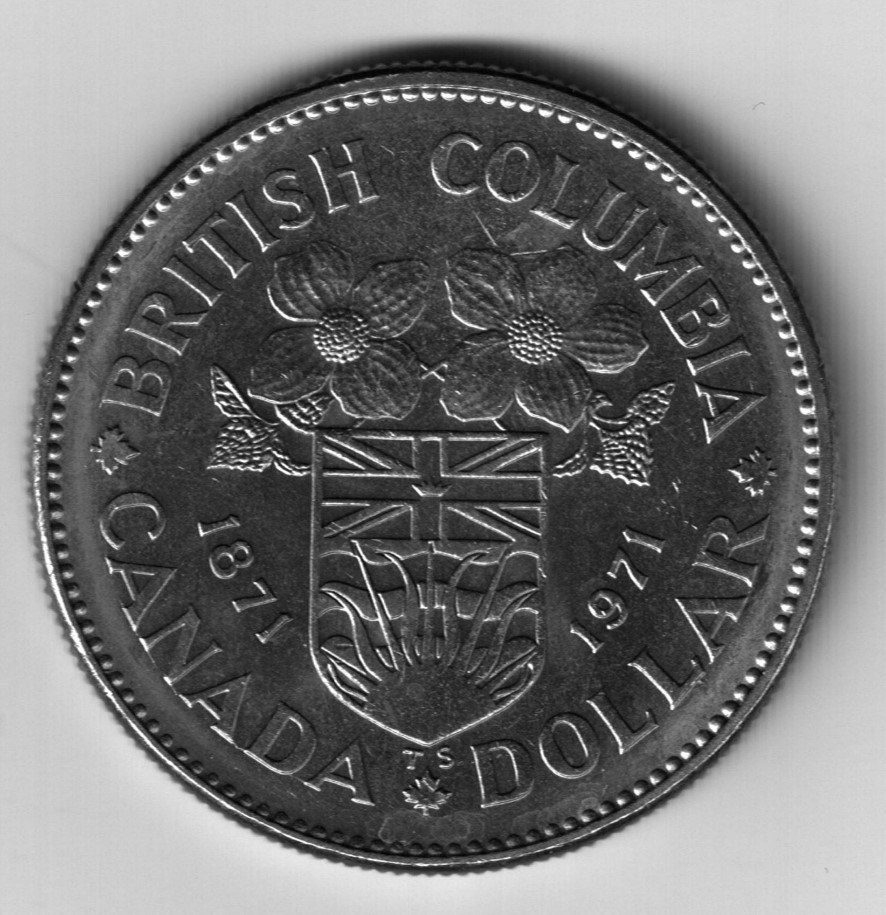
Start with the design that gives the coin away: a single upright totem pole in Pacific Northwest Coast style. No other regular Canadian silver dollar carries a totem pole, so this motif alone points strongly to the 1958 British Columbia commemorative issue. Confirm it by reading the two dates that flank the pole—1858 and 1958—which mark the province's centennial and are unique to this one year.
Check the other side to confirm the reign and era. The official obverse shows Queen Elizabeth II facing right in a laureate bust with the legend ELIZABETH II DEI GRATIA REGINA. This is the young-Queen portrait used on Canadian coinage of the 1950s; a different or older-looking portrait would mean a different coin or a different date entirely.
Measure and weigh it. A genuine example is about 36 mm across, roughly 23 grams, has a reeded edge, and is struck in .800 silver. A silver 'ring' when tapped, the correct diameter, and the reeded edge together rule out most base-metal souvenir medals or novelty pieces that borrow totem imagery. There is no mint mark to look for—all were made at the Royal Canadian Mint.
Watch for look-alikes among other Canadian commemorative dollars. The province issued a separate British Columbia dollar in 1971 for its entry into Confederation, but that coin shows the provincial arms and dogwood flowers with the dates 1871–1971, not a totem pole. Other one-year Canadian dollars (such as the 1964 Charlottetown or 1967 Confederation issues) use entirely different designs. The totem pole plus 1858–1958 is the combination that fixes this coin as the 1958 issue.
Because the coin is common and mostly valued for its silver, authentication concerns are modest. The bigger factors are condition and originality: inspect for cleaning (unnatural brightness or fine hairlines), rim knocks, and heavy contact marks, since an original, lustrous example is worth far more than a cleaned or damaged one of the same date.
Frequently asked questions
How do I tell the 1958 dollar from the 1971 British Columbia dollar?
Look at the design and dates. The 1958 coin shows a totem pole with the dates 1858–1958. The 1971 coin shows the provincial coat of arms with dogwood blossoms and the dates 1871–1971.
Does the coin have a mint mark?
No. Canadian dollars of this era were struck at the Royal Canadian Mint without a mint mark, so identification relies on the totem-pole design, the 1858–1958 dates, and the Elizabeth II obverse.
How can I confirm it is silver and not a replica?
Check the specifications: about 36 mm diameter, roughly 23 grams, a reeded edge, and .800 silver content. Correct size and weight together, plus the sharp original detail of a struck coin, distinguish a genuine dollar from a plated or base-metal copy.