
How to Identify the Bremen Thaler
A silver thaler from the Free Hanseatic City of Bremen, identified by its distinctive key emblem and civic Latin legends rather than a monarch's portrait.
Read the full Bremen Thaler encyclopedia entry →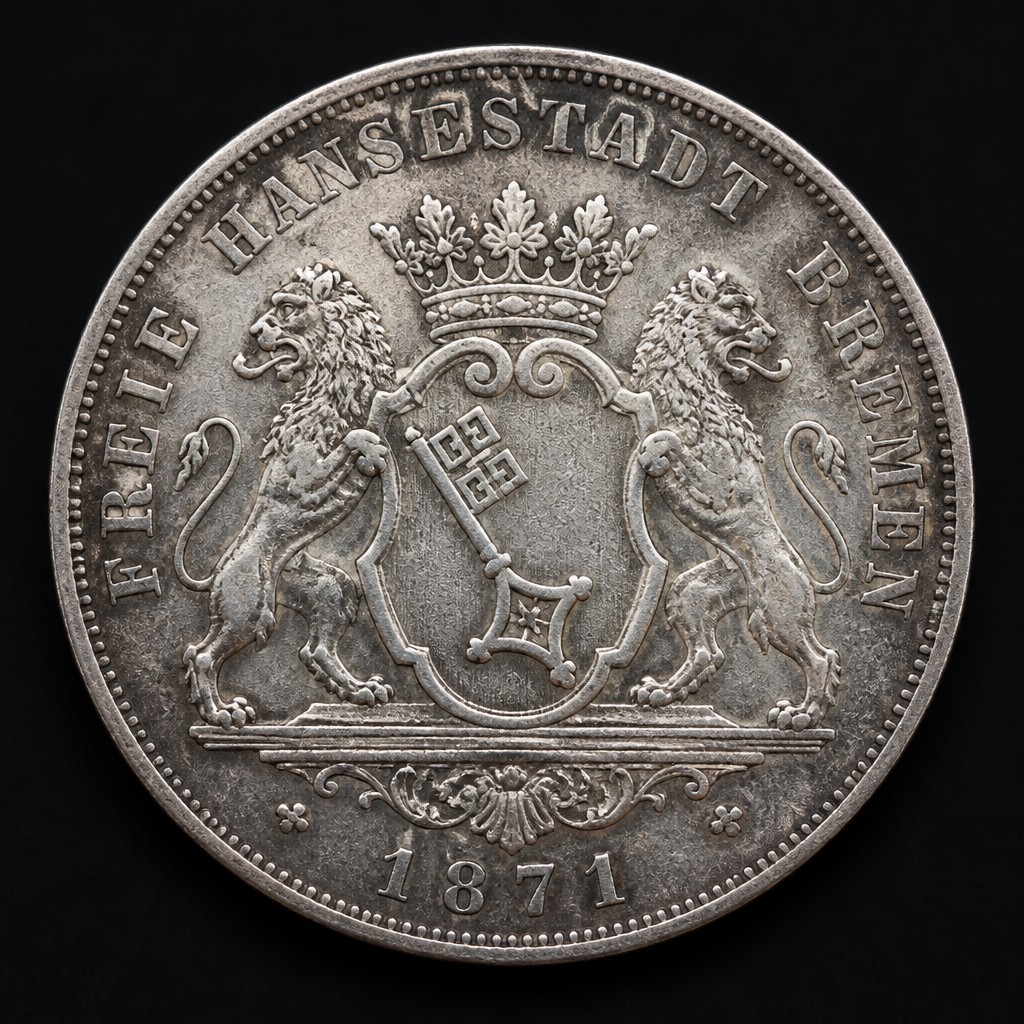
What It Is
The Bremen Thaler is a silver coin issued by the Free Hanseatic City of Bremen, a self-governing merchant city-state within the Holy Roman Empire and later the German Confederation and German Empire. Like its fellow Hanseatic free cities, Bremen's coinage reflects its civic rather than royal governance, using heraldic city symbols in place of a ruler's portrait. Despite its comparatively small size, Bremen's status as a major North Sea trading port meant its coinage needed to be trusted well beyond the city's own borders, which is part of why its silver content and design remained consistent over long stretches of time.
Obverse Design and Inscriptions
The obverse typically shows Bremen's civic emblem, most notably a large ornate key (referencing the city's patron saint, Saint Peter, who is traditionally depicted holding the keys of heaven), sometimes combined with an eagle, along with a Latin legend identifying the free city, such as "MON NOVA CIVITATIS BREMENSIS" (new coin of the city of Bremen).
Reverse Design and Inscriptions
The reverse commonly displays the denomination within a wreath or decorative border, along with the date, and on many types an additional heraldic element such as an imperial eagle reflecting Bremen's historical Holy Roman Empire status.
Size, Weight, Metal, and Edge
Bremen thalers generally follow standard German thaler weight conventions for their era, typically in the range of 22-33 grams at .750-.900 fine silver depending on the specific monetary standard in force, with a diameter usually between 33-41 mm. The edge can be plain, reeded, or lettered depending on the type and period.
Mint Marks and Where to Find Them
As an independent city minting authority, Bremen coins do not use a branch-mint letter; instead, a small mint master's initial or privy mark near the date or base of the design helps pinpoint the specific striking period.
Telling It Apart from Similar Coins
Bremen Thalers are distinguished from royal German thalers by the absence of any monarch's portrait, and from other Hanseatic city thalers by their unique key emblem, which differs from Hamburg's castle/gate design or Lübeck's own distinctive civic symbol. Always check the specific heraldic device and the city name spelled out in the Latin legend to confirm the issuing city.
Judging Condition at a Glance
Examine the fine detail of the key's ornate handle (the "bit" and "ward" patterns) and any accompanying eagle feather detail, since these are the highest-relief elements most prone to wear. A well-preserved coin shows a crisp, clearly defined key outline, while a worn example shows a smoothed, indistinct emblem with softened edges.
Authenticity Red Flags
Be cautious of coins with an incorrect weight or diameter for the claimed thaler standard, a blurred or poorly defined key emblem, or a surface with a grainy, pitted texture and a visible seam line, both of which point to a cast reproduction rather than a genuine struck coin.
Frequently asked questions
What does the key symbol on the Bremen Thaler represent?
It references Saint Peter, the city's patron saint, traditionally depicted holding the keys of heaven, and serves as Bremen's civic emblem on its coinage.
How do I tell a Bremen Thaler from a Hamburg Thaler?
Bremen's emblem is an ornate key, while Hamburg uses a castle or city gate with three towers; the city name in the Latin legend also confirms the issuer.
Why is there no ruler's portrait on this coin?
Bremen was a self-governing Hanseatic free city rather than a monarchy, so its thalers use civic heraldry instead of a king's likeness.
What silver content and weight should genuine examples have?
Typically .750-.900 fine silver, weighing between about 22 and 33 grams depending on the era's monetary standard.