
How to Identify the Brazilian 6400 Reis Gold (Peça)
Known colloquially as the 'Peça' (piece), the colonial Brazilian gold 6400 réis was a substantial gold coin bearing the Portuguese crowned arms, widely used across the colonial economy for large transactions.
Read the full Brazilian 6400 Reis Gold (Peça) encyclopedia entry →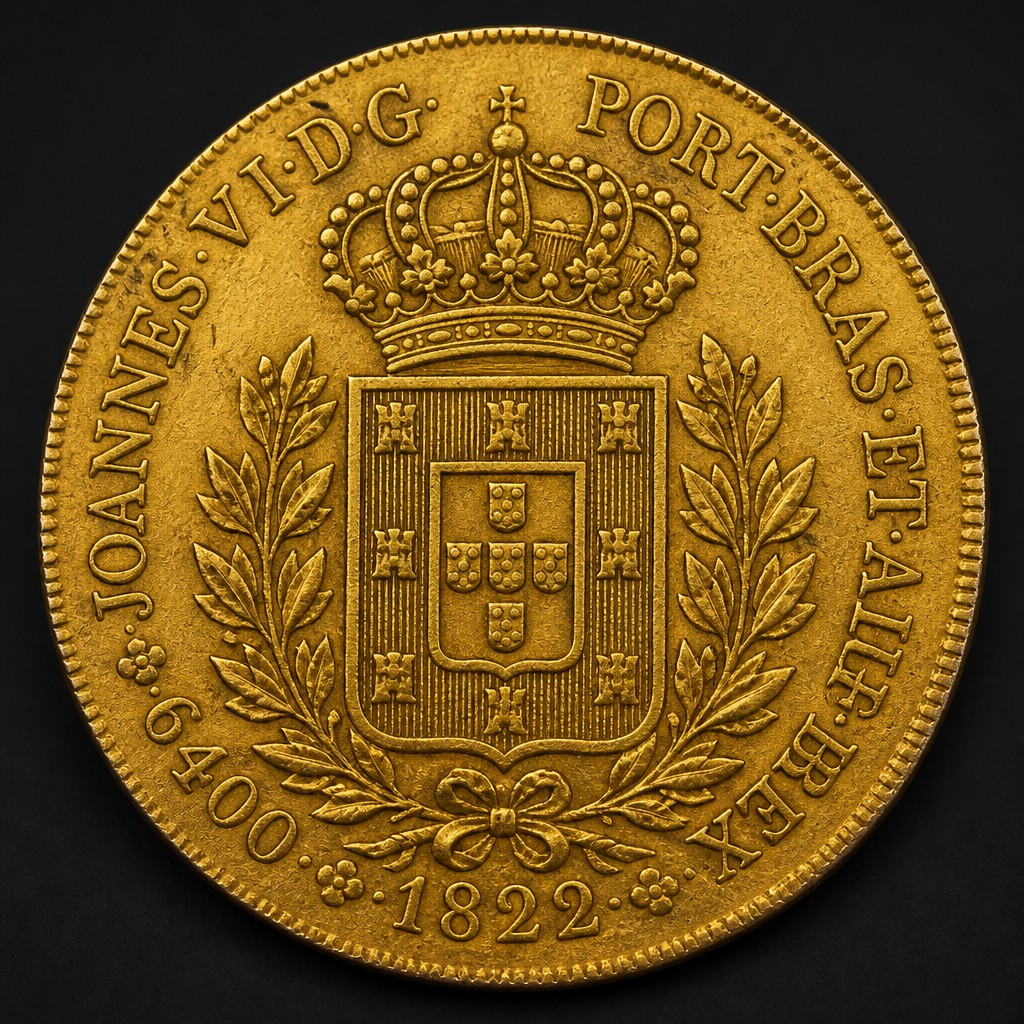
What the Coin Is
The 6400 réis gold coin, nicknamed the "Peça," was struck during the colonial period of Brazil under Portuguese rule, serving as one of the era's principal high-value gold coins. It circulated extensively both within Brazil and in Portugal itself, reflecting the wealth generated by Brazilian gold mining regions such as Minas Gerais.
Obverse Design & Inscriptions
The obverse typically bears the crowned Portuguese royal arms within an ornate shield, surrounded by a Latin legend naming the reigning Portuguese monarch (such as João V, José I, or Maria I/Pedro III, depending on the date) along with the royal title.
Reverse Design & Inscriptions
The reverse commonly shows a cross design (often a Maltese or similar patterned cross) or an armillary sphere motif associated with Portuguese royal and maritime symbolism, along with the mint location and the coin's denomination or an equivalent indicator.
Size, Weight, Metal, Edge
This coin was struck in high-fineness gold, weighing approximately 14.3 grams with a diameter around 33 mm, making it a substantial and visually impressive gold piece for its time. The edge may be plain or lightly patterned depending on the specific mint and period.
Mint Marks & Where to Find Them
Look for a small letter mintmark such as "R" for Rio de Janeiro or "B" for Bahia, generally placed near the base of the shield or beneath the crown, identifying which colonial Brazilian mint struck the piece.
Telling It Apart from Similar Coins
The 6400 réis should not be confused with smaller Brazilian colonial gold denominations (such as 1600 or 3200 réis, which share similar designs at smaller sizes) or with contemporary Portuguese mainland gold coinage. Compare diameter and weight carefully, since the design themes are similar across the denomination family.
Judging Condition at a Glance
Examine the crown's arches and the fine details of the shield's quarters for wear, as these high points smooth out first with handling. A well-struck, lightly worn coin shows crisp lettering around the rim and sharp definition in the cross or armillary sphere on the reverse.
Authenticity Red Flags
As a historically significant and valuable gold issue, this coin is a common target for counterfeits and later-made replicas. Check for correct weight and diameter, a properly colored deep-yellow gold tone, and edge consistency; be wary of soft, indistinct details that suggest a cast copy rather than an originally struck coin.
Frequently asked questions
Why is it called the 'Peça'?
'Peça' simply means 'piece' in Portuguese, a colloquial name used for this substantial gold coin during Brazil's colonial period.
What time period is this coin from?
It dates to the Portuguese colonial era in Brazil, spanning much of the 18th century into the early 19th century.
How much does the coin weigh?
It weighs approximately 14.3 grams, struck in high-fineness gold with a diameter of about 33 mm.
What's the difference between this and a 3200 réis gold coin?
The 3200 réis shares a similar design theme but is smaller in both weight and diameter, roughly half the size of the 6400 réis.
Where should I check for the mintmark?
Look near the base of the shield or beneath the crown for a small letter such as 'R' (Rio de Janeiro) or 'B' (Bahia).