
How to Identify the Braided Hair Large Cent
Confirm a Braided Hair large cent by its coronet-and-braid Liberty, laurel-wreath ONE CENT reverse, copper metal, and quarter-plus size.
Read the full Braided Hair Large Cent encyclopedia entry →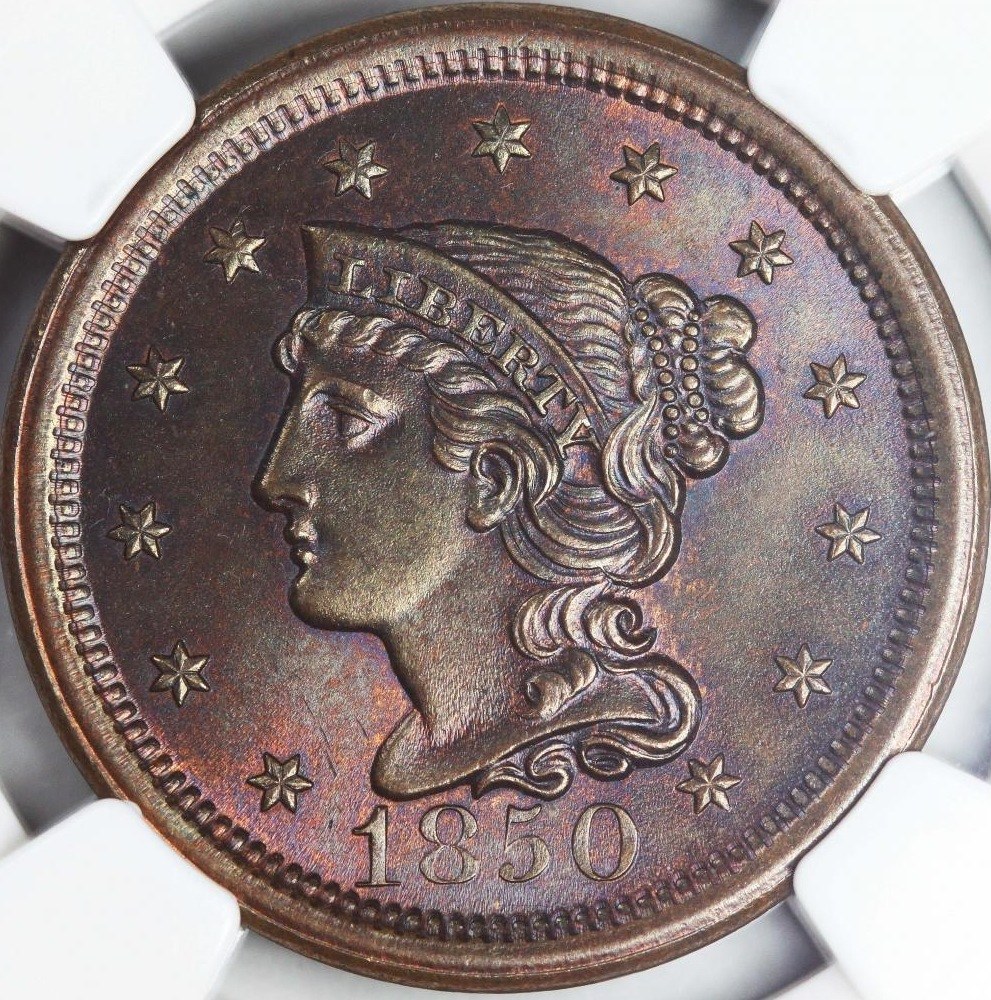
Start with the portrait. A genuine Braided Hair large cent shows Liberty facing right in a beaded coronet inscribed LIBERTY, her hair pulled into a tight braid, ringed by thirteen stars with the date beneath. If the head instead wears a Liberty cap, a flowing loose hairstyle, or a plain coronet without the braid, you are looking at an earlier large-cent type, not this one.
Check the reverse next. It should read ONE CENT in two lines inside a closed laurel wreath, with UNITED STATES OF AMERICA around the rim. Compare this to small cents: Flying Eagle and Indian Head cents that begin in 1857 are much smaller and use entirely different designs. The wreath style and legend placement help separate the Braided Hair cent from the earlier Coronet and Classic Head coppers.
Use size and metal as a hard filter. This is a solid-copper coin about 27–29 mm in diameter and heavy in hand—clearly larger than any modern cent. Hold it beside a U.S. quarter: the large cent is close to or larger than the quarter. A small, light, or magnetic 'penny' is not a large cent. Genuine surfaces are copper-brown to chocolate, sometimes with green or dark toning; bright, artificially shiny surfaces often signal cleaning.
Read the date and remember there is no mint mark to hunt for—all were struck at Philadelphia. For dates and die varieties, examine the coin directly (the 1850 shown here is a common date). Be cautious with copper: cleaning, corrosion, tooling, and cast counterfeits exist. Seams, a wrong weight, mushy detail, or a soapy cast texture are red flags, and any high-value example is best confirmed by a reputable dealer or third-party grading service.
Frequently asked questions
How do I tell a Braided Hair large cent from a small cent?
Size and design. The large cent is solid copper and roughly quarter-sized or bigger, with a coronet-and-braid Liberty over a laurel wreath. Small cents from 1857 on are much smaller and use Flying Eagle or Indian Head designs.
Where is the mint mark on a Braided Hair cent?
There isn't one. The entire type was struck at Philadelphia with no mint mark, so a plain field is correct and does not indicate a problem.
How can I distinguish it from earlier large cents?
Focus on the head: the Braided Hair type has a beaded coronet reading LIBERTY with the hair in a neat braid. Coronet (Matron Head), Classic Head, and cap-and-flowing-hair types have different hairstyles and headgear.
How do I know my copper cent hasn't been cleaned or damaged?
Original copper shows even brown or toned surfaces. Unnatural brightness, pink hues, fine hairline scratches, pitting, or a grainy cast texture suggest cleaning, corrosion, or a counterfeit. When in doubt, have it examined by a professional grader.