
How to Identify the Braided Hair Half Cent
A collector's checklist for confirming a Braided Hair Half Cent: reading the design, checking size and metal, and telling it apart from the large cent.
Read the full Braided Hair Half Cent encyclopedia entry →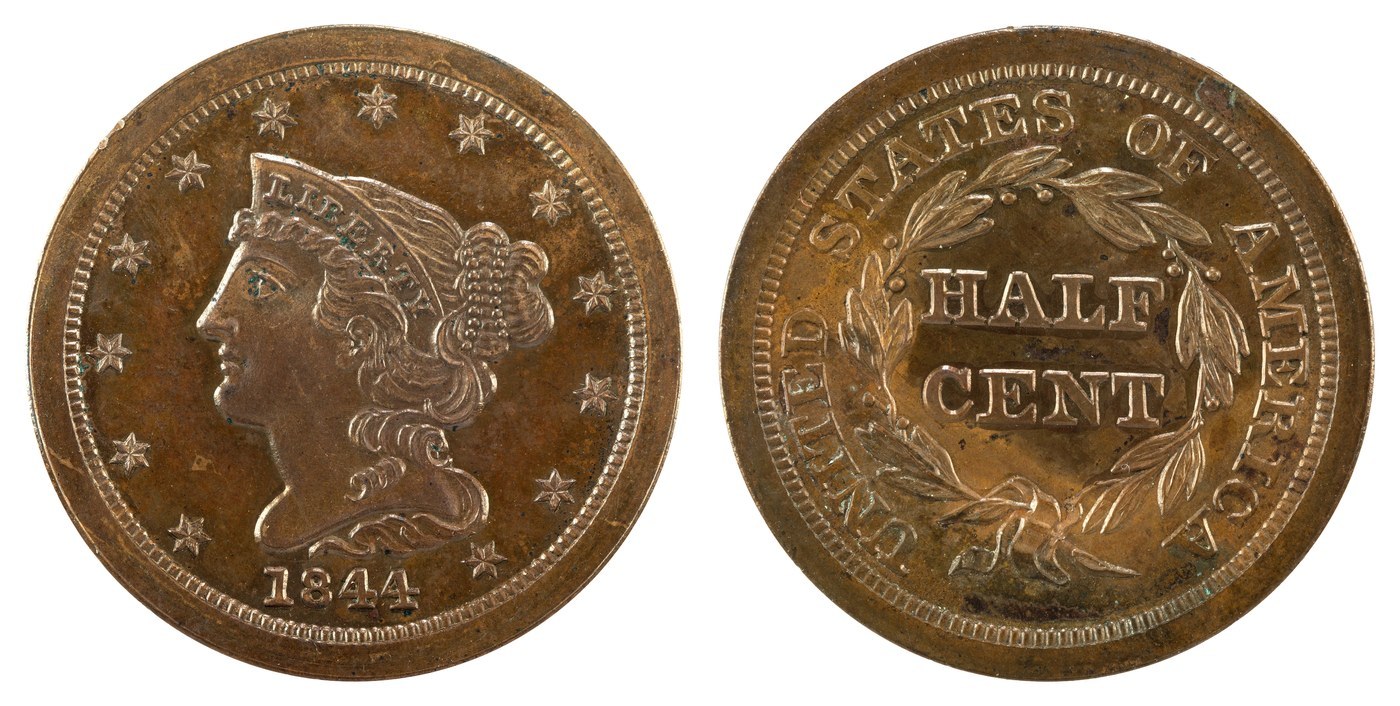
Start with the two design elements that define the type. The obverse must show Liberty facing left with her hair pulled into a braid beneath a coronet reading LIBERTY, ringed by thirteen stars with the date beneath the portrait. The reverse must show a full wreath tied at the bottom with UNITED STATES OF AMERICA around the edge and the denomination lettered inside the wreath. On the pictured coin the date reads 1844.
Next, verify the physical coin. It should be copper, roughly 23 mm in diameter, weigh about 5.4 grams, and have a plain, smooth edge with no reeding. Authentic copper of this period usually carries even brown or reddish-brown surfaces; a suspiciously bright, glossy, or uniform red-orange look can indicate cleaning or artificial toning.
The single most decisive check is the reverse legend inside the wreath. A half cent reads HALF CENT; the closely related Braided Hair large cent, which shares the same Liberty head and wreath layout, reads ONE CENT and is noticeably larger at roughly 27.5 mm. If the coin looks big and reads ONE CENT, it is a large cent, not the half cent described here.
Do not look for a mint mark. All half cents were produced in Philadelphia and carry none, so an absent mint mark is expected and does not signal a problem. Confirm identification instead through the date, the star count, and the denomination.
Finally, be cautious with rare early dates such as 1844, which exist as proofs and, for some years, as later restrikes. Copper is easy to clean, re-tone, or alter, and higher-value dates are sometimes faked by altering another coin's date. For any piece you believe to be scarce or valuable, seek authentication and grading from a recognized third-party service before buying or selling.
Frequently asked questions
How do I tell a Braided Hair half cent from a large cent?
Check the reverse legend inside the wreath and the size. The half cent reads HALF CENT and is about 23 mm; the large cent reads ONE CENT and is larger, around 27.5 mm, though both share a similar Liberty head.
What size and weight should it be?
A genuine Braided Hair half cent is copper, roughly 23 mm across, weighs about 5.4 grams, and has a plain edge without reeding.
Where is the mint mark located?
There is none. Half cents were struck only in Philadelphia, which used no mint mark, so you should not expect to find one.
What are the biggest authentication risks?
Cleaned or artificially re-toned copper, and altered dates on scarce years like 1844. Because several dates are proof-only or restrikes, valuable examples should be verified by a reputable grading service.