
How to Identify the Booker T. Washington Memorial Half Dollar
A collector's checklist for confirming a Booker T. Washington half dollar — the portrait, the slave-cabin reverse, silver specs, mint marks, and look-alikes.
Read the full Booker T. Washington Memorial Half Dollar encyclopedia entry →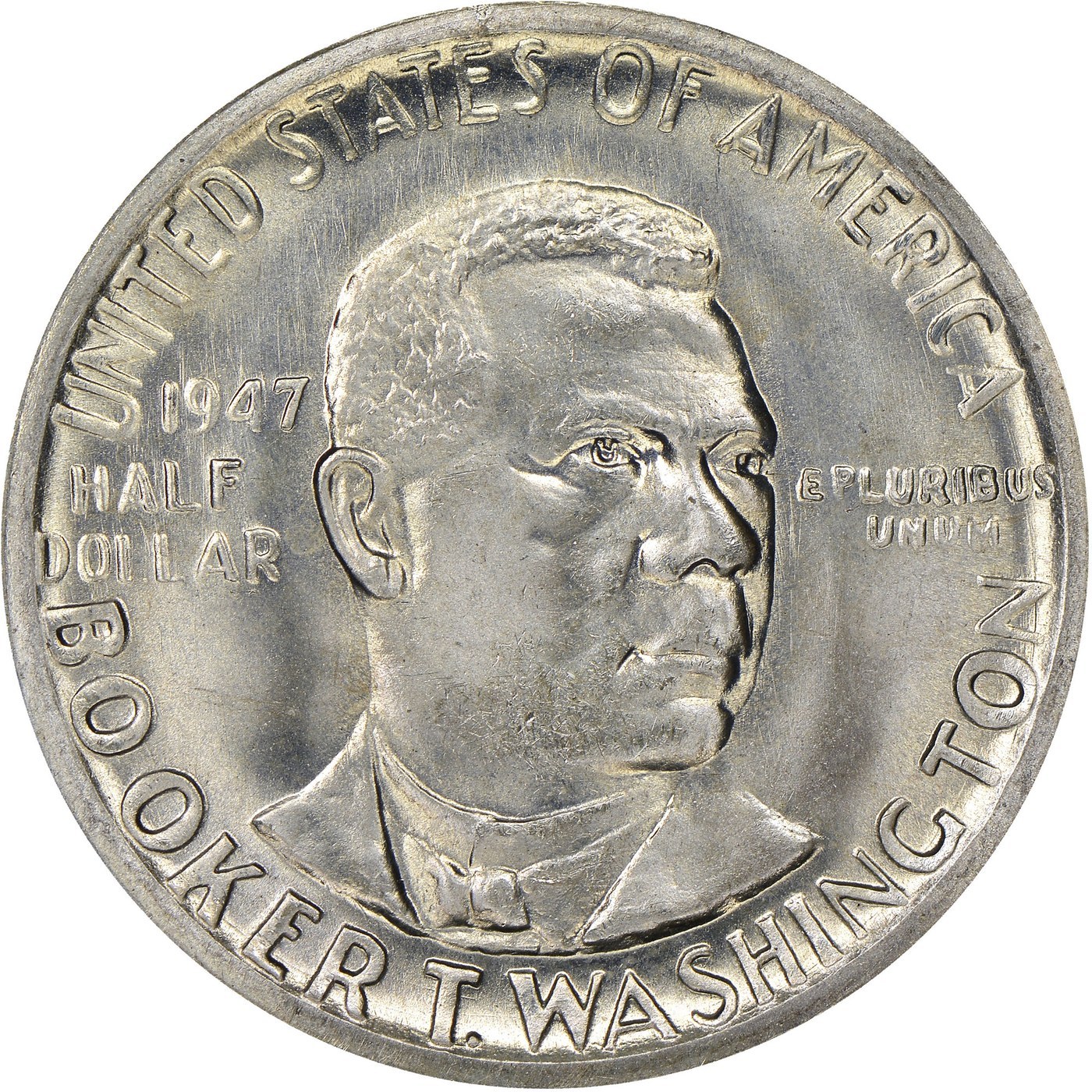
Begin with the obverse portrait and lettering. A genuine Booker T. Washington half dollar shows a single right-facing profile bust of Washington with HALF DOLLAR and a date (1946 through 1951) around the rim and E PLURIBUS UNUM in the field. A lone Washington portrait — not a Liberty figure or Liberty head — immediately separates it from the Walking Liberty and Franklin half dollars circulating in the same years.
Confirm the type on the reverse, which is the most distinctive feature. It shows the domed Hall of Fame colonnade above a small log cabin, encircled by the motto FROM SLAVE CABIN TO HALL OF FAME, along with FRANKLIN COUNTY, VA and the national mottoes. No circulating U.S. coin carries this design, so the reverse is the clinching diagnostic.
Check the physical specifications. The coin is a standard half dollar: roughly 30.6 mm in diameter, about 12.5 grams, struck in 90% silver with a reeded edge. A calibrated scale and calipers help here — a piece off in weight, diameter, or edge reeding for a silver half dollar is a warning sign. Look for the mint mark on the reverse: none for Philadelphia, D for Denver, or S for San Francisco. The date-and-mint combination determines which issue you have.
Watch for the closest look-alike, the Washington–Carver half dollar of 1951–1954. That later coin pairs two conjoined portraits — Washington and George Washington Carver — and a different reverse, so a single Washington portrait with the slave-cabin reverse tells you it is the Booker T. Washington type. Note that 1951 exists in both series, so read the design, not just the date.
Be cautious with authentication. Because most dates are common and inexpensive, outright counterfeits are less of a concern than cleaning, artificial toning, or altered mint marks used to fake a scarcer issue. Watch for tooling around the mint mark, mushy or doubled lettering, or surfaces that don't match natural 90% silver. For any higher-value or high-grade purchase, rely on reputable dealers and third-party grading (PCGS, NGC) rather than eye appeal alone.
Frequently asked questions
How do I tell it from the Walking Liberty or Franklin half dollar?
This commemorative shows a single Washington portrait and a Hall-of-Fame-and-log-cabin reverse with FROM SLAVE CABIN TO HALL OF FAME — designs found on no circulating coin. The standard halves show Liberty or Franklin instead.
How is it different from the Washington–Carver half dollar?
The Washington–Carver coin (1951–1954) shows two conjoined portraits — Washington and George Washington Carver. A single Washington portrait with the slave-cabin reverse identifies the Booker T. Washington type. Both exist dated 1951, so judge by the design.
Where is the mint mark and what should it be?
The mint mark, when present, is on the reverse. Philadelphia coins have none, Denver coins show a D, and San Francisco coins show an S. The date-plus-mint combination identifies the specific issue.
What should a genuine example weigh and measure?
About 12.5 grams and roughly 30.6 mm in diameter, in 90% silver with a reeded edge. Figures that don't match a standard silver half dollar are a warning sign of a fake or altered coin.