
How to Identify the Bolivian Boliviano Silver
The silver boliviano was Bolivia's standard coin from 1864 into the early 20th century, recognized by its national arms, condor crest, and a seated or standing Liberty-type figure on many issues.
Read the full Bolivian Boliviano Silver encyclopedia entry →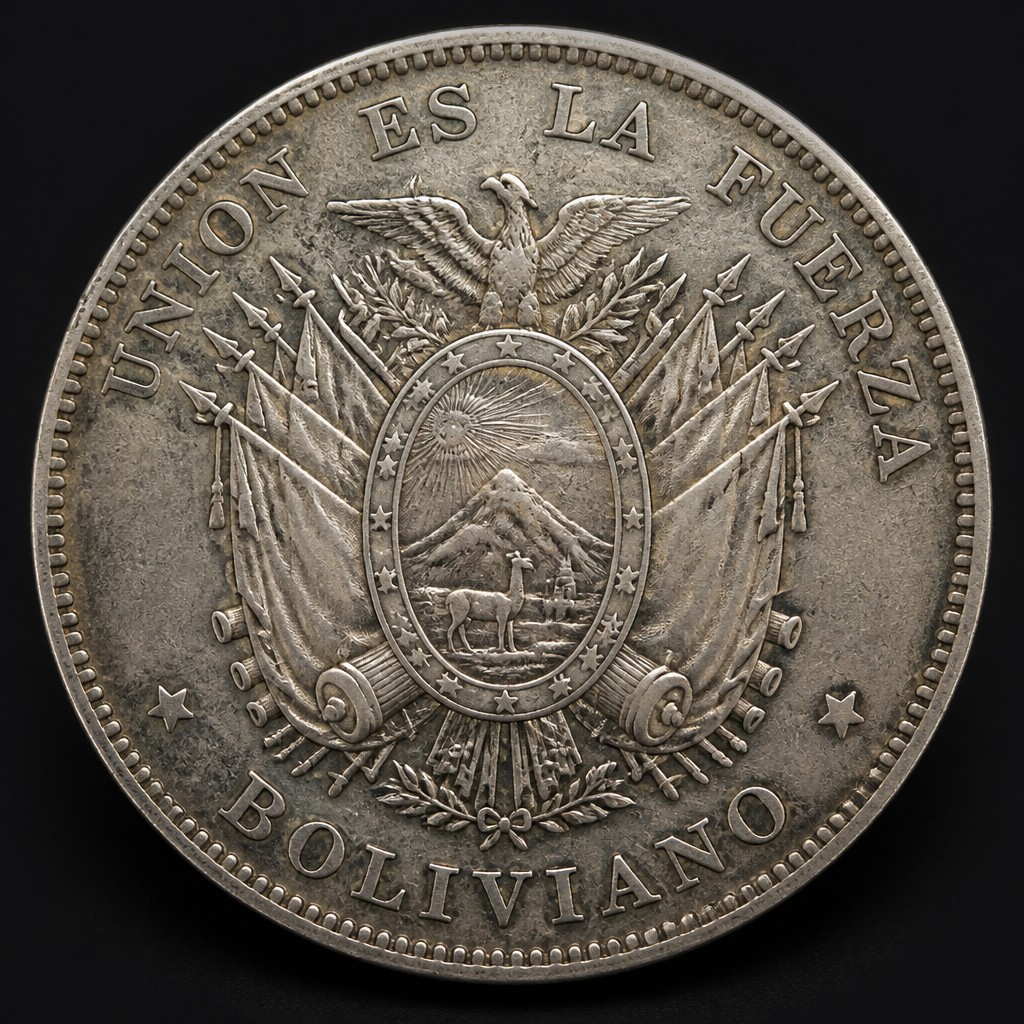
What the Coin Is
The boliviano replaced the earlier sol as Bolivia's monetary unit starting in 1864. Struck in silver at roughly the crown/dollar size for decades, it circulated widely across the Andean region and shows up in several design types spanning the late 1800s. Fractional pieces (½, ⅕, and other divisions) were also issued alongside the full boliviano.
Obverse Design & Inscriptions
Most boliviano types carry the Bolivian coat of arms: a shield showing Cerro Rico (Potosí's silver mountain), an alpaca or llama, a tree, a sheaf of wheat, and tools of mining and agriculture, topped by a condor with wings spread. The legend "REPUBLICA BOLIVIANA" or "ESTADO BOLIVIANO" typically encircles the shield, with the date below or within the design.
Reverse Design & Inscriptions
The reverse usually bears the denomination "UN BOLIVIANO" (or fractional wording) inside a wreath, sometimes accompanied by a liberty cap on a pole or a star pattern. Later 19th-century types show variations in the wreath style and lettering as the design was updated by different mints and engravers.
Size, Weight, Metal, Edge
The silver boliviano was struck in .900 or similar fine silver, weighing close to 25 grams with a diameter around 37 mm, comparable to other Latin American "peso"-sized silver crowns of the era. The edge is reeded.
Mint Marks & Where to Find Them
Look for a small mintmark near the date or at the base of the shield — common marks include "PTS" for Potosí. A mint director's initials or assayer's mark may appear as a small letter pair adjacent to the mintmark, which helps narrow down the exact year and striking authority.
Telling It Apart from Similar Coins
The boliviano is easy to confuse with the earlier Bolivian sol or with Peruvian sols, since both regions used similar shield-and-condor themes. Check the country name in the legend and the denomination wording — "BOLIVIANO" versus "SOL" — to confirm which coin you have. Weight and diameter also differ slightly between the two systems.
Judging Condition at a Glance
On well-preserved examples, the condor's feather detail and the fine lines of the mountain and figures in the shield remain sharp. Wear first appears on the high points of the shield's central elements and the crest of the condor. Heavily circulated coins show a smoothed, low-relief shield with legends still legible but design details flattened.
Authenticity Red Flags
Genuine silver bolivianos have a dense, slightly grayish tone from silver oxidation and a crisp reeded edge. Be cautious of coins that feel unusually light, show a soft or mushy edge from casting, or have a magnetic attraction (genuine silver is non-magnetic). Blurry, doubled lettering or a seam line around the edge can indicate a cast counterfeit.
Frequently asked questions
What metal is the boliviano made of?
It was struck in silver, typically around .900 fineness, giving it a whitish-gray tone rather than the yellow of gold or copper-nickel coins.
How can I tell a boliviano from a Bolivian sol?
Check the denomination text in the design — 'BOLIVIANO' versus 'SOL' — since both share similar shield and condor imagery but belong to different eras and monetary systems.
Where is the mintmark located?
Look near the date or at the lower edge of the shield on the obverse for a small mintmark such as 'PTS' for the Potosí mint.
Why does my coin look dark or tarnished?
Silver naturally tones over time when exposed to air and sulfur compounds; dark toning alone does not indicate a fake, though it can obscure design details.
Does a light weight mean it's fake?
A coin noticeably lighter than the expected weight for its type is a warning sign, but confirm with a proper scale and comparison to known genuine specimens before concluding it's counterfeit.