
How to Identify the Bill of Rights Silver Dollar
A collector's checklist for confirming a 1993 Bill of Rights silver dollar — the Liberty-and-torch obverse, Montpelier reverse, silver specs, and cautions.
Read the full Bill of Rights Silver Dollar encyclopedia entry →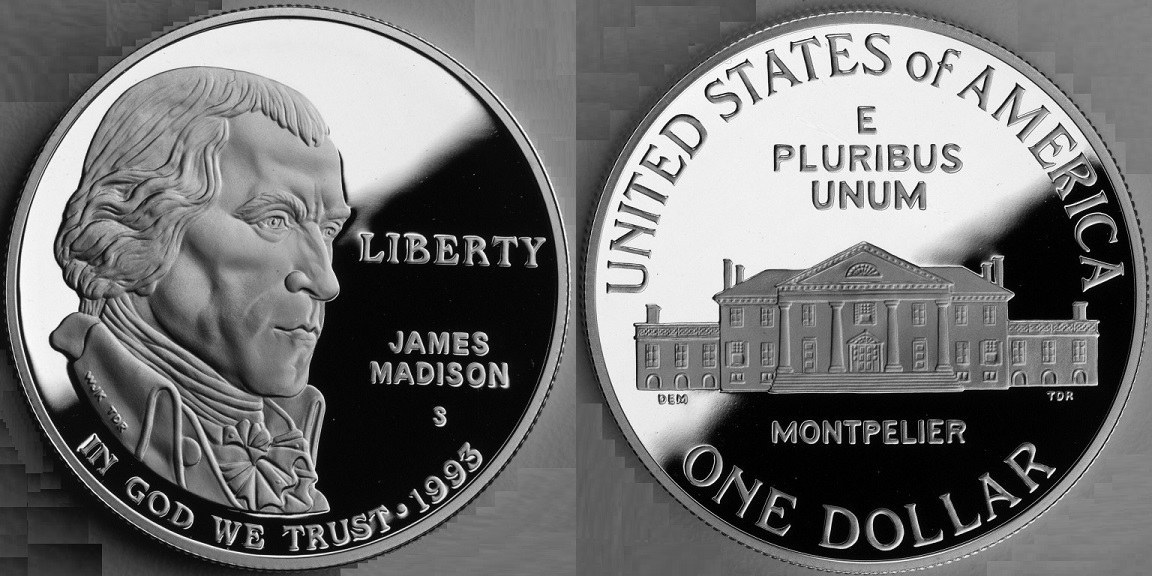
Start with the obverse imagery. A genuine Bill of Rights Silver Dollar shows a standing Liberty figure holding a torch, flanked by flags, with the motto "IN GOD WE TRUST" and the 1993 date. This torch-bearing Liberty is the quickest way to separate it from other modern commemorative dollars, which use entirely different portraits and scenes.
Next, confirm the reverse. Look for an eagle set above a depiction of Montpelier — a classical columned building — accompanied by lettering referencing the bicentennial of the Bill of Rights. The pairing of this building-and-eagle reverse with the torch-bearing Liberty obverse is the definitive identifier; if either side does not match, you are looking at a different coin.
Verify the physical specifications. The silver dollar measures about 38.1 mm in diameter and roughly 26.7 grams, struck in 90% silver with a reeded edge. A calibrated scale and calipers help here: a piece well off in weight, diameter, or edge for a silver commemorative dollar is a warning sign. Note also which format you have — a proof shows mirrored fields with frosted raised designs, while an uncirculated coin has a more uniform satiny finish.
Check for the mint mark and date. Genuine examples carry the 1993 date and a small mint mark; the program did not use other dates, so a different date on a coin with this design should be treated as suspect. Because the design was also offered on a smaller half dollar and a gold coin within the same commemorative program, make sure you are weighing and measuring a full-size silver dollar and not a related denomination.
Authentication is usually straightforward for this issue because it is common and inexpensive, so outright counterfeits are less of a concern than with rare coins. Still, confirm the metal by weight and edge, be wary of cleaned or polished surfaces that hurt value, and for a certified example rely on reputable third-party grading (PCGS, NGC) and, when available, the original Mint packaging and certificate of authenticity.
Frequently asked questions
How do I tell this from other modern commemorative dollars?
Look for the standing Liberty holding a torch with flags on the obverse and an eagle above Montpelier with bicentennial lettering on the reverse, dated 1993. That specific pairing is unique to this issue.
How can I confirm it is silver and the right size?
Weigh and measure it: a genuine coin is about 26.7 grams and 38.1 mm across, 90% silver with a reeded edge. Values well off these specs suggest a different coin or a fake.
What is the difference between the proof and uncirculated versions?
The proof has deeply mirrored fields with frosted raised designs and was made for collectors; the uncirculated version has a more uniform satiny finish. Both are genuine 1993 issues.
Does original packaging matter for identification and value?
For identification it is not required, but the original Mint packaging and certificate of authenticity help confirm the coin's origin and tend to bring the higher end of its modest value range.