
How to Identify the Bavaria 6 Kreuzer
Spot a Bavarian 6 Kreuzer by its ornate Charles VII portrait, crowned double-headed imperial eagle, value mark for six, small silver form, and 1745 date.
Read the full Bavaria 6 Kreuzer encyclopedia entry →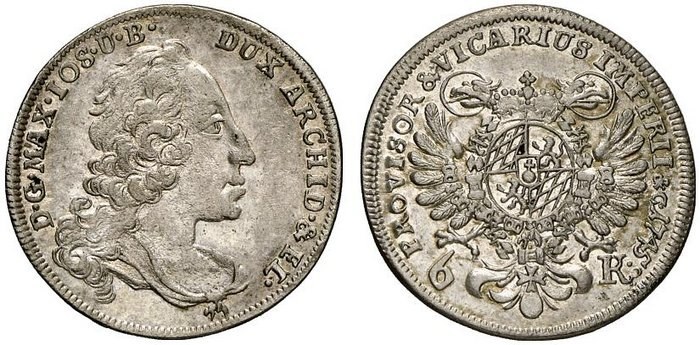
Start with the portrait. The obverse shows an ornate profile bust of Charles VII, ringed by a Latin legend naming him and his titles. A side-facing head with detailed hair and drapery, combined with a name beginning in the CAROLUS/KARL family of legends, points to this Bavarian imperial issue. Read the legend carefully, as it distinguishes the ruler and helps confirm the attribution.
Check the reverse for the eagle and the six. The reverse carries a crowned double-headed imperial eagle together with a value mark for 6 (seen here as a "6 R" style indicator) and the date 1745. The eagle-plus-six pairing is the single most useful diagnostic: it identifies both the imperial context and the 6 Kreuzer denomination at a glance.
Confirm size and metal. This is a small, thin silver coin, far smaller than a Bavarian Thaler or Gulden and struck in a modest silver alloy. Genuine period silver is non-magnetic and shows honest wear on the high points of the portrait and eagle. If a piece is oversized, heavy, or bright white with no wear, question whether it is the right denomination or a modern reproduction.
Watch for look-alikes. Many south-German and Austrian states issued Kreuzer coins of similar size, and other Bavarian rulers used comparable portrait-and-eagle layouts. Use the combination of the specific ruler's name, the value six, the imperial double-headed eagle, and the 1745 date to separate this type from neighbouring 3, 6, and other Kreuzer coins that can look alike at first.
Authenticate carefully. Small silver coins of this age can be cast copies or tooled. Inspect the edge for casting seams, check that the legends are crisp rather than mushy, and compare the portrait and eagle against verified examples of the type. For any better-grade or higher-value piece, seek a specialist or third-party grading opinion before buying or selling.
Frequently asked questions
How do I know this is a 6 Kreuzer and not another denomination?
Look for the value mark for six on the reverse alongside the double-headed eagle. Other Kreuzer coins carry different numerals, so the number six is the key indicator of this denomination.
How can I tell it apart from other German States coins?
Combine the clues: the Latin legend naming Charles VII, the imperial double-headed eagle, the value six, the small silver format, and the 1745 date. That full set separates it from similar-looking Kreuzer coins of other states and rulers.
What signs suggest a fake or reproduction?
Casting seams on the edge, soft or blurry legends, incorrect weight or size, and a magnetic response all raise concern. Period silver is non-magnetic and should show natural wear; authenticate valuable examples professionally.
Why is the imperial eagle on a Bavarian coin?
Charles VII was both Elector of Bavaria and Holy Roman Emperor when this coin was struck, so his Bavarian coinage displays the imperial double-headed eagle to advertise that imperial title.