How to Identify the Barber Quarter
How to read the left-facing Liberty head, heraldic eagle reverse, silver size and edge, mint marks, Proof surfaces, and look-alikes.
Read the full Barber Quarter encyclopedia entry →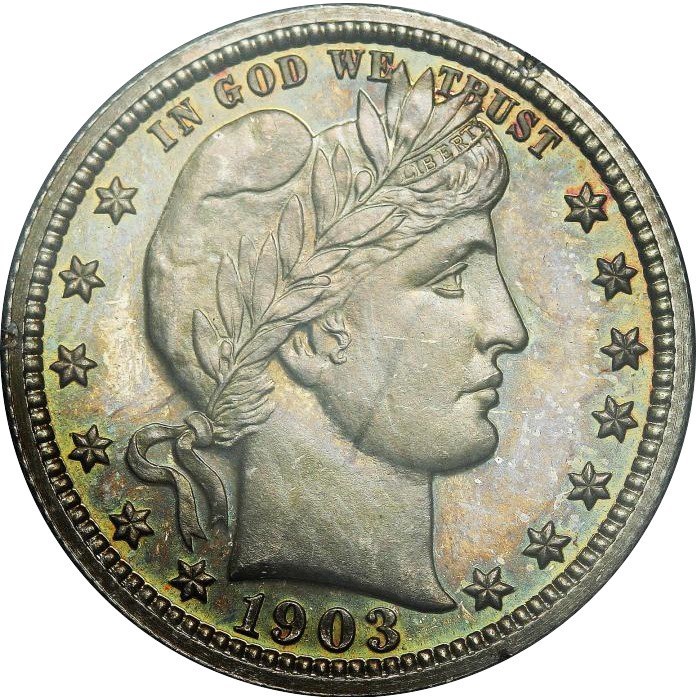
Start With the Obverse
Look for a left-facing head of Liberty wearing a laurel wreath and a cap, with the word "LIBERTY" spelled across a headband on her brow. "UNITED STATES OF AMERICA" curves around the top rim and the four-digit date sits at the bottom — our example reads 1903. The sharpness of the letters in "LIBERTY" on the headband is the classic wear check: a full, readable word points to a better-preserved coin, and on a Proof it should be crisp and complete.
Check the Reverse Eagle
Turn the coin over and confirm a heraldic eagle with a striped shield on its breast, clutching a bundle of arrows in one talon and an olive branch in the other. A scroll reading "E PLURIBUS UNUM" sits above the eagle's head, a row of thirteen stars runs along the top, and "QUARTER DOLLAR" curves around the bottom. This shield-eagle reverse is what separates the quarter and half dollar from the Barber dime, which instead uses a wreath around "ONE DIME."
Confirm Size, Metal, and Edge
The Barber Quarter is 90% silver: about 24.3 mm in diameter, roughly 6.25 grams, with a reeded (grooved) edge and a light gray silver tone. It sits between the smaller Barber dime and the larger Barber half dollar. The reeded edge and silver heft help separate it from copper-nickel coins of similar size and from the later Standing Liberty and Washington quarters.
Read Mint Marks and Proof Surfaces
On business strikes, the mint mark appears on the reverse just below the eagle: "O" for New Orleans, "D" for Denver, "S" for San Francisco, and none for Philadelphia. Our 1903 is a Philadelphia Proof, so it carries no mint mark. Proofs are recognized not by a letter but by their look — deeply reflective, mirror-like fields, squared-off rims, and unusually sharp design detail compared with the softer, more even surfaces of a normal circulation strike.
Watch for Look-Alikes and Altered Coins
Don't confuse the Barber Quarter with the Seated Liberty quarter it replaced (a full seated figure of Liberty) or the Standing Liberty quarter that followed in 1916. Because key dates like the 1901-S and genuine Proofs are valuable, be cautious of added or altered mint marks, re-cut dates, and cleaned or artificially "mirrored" surfaces meant to imitate a Proof. For any coin that appears scarce or unusually well preserved, rely on a reputable third-party grading service to confirm the date, the Proof status, and authenticity.
Frequently asked questions
How can I tell a Barber Quarter from a Barber dime or half dollar?
Size and reverse. The quarter is about 24.3 mm with a shield-eagle reverse; the dime is smaller (about 17.9 mm) with a wreath reverse, and the half dollar is larger (about 30.6 mm) with a similar eagle.
How do I know if my 1903 quarter is a Proof?
Proofs have mirror-like, reflective fields, very sharp devices, and squared rims. A circulated business strike looks softer and more matte. When in doubt, a grading service can confirm Proof status.
Where is the mint mark on a Barber Quarter?
On the reverse, just below the eagle. O is New Orleans, D is Denver, and S is San Francisco; Philadelphia coins, including all Proofs, have no mint mark.
Why should I have a Barber Quarter authenticated?
Key dates and Proofs carry high premiums, which makes them targets for altered mint marks, added dates, or surfaces faked to mimic a Proof. Third-party certification protects against these.
Barber Quarter identified by the community
Recent Barber Quarter coins identified with Coin Identifier.