
How to Identify the Barber Half Dollar
The Barber Half Dollar (1892-1915) shows Liberty's head in a laurel wreath cap, designed by Charles E. Barber, and was struck in 90% silver.
Read the full Barber Half Dollar encyclopedia entry →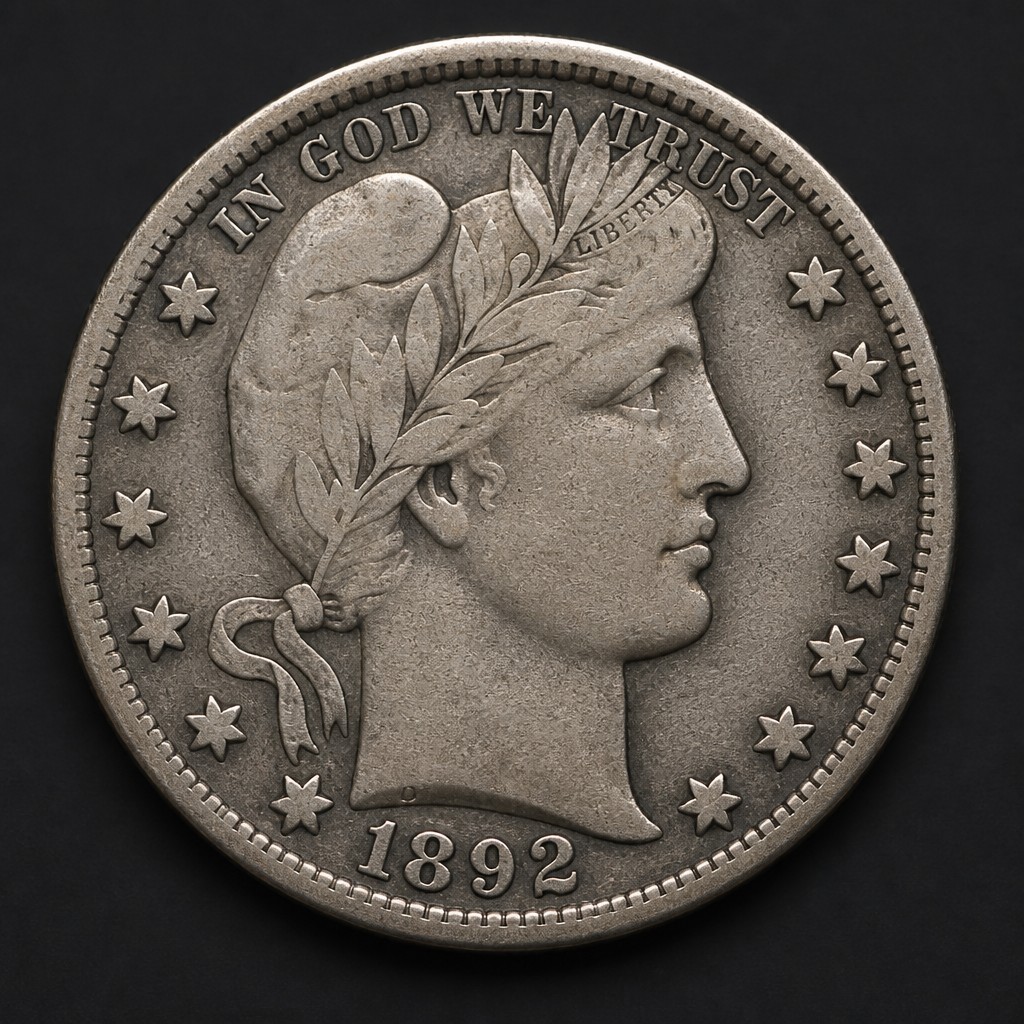
What It Is
The Barber Half Dollar was struck from 1892 to 1915, named for Mint Chief Engraver Charles E. Barber, who also designed the matching dime and quarter of the same era. It replaced the long-running Seated Liberty design and was followed by the Walking Liberty half dollar in 1916.
Obverse Design
Liberty's head faces right, wearing a laurel-wreathed cap with "LIBERTY" inscribed on a headband. Stars encircle the portrait and the date sits below.
Reverse Design
A heraldic eagle with outstretched wings grips arrows and an olive branch, shield on its breast. "UNITED STATES OF AMERICA" arcs above, "HALF DOLLAR" below, and "E PLURIBUS UNUM" appears just above the eagle.
Size, Weight & Metal
Struck in 90% silver, 10% copper, these coins weigh 12.5 grams, measure 30.6 mm across, and have a reeded edge, consistent with other silver half dollars of the period.
Mint Marks
The mint mark is on the reverse, below the eagle and just above "HALF DOLLAR." Look for "O" (New Orleans), "S" (San Francisco), "D" (Denver, starting in 1906), or "CC" (Carson City, only in 1892 and 1893, near the end of that mint's operation). No letter means Philadelphia.
Telling It Apart from Similar Coins
Barber halves are easy to distinguish from their predecessor, the Seated Liberty half, which shows a full seated figure rather than a head-only portrait, and from the succeeding Walking Liberty half, which depicts Liberty striding forward wrapped in a flag. The laurel-wreath cap and profile bust are unique to the Barber design across the dime, quarter, and half dollar, so check the denomination wording on the reverse to know which one you have.
Grading at a Glance
Wear appears first on Liberty's cheek and the high point of her hair above the ear, and on the eagle's breast feathers on the reverse. Because Barber halves saw heavy circulation, well-struck, lightly worn examples with full letters in "LIBERTY" on the headband are notably scarcer than worn ones.
Authenticity Red Flags
Some later dates and mint marks are scarcer and occasionally targeted for alteration, such as an added mint mark or re-engraved digit in the date. Examine the mint mark under magnification for the correct size, font, and placement compared to genuine examples of that year, and look for file marks, glue residue, or an unnatural surface texture around the date and mint mark area.
Frequently asked questions
Where is the mint mark on a Barber Half Dollar?
On the reverse, directly below the eagle and just above the words 'HALF DOLLAR.'
Did Carson City strike Barber Half Dollars?
Yes, but only in 1892 and 1893, shortly before the Carson City Mint closed.
How do I tell a Barber half from a Walking Liberty half?
The Barber half shows only Liberty's head in profile; the Walking Liberty half shows her full body striding forward.
What causes uneven wear on the headband lettering?
The raised 'LIBERTY' lettering sits on a high point of the design, so it wears down quickly and is a key grading spot.