
How to Identify the Barber Dime
A step-by-step look at the right-facing Liberty head, wreath reverse, silver size and color, mint-mark placement, and look-alikes to rule out.
Read the full Barber Dime encyclopedia entry →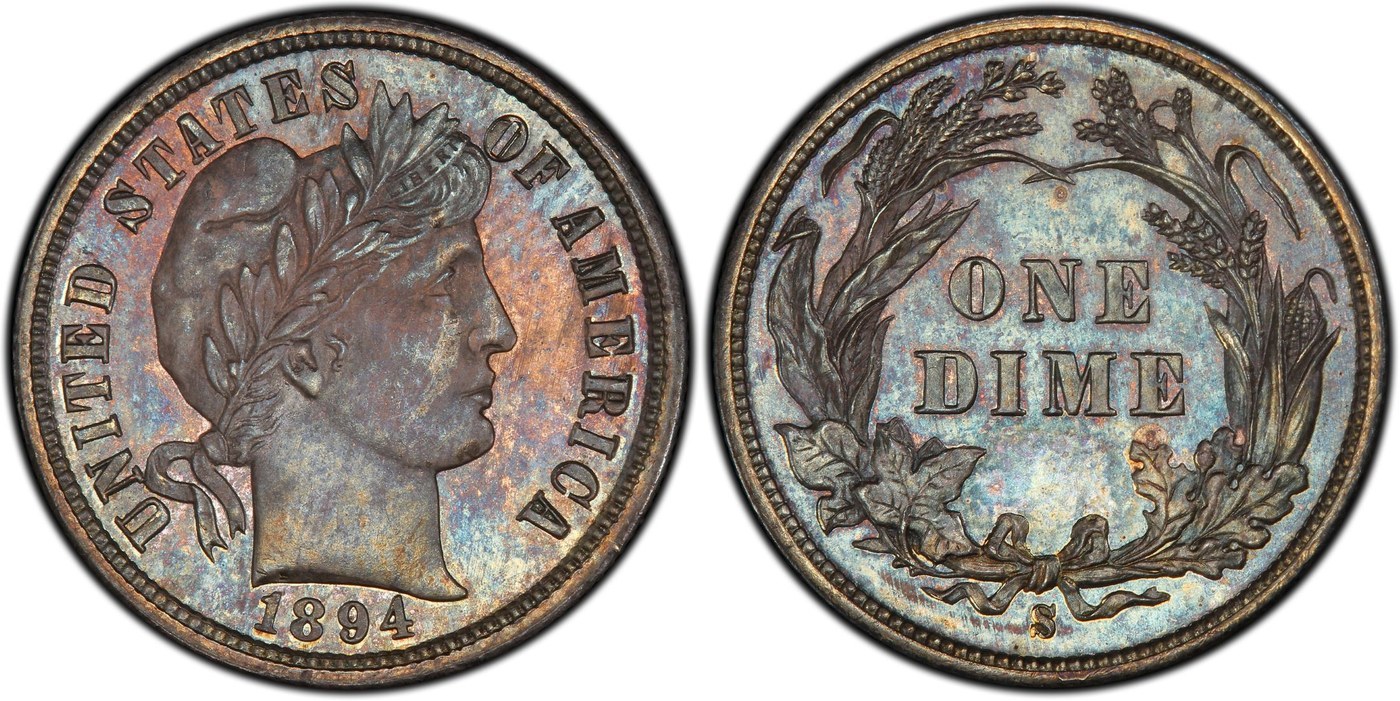
Start With the Obverse
Look for a right-facing head of Liberty wearing a laurel wreath and a cap, with the word "LIBERTY" spelled across a headband on her brow. The legend "UNITED STATES OF AMERICA" curves around the top rim and the four-digit date sits at the bottom — our example reads 1914. The sharpness of the letters in "LIBERTY" on the headband is the classic wear check: a full, readable word points to a better-preserved coin.
Check the Reverse Wreath
Turn the coin over and confirm a wreath of leaves — corn, wheat, oak, and maple — tied with a ribbon and enclosing the two-line inscription "ONE DIME." This wreath reverse is the single most important test for the denomination: the Barber quarter and half dollar share the same Liberty head but use a shield-and-eagle reverse instead. If you see "ONE DIME" inside a wreath, you are holding the ten-cent coin.
Confirm Size, Metal, and Edge
The Barber Dime is 90% silver: about 17.9 mm in diameter, roughly 2.5 grams, with a reeded (grooved) edge and a light gray silver luster. It is the smallest of the three Barber denominations — noticeably smaller than a Barber quarter and much smaller than the half dollar. The reeded edge and thin, light-gray silver look help separate it from copper-nickel coins of similar diameter.
Find the Mint Mark
On the reverse, look just below the wreath, above the ribbon at the bottom. A small "O" indicates New Orleans, "D" indicates Denver, and "S" indicates San Francisco; no mint mark means Philadelphia. For 1914 you may see 1914 (Philadelphia), 1914-D, or 1914-S. Date and mint mark together determine the exact issue and strongly influence value.
Watch for Look-Alikes and Altered Coins
Don't confuse the Barber Dime with the Seated Liberty dime it replaced (a full seated figure of Liberty) or the Mercury dime that followed in 1916 (a winged Liberty cap). Because the 1894-S and certain early branch-mint dates are extremely valuable, be wary of added or altered mint marks and re-cut dates. For any coin that appears scarce or unusually well preserved, rely on a reputable third-party grading service to confirm both the date and the authenticity.
Frequently asked questions
How do I know my Barber coin is a dime and not a quarter?
Check the reverse and the size. The dime has a wreath enclosing "ONE DIME" and is only about 17.9 mm across; the Barber quarter is larger and shows a shield-and-eagle reverse reading "QUARTER DOLLAR."
Why does the word 'LIBERTY' matter when grading a Barber Dime?
The seven letters of "LIBERTY" on the headband sit on a high point of the design and wear away first. Collectors use how many letters remain readable as a quick gauge of grade and value.
Is a mint mark under the wreath important?
Yes. An "O" (New Orleans), "D" (Denver), or "S" (San Francisco) below the wreath identifies a branch-mint coin, which for some dates is far scarcer than the no-mint-mark Philadelphia version. Always note it.
Should I clean a Barber Dime to read it better?
No. Cleaning scratches the soft silver surface and lowers value to collectors. Examine it under good light and magnification instead, and leave any conservation to professionals.